 Add to Chrome
 Add to Firefox
 Add to Edge
WUTDet: A 100K-Scale Ship Detection Dataset and Benchmarks with Dense Small Objects
Apr 09, 2026
Ship detection for navigation is a fundamental perception task in intelligent waterway transportation systems. However, existing public ship detection datasets remain limited in terms of scale, the proportion of small-object instances, and scene diversity, which hinders the systematic evaluation and generalization study of detection algorithms in complex maritime environments. To this end, we construct WUTDet, a large-scale ship detection dataset. WUTDet contains 100,576 images and 381,378 annotated ship instances, covering diverse operational scenarios such as ports, anchorages, navigation, and berthing, as well as various imaging conditions including fog, glare, low-lightness, and rain, thereby exhibiting substantial diversity and challenge. Based on WUTDet, we systematically evaluate 20 baseline models from three mainstream detection architectures, namely CNN, Transformer, and Mamba. Experimental results show that the Transformer architecture achieves superior overall detection accuracy (AP) and small-object detection performance (APs), demonstrating stronger adaptability to complex maritime scenes; the CNN architecture maintains an advantage in inference efficiency, making it more suitable for real-time applications; and the Mamba architecture achieves a favorable balance between detection accuracy and computational efficiency. Furthermore, we construct a unified cross-dataset test set, Ship-GEN, to evaluate model generalization. Results on Ship-GEN show that models trained on WUTDet exhibit stronger generalization under different data distributions. These findings demonstrate that WUTDet provides effective data support for the research, evaluation, and generalization analysis of ship detection algorithms in complex maritime scenarios. The dataset is publicly available at: https://github.com/MAPGroup/WUTDet.

Enhancing Language Representation with Constructional Information for Natural Language Understanding
Jun 05, 2023

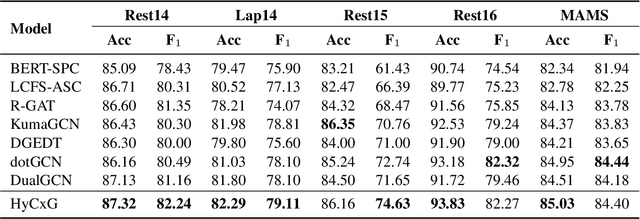

Natural language understanding (NLU) is an essential branch of natural language processing, which relies on representations generated by pre-trained language models (PLMs). However, PLMs primarily focus on acquiring lexico-semantic information, while they may be unable to adequately handle the meaning of constructions. To address this issue, we introduce construction grammar (CxG), which highlights the pairings of form and meaning, to enrich language representation. We adopt usage-based construction grammar as the basis of our work, which is highly compatible with statistical models such as PLMs. Then a HyCxG framework is proposed to enhance language representation through a three-stage solution. First, all constructions are extracted from sentences via a slot-constraints approach. As constructions can overlap with each other, bringing redundancy and imbalance, we formulate the conditional max coverage problem for selecting the discriminative constructions. Finally, we propose a relational hypergraph attention network to acquire representation from constructional information by capturing high-order word interactions among constructions. Extensive experiments demonstrate the superiority of the proposed model on a variety of NLU tasks.
Multi-Action Dialog Policy Learning from Logged User Feedback
Feb 27, 2023Multi-action dialog policy, which generates multiple atomic dialog actions per turn, has been widely applied in task-oriented dialog systems to provide expressive and efficient system responses. Existing policy models usually imitate action combinations from the labeled multi-action dialog examples. Due to data limitations, they generalize poorly toward unseen dialog flows. While reinforcement learning-based methods are proposed to incorporate the service ratings from real users and user simulators as external supervision signals, they suffer from sparse and less credible dialog-level rewards. To cope with this problem, we explore to improve multi-action dialog policy learning with explicit and implicit turn-level user feedback received for historical predictions (i.e., logged user feedback) that are cost-efficient to collect and faithful to real-world scenarios. The task is challenging since the logged user feedback provides only partial label feedback limited to the particular historical dialog actions predicted by the agent. To fully exploit such feedback information, we propose BanditMatch, which addresses the task from a feedback-enhanced semi-supervised learning perspective with a hybrid objective of semi-supervised learning and bandit learning. BanditMatch integrates pseudo-labeling methods to better explore the action space through constructing full label feedback. Extensive experiments show that our BanditMatch outperforms the state-of-the-art methods by generating more concise and informative responses. The source code and the appendix of this paper can be obtained from https://github.com/ShuoZhangXJTU/BanditMatch.