 Add to Chrome
 Add to Firefox
 Add to Edge
Dashboard2Code: Evaluating Multimodal Models on Reconstructing Interactive Dashboards
Jul 06, 2026
Automatic data visualization generation has advanced rapidly with multi-modal large language models, yet existing efforts largely focus on static charts and overlook the interactive dashboards commonly used for real-world data exploration. We introduce Dashboard2Code, a novel task that requires a model to proactively explore an interactive dashboard, acquire and integrate feedback from its own interactions (e.g., clicking and filtering), and generate code that reproduces the target dashboard. To support comprehensive evaluation, we present DashboardMimic, the first Plotly+Dash benchmark for Dashboard2Code, comprising 180 carefully designed and manually verified dashboard-code pairs spanning three difficulty levels and covering eight common real-world interaction patterns. We further propose an automated evaluation framework tailored to dashboards that combines code semantic analysis with dynamic interaction-based testing to assess visual and interaction consistency, showing strong agreement with human judgments. Experiments across a range of open- and closed-source multi-modal models reveal that even the strongest systems struggle on high-complexity dashboards and that a substantial performance gap remains between open-source and closed-source models on the Dashboard2Code task.

What You See Is What You Get: Observation-Aligned Supervision for Chart-to-Code Generation
Jul 06, 2026Chart-to-code generation is commonly trained with supervised fine-tuning on reference plotting scripts, implicitly treating the gold code as a fully observable target. We argue that this assumption is often invalid: many chart programs contain latent raw variables that cannot be uniquely recovered from the rendered image. For example, a boxplot exposes summary statistics rather than original samples, a pie chart reveals proportions rather than arbitrary raw values, and a histogram shows bin-level mass rather than individual observations. Supervising models to reproduce such non-identifiable quantities encourages hallucination and over-specified code generation. We introduce Observation-Aligned supervision, a rewriting framework that replaces latent raw-data targets with quantities constrained by the visual observation: box statistics for boxplots, wedge percentages for pie charts, and bin weights for histograms. Applying this framework to chart-to-code training data from two sources, we obtain the Observation-Aligned supervision target data. Experiments across multiple VLMs on ChartMimic and ChartX demonstrate consistent improvements in observable value recovery, including under both-executable evaluation. Our results suggest that improving chart-to-code models requires not only more data or advanced learning objectives or algorithms, but also supervision targets that respect what is identifiable from the chart image.
When Does Language Matter? Multilingual Instructions Reveal Step-wise Language Sensitivity in Vision-Language-Action Models
Jun 10, 2026Vision-Language-Action (VLA) models have shown strong performance in language-conditioned robotic manipulation, yet their robustness to linguistic variation remains poorly understood. In this work, we present the first systematic multilingual evaluation of VLA models by translating the LIBERO benchmark into ten languages, revealing severe performance degradation under non-English instructions, with success rates dropping by 30-50%. Through fine-grained analysis of task executions, we find that language influence is highly non-uniform across steps: certain steps exhibit strong language dependence and dominate overall task failure, while others are largely language-agnostic. Based on this insight, we propose a step-wise inference-time intervention that aligns representations according to step language sensitivity, substantially improving performance under linguistic variation. Our results indicate that language robustness in VLA models is fundamentally a step-wise control problem, highlighting the importance of temporally structured analysis for reliable embodied agents.
EpiBench: Benchmarking Multi-turn Research Workflows for Multimodal Agents
Apr 07, 2026Scientific research follows multi-turn, multi-step workflows that require proactively searching the literature, consulting figures and tables, and integrating evidence across papers to align experimental settings and support reproducible conclusions. This joint capability is not systematically assessed in existing benchmarks, which largely under-evaluate proactive search, multi-evidence integration and sustained evidence use over time. In this work, we introduce EpiBench, an episodic multi-turn multimodal benchmark that instantiates short research workflows. Given a research task, agents must navigate across papers over multiple turns, align evidence from figures and tables, and use the accumulated evidence in the memory to answer objective questions that require cross paper comparisons and multi-figure integration. EpiBench introduces a process-level evaluation framework for fine-grained testing and diagnosis of research agents. Our experiments show that even the leading model achieves an accuracy of only 29.23% on the hard split, indicating substantial room for improvement in multi-turn, multi-evidence research workflows, providing an evaluation platform for verifiable and reproducible research agents.
Exploring Multi-Grained Concept Annotations for Multimodal Large Language Models
Dec 08, 2024

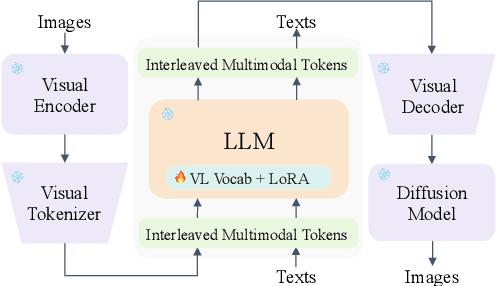
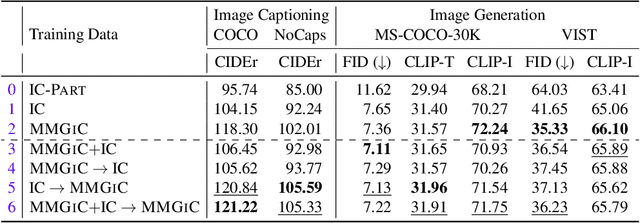
Multimodal Large Language Models (MLLMs) excel in vision--language tasks by pre-training solely on coarse-grained concept annotations (e.g., image captions). We hypothesize that integrating fine-grained concept annotations (e.g., object labels and object regions) will further improve performance, as both data granularities complement each other in terms of breadth and depth in concept representation. We introduce a new dataset featuring Multimodal Multi-Grained Concept annotations (MMGiC) for MLLMs. In constructing MMGiC, we explore the impact of different data recipes on multimodal comprehension and generation. Our analyses reveal that multi-grained concept annotations integrate and complement each other, under our structured template and a general MLLM framework. We clearly explore and demonstrate the potential of MMGiC to help MLLMs better locate and learn concepts, aligning vision and language at multiple granularities. We further validate our hypothesis by investigating the fair comparison and effective collaboration between MMGiC and image--caption data on 12 multimodal comprehension and generation benchmarks, e.g., their appropriate combination achieve 3.95% and 2.34% absolute improvements over image--caption data alone on POPE and SEED-Bench. Code, data and models will be available at https://github.com/LooperXX/MMGiC.