 Add to Chrome
 Add to Firefox
 Add to Edge
Domain-Adapted Retrieval for In-Context Annotation of Pedagogical Dialogue Acts
Apr 03, 2026
Automated annotation of pedagogical dialogue is a high-stakes task where LLMs often fail without sufficient domain grounding. We present a domain-adapted RAG pipeline for tutoring move annotation. Rather than fine-tuning the generative model, we adapt retrieval by fine-tuning a lightweight embedding model on tutoring corpora and indexing dialogues at the utterance level to retrieve labeled few-shot demonstrations. Evaluated across two real tutoring dialogue datasets (TalkMoves and Eedi) and three LLM backbones (GPT-5.2, Claude Sonnet 4.6, Qwen3-32b), our best configuration achieves Cohen's $κ$ of 0.526-0.580 on TalkMoves and 0.659-0.743 on Eedi, substantially outperforming no-retrieval baselines ($κ= 0.275$-$0.413$ and $0.160$-$0.410$). An ablation study reveals that utterance-level indexing, rather than embedding quality alone, is the primary driver of these gains, with top-1 label match rates improving from 39.7\% to 62.0\% on TalkMoves and 52.9\% to 73.1\% on Eedi under domain-adapted retrieval. Retrieval also corrects systematic label biases present in zero-shot prompting and yields the largest improvements for rare and context-dependent labels. These findings suggest that adapting the retrieval component alone is a practical and effective path toward expert-level pedagogical dialogue annotation while keeping the generative model frozen.

Utility-Preserving De-Identification for Math Tutoring: Investigating Numeric Ambiguity in the MathEd-PII Benchmark Dataset
Feb 18, 2026Large-scale sharing of dialogue-based data is instrumental for advancing the science of teaching and learning, yet rigorous de-identification remains a major barrier. In mathematics tutoring transcripts, numeric expressions frequently resemble structured identifiers (e.g., dates or IDs), leading generic Personally Identifiable Information (PII) detection systems to over-redact core instructional content and reduce dataset utility. This work asks how PII can be detected in math tutoring transcripts while preserving their educational utility. To address this challenge, we investigate the "numeric ambiguity" problem and introduce MathEd-PII, the first benchmark dataset for PII detection in math tutoring dialogues, created through a human-in-the-loop LLM workflow that audits upstream redactions and generates privacy-preserving surrogates. The dataset contains 1,000 tutoring sessions (115,620 messages; 769,628 tokens) with validated PII annotations. Using a density-based segmentation method, we show that false PII redactions are disproportionately concentrated in math-dense regions, confirming numeric ambiguity as a key failure mode. We then compare four detection strategies: a Presidio baseline and LLM-based approaches with basic, math-aware, and segment-aware prompting. Math-aware prompting substantially improves performance over the baseline (F1: 0.821 vs. 0.379) while reducing numeric false positives, demonstrating that de-identification must incorporate domain context to preserve analytic utility. This work provides both a new benchmark and evidence that utility-preserving de-identification for tutoring data requires domain-aware modeling.
LLM Reasoning Predicts When Models Are Right: Evidence from Coding Classroom Discourse
Feb 10, 2026Large Language Models (LLMs) are increasingly deployed to automatically label and analyze educational dialogue at scale, yet current pipelines lack reliable ways to detect when models are wrong. We investigate whether reasoning generated by LLMs can be used to predict the correctness of a model's own predictions. We analyze 30,300 teacher utterances from classroom dialogue, each labeled by multiple state-of-the-art LLMs with an instructional move construct and an accompanying reasoning. Using human-verified ground-truth labels, we frame the task as predicting whether a model's assigned label for a given utterance is correct. We encode LLM reasoning using Term Frequency-Inverse Document Frequency (TF-IDF) and evaluate five supervised classifiers. A Random Forest classifier achieves an F1 score of 0.83 (Recall = 0.854), successfully identifying most incorrect predictions and outperforming baselines. Training specialist detectors for specific instructional move constructs further improves performance on difficult constructs, indicating that error detection benefits from construct-specific linguistic cues. Using the Linguistic Inquiry and Word Count (LIWC) framework, we examine four linguistic markers of correctness: Causation, Differentiation, Tentativeness, and Insight. Correct predictions exhibit grounded causal language (e.g., because, therefore), while incorrect reasoning is substantially more likely to rely on epistemic hedging (e.g., might, could) and performative metacognition (e.g., think, realize). Syntactic complexity does not distinguish correct from incorrect reasoning, and longer reasoning is not more reliable. These findings demonstrate that reasoning-based error detection offers a practical and scalable approach to quality control in automated educational dialogue analysis.
Codebook-Injected Dialogue Segmentation for Multi-Utterance Constructs Annotation: LLM-Assisted and Gold-Label-Free Evaluation
Jan 17, 2026Dialogue Act (DA) annotation typically treats communicative or pedagogical intent as localized to individual utterances or turns. This leads annotators to agree on the underlying action while disagreeing on segment boundaries, reducing apparent reliability. We propose codebook-injected segmentation, which conditions boundary decisions on downstream annotation criteria, and evaluate LLM-based segmenters against standard and retrieval-augmented baselines. To assess these without gold labels, we introduce evaluation metrics for span consistency, distinctiveness, and human-AI distributional agreement. We found DA-awareness produces segments that are internally more consistent than text-only baselines. While LLMs excel at creating construct-consistent spans, coherence-based baselines remain superior at detecting global shifts in dialogue flow. Across two datasets, no single segmenter dominates. Improvements in within-segment coherence frequently trade off against boundary distinctiveness and human-AI distributional agreement. These results highlight segmentation as a consequential design choice that should be optimized for downstream objectives rather than a single performance score.
AI Annotation Orchestration: Evaluating LLM verifiers to Improve the Quality of LLM Annotations in Learning Analytics
Nov 12, 2025Large Language Models (LLMs) are increasingly used to annotate learning interactions, yet concerns about reliability limit their utility. We test whether verification-oriented orchestration-prompting models to check their own labels (self-verification) or audit one another (cross-verification)-improves qualitative coding of tutoring discourse. Using transcripts from 30 one-to-one math sessions, we compare three production LLMs (GPT, Claude, Gemini) under three conditions: unverified annotation, self-verification, and cross-verification across all orchestration configurations. Outputs are benchmarked against a blinded, disagreement-focused human adjudication using Cohen's kappa. Overall, orchestration yields a 58 percent improvement in kappa. Self-verification nearly doubles agreement relative to unverified baselines, with the largest gains for challenging tutor moves. Cross-verification achieves a 37 percent improvement on average, with pair- and construct-dependent effects: some verifier-annotator pairs exceed self-verification, while others reduce alignment, reflecting differences in verifier strictness. We contribute: (1) a flexible orchestration framework instantiating control, self-, and cross-verification; (2) an empirical comparison across frontier LLMs on authentic tutoring data with blinded human "gold" labels; and (3) a concise notation, verifier(annotator) (e.g., Gemini(GPT) or Claude(Claude)), to standardize reporting and make directional effects explicit for replication. Results position verification as a principled design lever for reliable, scalable LLM-assisted annotation in Learning Analytics.
Poor Alignment and Steerability of Large Language Models: Evidence from College Admission Essays
Mar 25, 2025People are increasingly using technologies equipped with large language models (LLM) to write texts for formal communication, which raises two important questions at the intersection of technology and society: Who do LLMs write like (model alignment); and can LLMs be prompted to change who they write like (model steerability). We investigate these questions in the high-stakes context of undergraduate admissions at a selective university by comparing lexical and sentence variation between essays written by 30,000 applicants to two types of LLM-generated essays: one prompted with only the essay question used by the human applicants; and another with additional demographic information about each applicant. We consistently find that both types of LLM-generated essays are linguistically distinct from human-authored essays, regardless of the specific model and analytical approach. Further, prompting a specific sociodemographic identity is remarkably ineffective in aligning the model with the linguistic patterns observed in human writing from this identity group. This holds along the key dimensions of sex, race, first-generation status, and geographic location. The demographically prompted and unprompted synthetic texts were also more similar to each other than to the human text, meaning that prompting did not alleviate homogenization. These issues of model alignment and steerability in current LLMs raise concerns about the use of LLMs in high-stakes contexts.
Fairness Hub Technical Briefs: AUC Gap
Sep 25, 2023To measure bias, we encourage teams to consider using AUC Gap: the absolute difference between the highest and lowest test AUC for subgroups (e.g., gender, race, SES, prior knowledge). It is agnostic to the AI/ML algorithm used and it captures the disparity in model performance for any number of subgroups, which enables non-binary fairness assessments such as for intersectional identity groups. The teams use a wide range of AI/ML models in pursuit of a common goal of doubling math achievement in low-income middle schools. Ensuring that the models, which are trained on datasets collected in many different contexts, do not introduce or amplify biases is important for achieving the goal. We offer here a versatile and easy-to-compute measure of model bias for all the teams in order to create a common benchmark and an analytical basis for sharing what strategies have worked for different teams.
Augmenting Holistic Review in University Admission using Natural Language Processing for Essays and Recommendation Letters
Jun 30, 2023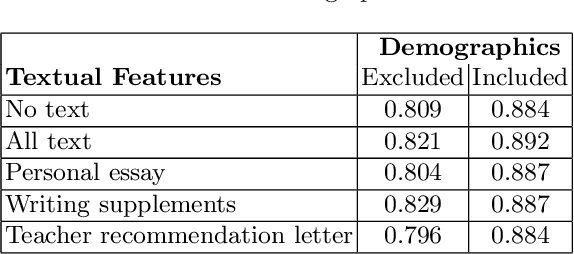
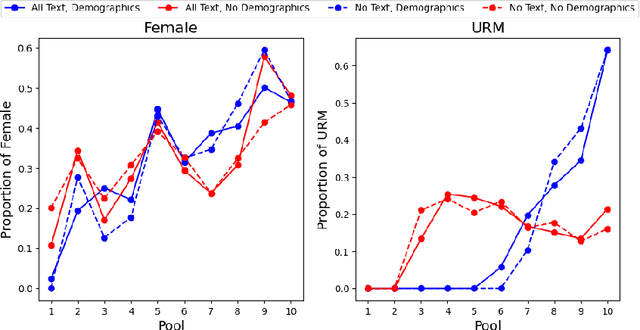
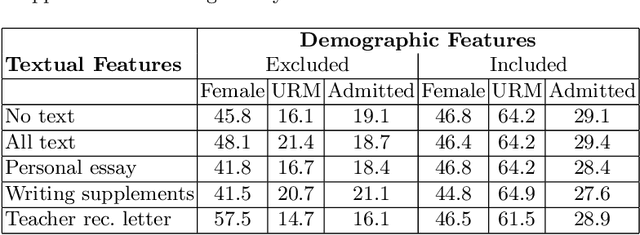
University admission at many highly selective institutions uses a holistic review process, where all aspects of the application, including protected attributes (e.g., race, gender), grades, essays, and recommendation letters are considered, to compose an excellent and diverse class. In this study, we empirically evaluate how influential protected attributes are for predicting admission decisions using a machine learning (ML) model, and in how far textual information (e.g., personal essay, teacher recommendation) may substitute for the loss of protected attributes in the model. Using data from 14,915 applicants to an undergraduate admission office at a selective U.S. institution in the 2022-2023 cycle, we find that the exclusion of protected attributes from the ML model leads to substantially reduced admission-prediction performance. The inclusion of textual information via both a TF-IDF representation and a Latent Dirichlet allocation (LDA) model partially restores model performance, but does not appear to provide a full substitute for admitting a similarly diverse class. In particular, while the text helps with gender diversity, the proportion of URM applicants is severely impacted by the exclusion of protected attributes, and the inclusion of new attributes generated from the textual information does not recover this performance loss.