 Add to Chrome
 Add to Firefox
 Add to Edge
Unsupervised Confidence Calibration for Reasoning LLMs from a Single Generation
Apr 21, 2026
Reasoning language models can solve increasingly complex tasks, but struggle to produce the calibrated confidence estimates necessary for reliable deployment. Existing calibration methods usually depend on labels or repeated sampling at inference time, making them impractical in many settings. We introduce a method for unsupervised confidence calibration of reasoning LLMs when only a single generation is available at inference time. Our approach uses offline sampling on unlabeled data to derive a self-consistency-based proxy target, then distills this signal into a lightweight deployment-time confidence predictor. In a broad evaluation across 5 math and question-answering tasks using 9 reasoning models, our method substantially outperforms baselines, including under distribution shift, and improves downstream performance in selective prediction and simulated downstream decision-making.

Reliable and Responsible Foundation Models: A Comprehensive Survey
Feb 04, 2026Foundation models, including Large Language Models (LLMs), Multimodal Large Language Models (MLLMs), Image Generative Models (i.e, Text-to-Image Models and Image-Editing Models), and Video Generative Models, have become essential tools with broad applications across various domains such as law, medicine, education, finance, science, and beyond. As these models see increasing real-world deployment, ensuring their reliability and responsibility has become critical for academia, industry, and government. This survey addresses the reliable and responsible development of foundation models. We explore critical issues, including bias and fairness, security and privacy, uncertainty, explainability, and distribution shift. Our research also covers model limitations, such as hallucinations, as well as methods like alignment and Artificial Intelligence-Generated Content (AIGC) detection. For each area, we review the current state of the field and outline concrete future research directions. Additionally, we discuss the intersections between these areas, highlighting their connections and shared challenges. We hope our survey fosters the development of foundation models that are not only powerful but also ethical, trustworthy, reliable, and socially responsible.
Adaptive Elicitation of Latent Information Using Natural Language
Apr 05, 2025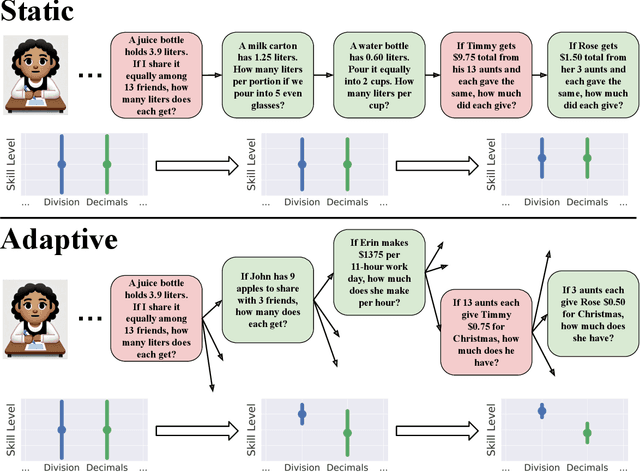
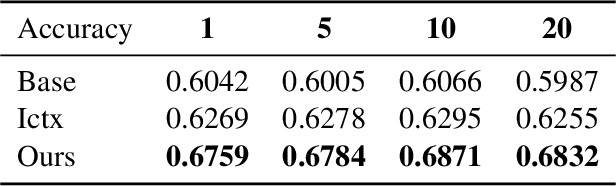
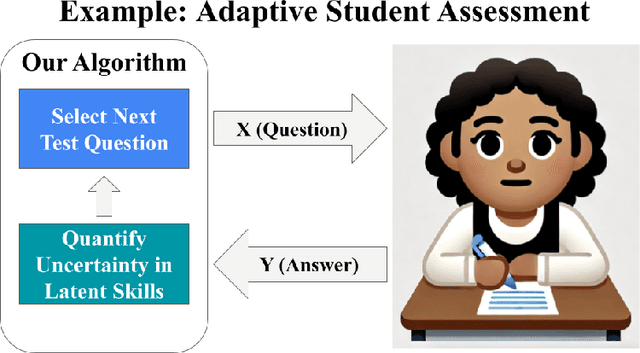
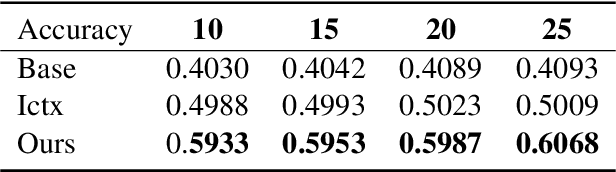
Eliciting information to reduce uncertainty about a latent entity is a critical task in many application domains, e.g., assessing individual student learning outcomes, diagnosing underlying diseases, or learning user preferences. Though natural language is a powerful medium for this purpose, large language models (LLMs) and existing fine-tuning algorithms lack mechanisms for strategically gathering information to refine their own understanding of the latent entity. To harness the generalization power and world knowledge of LLMs in developing effective information-gathering strategies, we propose an adaptive elicitation framework that actively reduces uncertainty on the latent entity. Since probabilistic modeling of an abstract latent entity is difficult, our framework adopts a predictive view of uncertainty, using a meta-learned language model to simulate future observations and enable scalable uncertainty quantification over complex natural language. Through autoregressive forward simulation, our model quantifies how new questions reduce epistemic uncertainty, enabling the development of sophisticated information-gathering strategies to choose the most informative next queries. In experiments on the 20 questions game, dynamic opinion polling, and adaptive student assessment, our method consistently outperforms baselines in identifying critical unknowns and improving downstream predictions, illustrating the promise of strategic information gathering in natural language settings.