 Add to Chrome
 Add to Firefox
 Add to Edge
Overview of CHIP 2025 Shared Task 2: Discharge Medication Recommendation for Metabolic Diseases Based on Chinese Electronic Health Records
Nov 09, 2025
Discharge medication recommendation plays a critical role in ensuring treatment continuity, preventing readmission, and improving long-term management for patients with chronic metabolic diseases. This paper present an overview of the CHIP 2025 Shared Task 2 competition, which aimed to develop state-of-the-art approaches for automatically recommending appro-priate discharge medications using real-world Chinese EHR data. For this task, we constructed CDrugRed, a high-quality dataset consisting of 5,894 de-identified hospitalization records from 3,190 patients in China. This task is challenging due to multi-label nature of medication recommendation, het-erogeneous clinical text, and patient-specific variability in treatment plans. A total of 526 teams registered, with 167 and 95 teams submitting valid results to the Phase A and Phase B leaderboards, respectively. The top-performing team achieved the highest overall performance on the final test set, with a Jaccard score of 0.5102, F1 score of 0.6267, demonstrating the potential of advanced large language model (LLM)-based ensemble systems. These re-sults highlight both the promise and remaining challenges of applying LLMs to medication recommendation in Chinese EHRs. The post-evaluation phase remains open at https://tianchi.aliyun.com/competition/entrance/532411/.

FocusMed: A Large Language Model-based Framework for Enhancing Medical Question Summarization with Focus Identification
Oct 06, 2025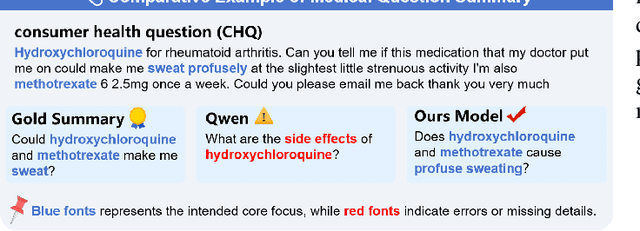
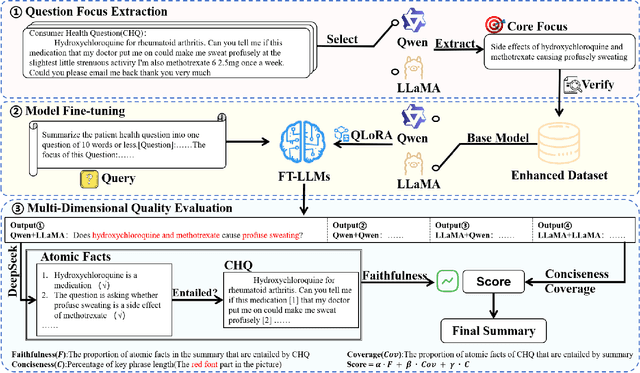
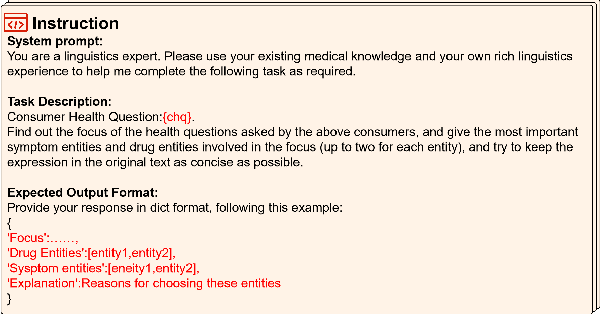
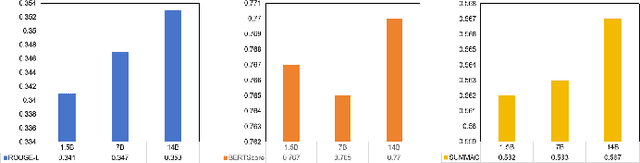
With the rapid development of online medical platforms, consumer health questions (CHQs) are inefficient in diagnosis due to redundant information and frequent non-professional terms. The medical question summary (MQS) task aims to transform CHQs into streamlined doctors' frequently asked questions (FAQs), but existing methods still face challenges such as poor identification of question focus and model hallucination. This paper explores the potential of large language models (LLMs) in the MQS task and finds that direct fine-tuning is prone to focus identification bias and generates unfaithful content. To this end, we propose an optimization framework based on core focus guidance. First, a prompt template is designed to drive the LLMs to extract the core focus from the CHQs that is faithful to the original text. Then, a fine-tuning dataset is constructed in combination with the original CHQ-FAQ pairs to improve the ability to identify the focus of the question. Finally, a multi-dimensional quality evaluation and selection mechanism is proposed to comprehensively improve the quality of the summary from multiple dimensions. We conduct comprehensive experiments on two widely-adopted MQS datasets using three established evaluation metrics. The proposed framework achieves state-of-the-art performance across all measures, demonstrating a significant boost in the model's ability to identify critical focus of questions and a notable mitigation of hallucinations. The source codes are freely available at https://github.com/DUT-LiuChao/FocusMed.