 Add to Chrome
 Add to Firefox
 Add to Edge
RexDrug: Reliable Multi-Drug Combination Extraction through Reasoning-Enhanced LLMs
Mar 09, 2026
Automated Drug Combination Extraction (DCE) from large-scale biomedical literature is crucial for advancing precision medicine and pharmacological research. However, existing relation extraction methods primarily focus on binary interactions and struggle to model variable-length n-ary drug combinations, where complex compatibility logic and distributed evidence need to be considered. To address these limitations, we propose RexDrug, an end-to-end reasoning-enhanced relation extraction framework for n-ary drug combination extraction based on large language models. RexDrug adopts a two-stage training strategy. First, a multi-agent collaborative mechanism is utilized to automatically generate high-quality expert-like reasoning traces for supervised fine-tuning. Second, reinforcement learning with a multi-dimensional reward function specifically tailored for DCE is applied to further refine reasoning quality and extraction accuracy. Extensive experiments on the DrugComb dataset show that RexDrug consistently outperforms state-of-the-art baselines for n-ary extraction. Additional evaluation on the DDI13 corpus confirms its generalizability to binary drugdrug interaction tasks. Human expert assessment and automatic reasoning metrics further indicates that RexDrug produces coherent medical reasoning while accurately identifying complex therapeutic regimens. These results establish RexDrug as a scalable and reliable solution for complex biomedical relation extraction from unstructured text. The source code and data are available at https://github.com/DUTIR-BioNLP/RexDrug

FocusMed: A Large Language Model-based Framework for Enhancing Medical Question Summarization with Focus Identification
Oct 06, 2025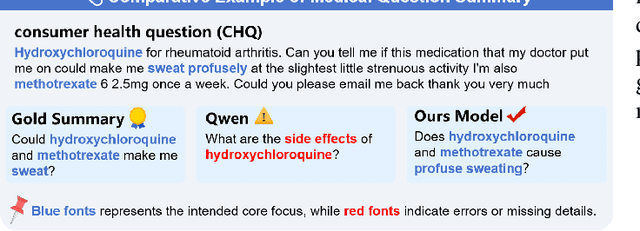
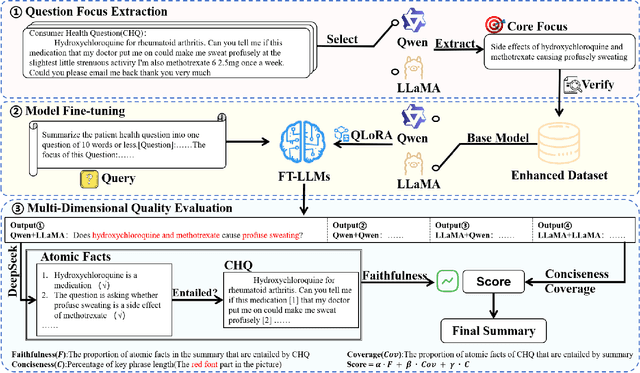
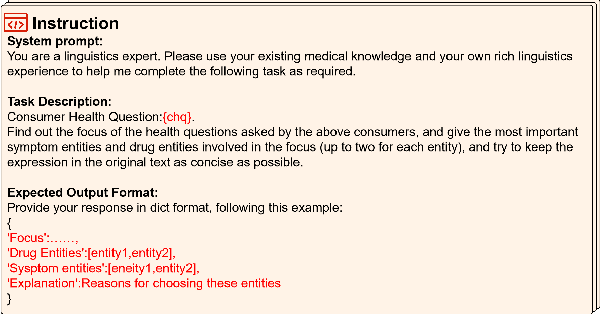
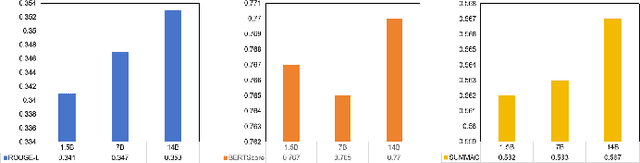
With the rapid development of online medical platforms, consumer health questions (CHQs) are inefficient in diagnosis due to redundant information and frequent non-professional terms. The medical question summary (MQS) task aims to transform CHQs into streamlined doctors' frequently asked questions (FAQs), but existing methods still face challenges such as poor identification of question focus and model hallucination. This paper explores the potential of large language models (LLMs) in the MQS task and finds that direct fine-tuning is prone to focus identification bias and generates unfaithful content. To this end, we propose an optimization framework based on core focus guidance. First, a prompt template is designed to drive the LLMs to extract the core focus from the CHQs that is faithful to the original text. Then, a fine-tuning dataset is constructed in combination with the original CHQ-FAQ pairs to improve the ability to identify the focus of the question. Finally, a multi-dimensional quality evaluation and selection mechanism is proposed to comprehensively improve the quality of the summary from multiple dimensions. We conduct comprehensive experiments on two widely-adopted MQS datasets using three established evaluation metrics. The proposed framework achieves state-of-the-art performance across all measures, demonstrating a significant boost in the model's ability to identify critical focus of questions and a notable mitigation of hallucinations. The source codes are freely available at https://github.com/DUT-LiuChao/FocusMed.