 Add to Chrome
 Add to Firefox
 Add to Edge
Stitch4D: Sparse Multi-Location 4D Urban Reconstruction via Spatio-Temporal Interpolation
Apr 09, 2026
Dynamic urban environments are often captured by cameras placed at spatially separated locations with little or no view overlap. However, most existing 4D reconstruction methods assume densely overlapping views. When applied to such sparse observations, these methods fail to reconstruct intermediate regions and often introduce temporal artifacts. To address this practical yet underexplored sparse multi-location setting, we propose Stitch4D, a unified 4D reconstruction framework that explicitly compensates for missing spatial coverage in sparse observations. Stitch4D (i) synthesizes intermediate bridge views to densify spatial constraints and improve spatial coverage, and (ii) jointly optimizes real and synthesized observations within a unified coordinate frame under explicit inter-location consistency constraints. By restoring intermediate coverage before optimization, Stitch4D prevents geometric collapse and reconstructs coherent geometry and smooth scene dynamics even in sparsely observed environments. To evaluate this setting, we introduce Urban Sparse 4D (U-S4D), a CARLA-based benchmark designed to assess spatiotemporal alignment under sparse multi-location configurations. Experimental results on U-S4D show that Stitch4D surpasses representative 4D reconstruction baselines and achieves superior visual quality. These results indicate that recovering intermediate spatial coverage is essential for stable 4D reconstruction in sparse urban environments.

NaiLIA: Multimodal Nail Design Retrieval Based on Dense Intent Descriptions and Palette Queries
Mar 05, 2026We focus on the task of retrieving nail design images based on dense intent descriptions, which represent multi-layered user intent for nail designs. This is challenging because such descriptions specify unconstrained painted elements and pre-manufactured embellishments as well as visual characteristics, themes, and overall impressions. In addition to these descriptions, we assume that users provide palette queries by specifying zero or more colors via a color picker, enabling the expression of subtle and continuous color nuances. Existing vision-language foundation models often struggle to incorporate such descriptions and palettes. To address this, we propose NaiLIA, a multimodal retrieval method for nail design images, which comprehensively aligns with dense intent descriptions and palette queries during retrieval. Our approach introduces a relaxed loss based on confidence scores for unlabeled images that can align with the descriptions. To evaluate NaiLIA, we constructed a benchmark consisting of 10,625 images collected from people with diverse cultural backgrounds. The images were annotated with long and dense intent descriptions given by over 200 annotators. Experimental results demonstrate that NaiLIA outperforms standard methods.
Mobile Manipulation Instruction Generation from Multiple Images with Automatic Metric Enhancement
Jan 28, 2025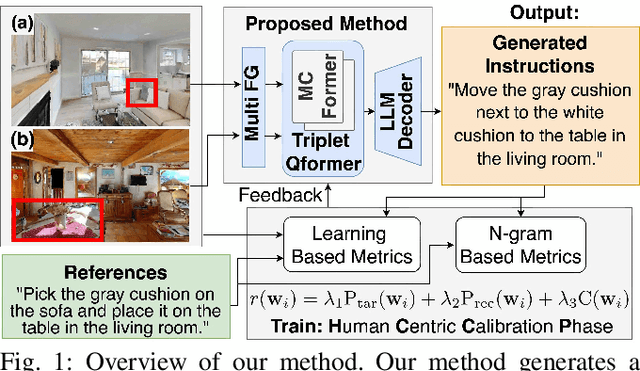
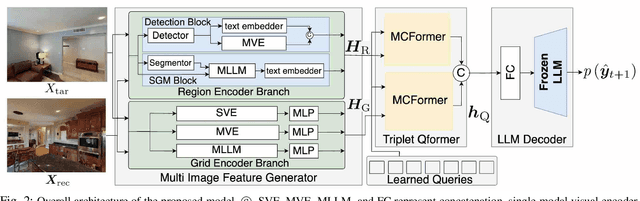
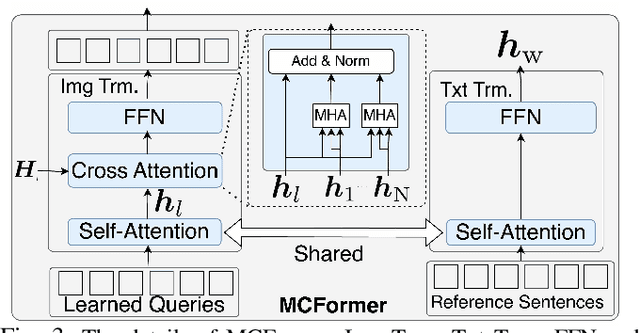

We consider the problem of generating free-form mobile manipulation instructions based on a target object image and receptacle image. Conventional image captioning models are not able to generate appropriate instructions because their architectures are typically optimized for single-image. In this study, we propose a model that handles both the target object and receptacle to generate free-form instruction sentences for mobile manipulation tasks. Moreover, we introduce a novel training method that effectively incorporates the scores from both learning-based and n-gram based automatic evaluation metrics as rewards. This method enables the model to learn the co-occurrence relationships between words and appropriate paraphrases. Results demonstrate that our proposed method outperforms baseline methods including representative multimodal large language models on standard automatic evaluation metrics. Moreover, physical experiments reveal that using our method to augment data on language instructions improves the performance of an existing multimodal language understanding model for mobile manipulation.