 Add to Chrome
 Add to Firefox
 Add to Edge
Massively Multilingual Joint Segmentation and Glossing
Jan 16, 2026
Automated interlinear gloss prediction with neural networks is a promising approach to accelerate language documentation efforts. However, while state-of-the-art models like GlossLM achieve high scores on glossing benchmarks, user studies with linguists have found critical barriers to the usefulness of such models in real-world scenarios. In particular, existing models typically generate morpheme-level glosses but assign them to whole words without predicting the actual morpheme boundaries, making the predictions less interpretable and thus untrustworthy to human annotators. We conduct the first study on neural models that jointly predict interlinear glosses and the corresponding morphological segmentation from raw text. We run experiments to determine the optimal way to train models that balance segmentation and glossing accuracy, as well as the alignment between the two tasks. We extend the training corpus of GlossLM and pretrain PolyGloss, a family of seq2seq multilingual models for joint segmentation and glossing that outperforms GlossLM on glossing and beats various open-source LLMs on segmentation, glossing, and alignment. In addition, we demonstrate that PolyGloss can be quickly adapted to a new dataset via low-rank adaptation.

Measuring Contextual Informativeness in Child-Directed Text
Dec 23, 2024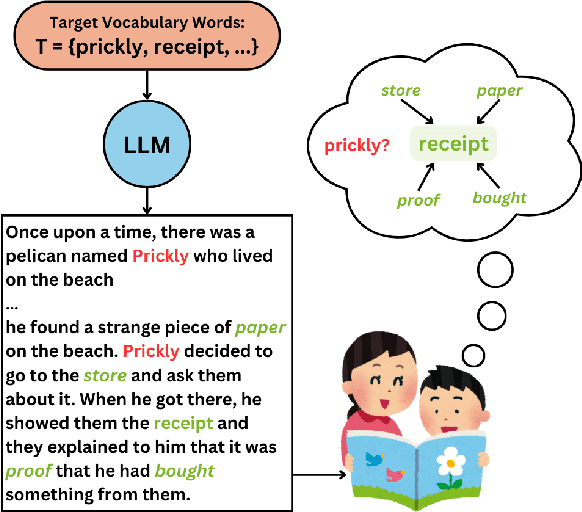
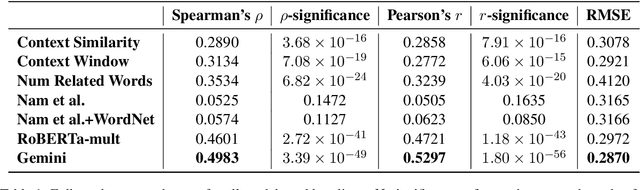
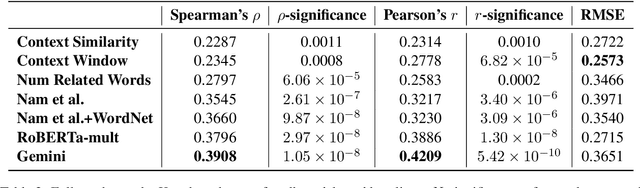
To address an important gap in creating children's stories for vocabulary enrichment, we investigate the automatic evaluation of how well stories convey the semantics of target vocabulary words, a task with substantial implications for generating educational content. We motivate this task, which we call measuring contextual informativeness in children's stories, and provide a formal task definition as well as a dataset for the task. We further propose a method for automating the task using a large language model (LLM). Our experiments show that our approach reaches a Spearman correlation of 0.4983 with human judgments of informativeness, while the strongest baseline only obtains a correlation of 0.3534. An additional analysis shows that the LLM-based approach is able to generalize to measuring contextual informativeness in adult-directed text, on which it also outperforms all baselines.
On the Automatic Generation and Simplification of Children's Stories
Oct 27, 2023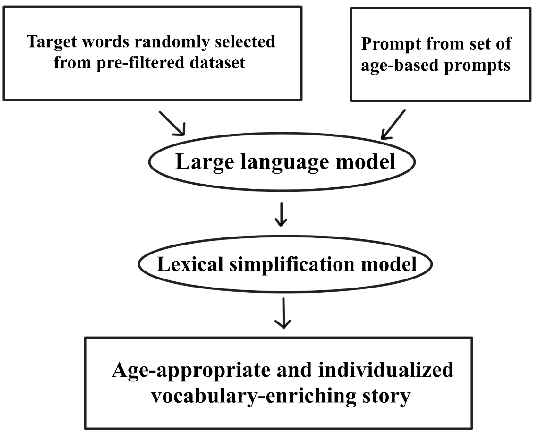
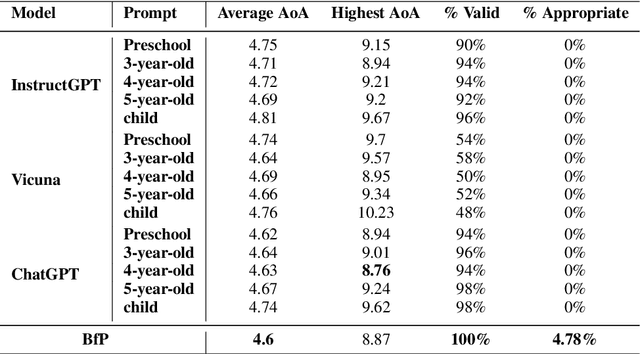
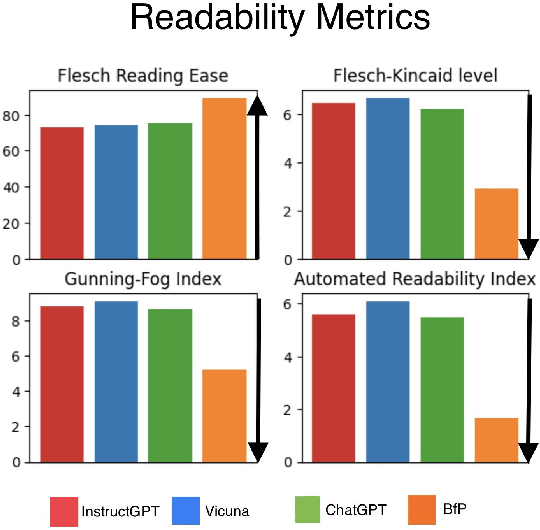
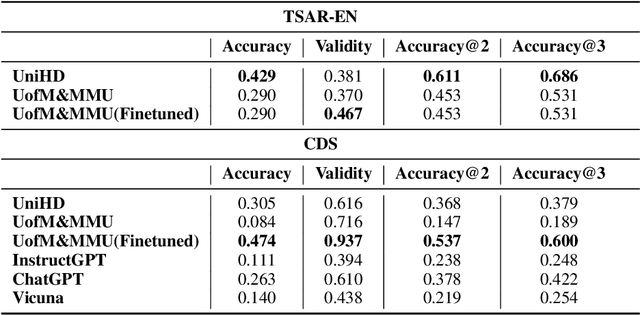
With recent advances in large language models (LLMs), the concept of automatically generating children's educational materials has become increasingly realistic. Working toward the goal of age-appropriate simplicity in generated educational texts, we first examine the ability of several popular LLMs to generate stories with properly adjusted lexical and readability levels. We find that, in spite of the growing capabilities of LLMs, they do not yet possess the ability to limit their vocabulary to levels appropriate for younger age groups. As a second experiment, we explore the ability of state-of-the-art lexical simplification models to generalize to the domain of children's stories and, thus, create an efficient pipeline for their automatic generation. In order to test these models, we develop a dataset of child-directed lexical simplification instances, with examples taken from the LLM-generated stories in our first experiment. We find that, while the strongest-performing current lexical simplification models do not perform as well on material designed for children due to their reliance on large language models behind the scenes, some models that still achieve fairly strong results on general data can mimic or even improve their performance on children-directed data with proper fine-tuning, which we conduct using our newly created child-directed simplification dataset.