 Add to Chrome
 Add to Firefox
 Add to Edge
An Investigation of Translationese in the Generations of Multilingual Large Language Models
Aug 18, 2026
Text which has been translated from another language tends to carry with it evidence of translation$\unicode{x2014}$hence, it is often referred to as $\textit{translationese}$. Multilingual large language models (MLLMs) generate text in a variety of languages. However, it is still unclear if MLLMs' generations resemble internal translation (from English or, potentially, other languages) and, thus, result in translationese. Here, we ask the following research questions: (1) Does text generated by MLLMs resemble translationese? (2) How does translationese produced by MLLMs differ from translationese produced through direct translation? We leverage established indicators of translated text to evaluate text generated by state-of-the-art MLLMs in five languages, comparing to both non-translated and human-written baselines in order to isolate translationese from other kinds of interference. Through the use of high-accuracy classification models, analyses of variance on individual linguistic features, and the collection of human annotations in a subset of two languages (German and Spanish), we assess the translationese content of MLLM generations and examine the key features that distinguish MLLM-generated text from typical translation-related interference.

Measuring Contextual Informativeness in Child-Directed Text
Dec 23, 2024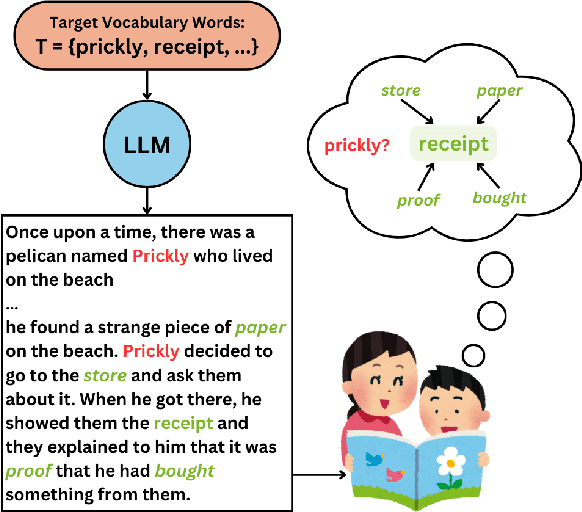
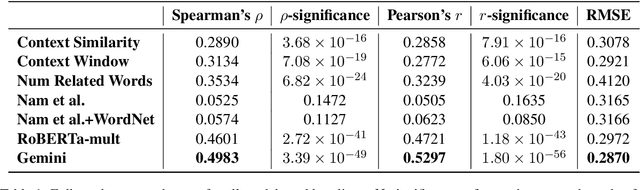
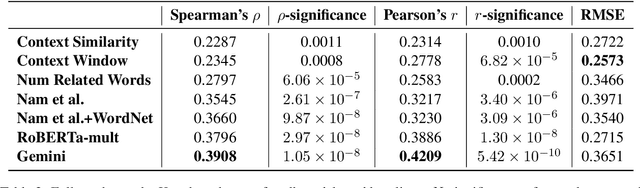
To address an important gap in creating children's stories for vocabulary enrichment, we investigate the automatic evaluation of how well stories convey the semantics of target vocabulary words, a task with substantial implications for generating educational content. We motivate this task, which we call measuring contextual informativeness in children's stories, and provide a formal task definition as well as a dataset for the task. We further propose a method for automating the task using a large language model (LLM). Our experiments show that our approach reaches a Spearman correlation of 0.4983 with human judgments of informativeness, while the strongest baseline only obtains a correlation of 0.3534. An additional analysis shows that the LLM-based approach is able to generalize to measuring contextual informativeness in adult-directed text, on which it also outperforms all baselines.
On the Automatic Generation and Simplification of Children's Stories
Oct 27, 2023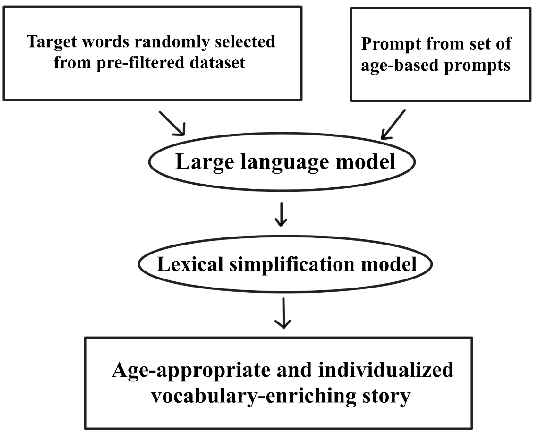
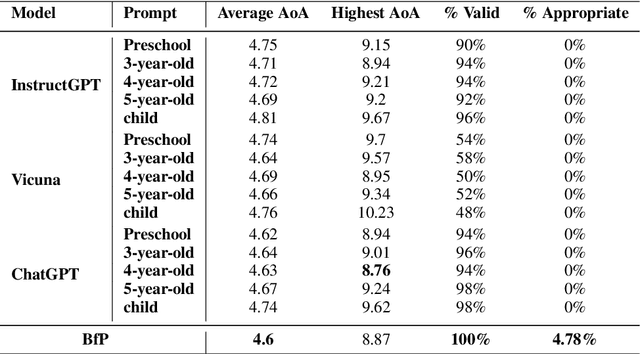
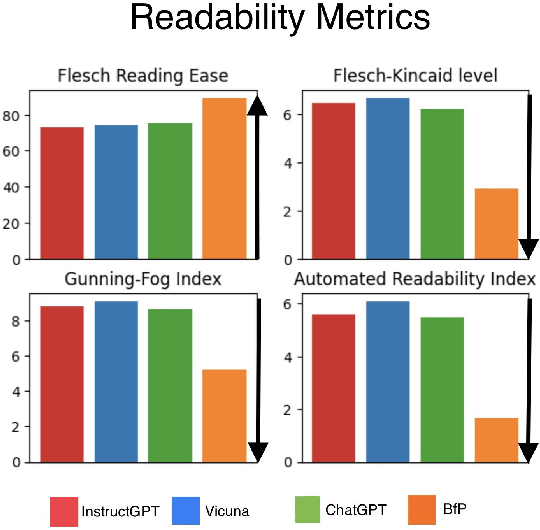
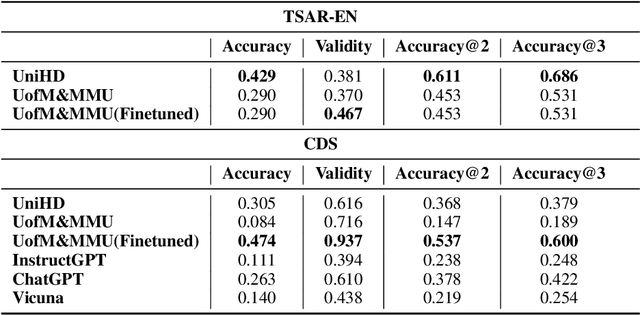
With recent advances in large language models (LLMs), the concept of automatically generating children's educational materials has become increasingly realistic. Working toward the goal of age-appropriate simplicity in generated educational texts, we first examine the ability of several popular LLMs to generate stories with properly adjusted lexical and readability levels. We find that, in spite of the growing capabilities of LLMs, they do not yet possess the ability to limit their vocabulary to levels appropriate for younger age groups. As a second experiment, we explore the ability of state-of-the-art lexical simplification models to generalize to the domain of children's stories and, thus, create an efficient pipeline for their automatic generation. In order to test these models, we develop a dataset of child-directed lexical simplification instances, with examples taken from the LLM-generated stories in our first experiment. We find that, while the strongest-performing current lexical simplification models do not perform as well on material designed for children due to their reliance on large language models behind the scenes, some models that still achieve fairly strong results on general data can mimic or even improve their performance on children-directed data with proper fine-tuning, which we conduct using our newly created child-directed simplification dataset.
Morphological Processing of Low-Resource Languages: Where We Are and What's Next
Mar 16, 2022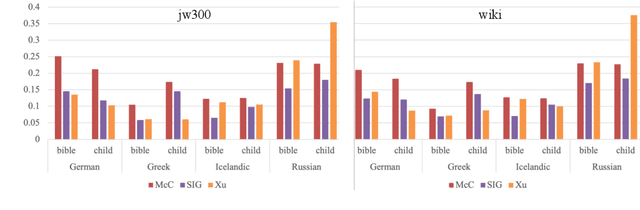
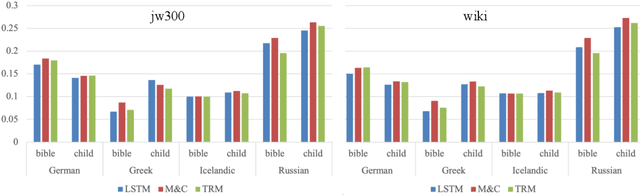
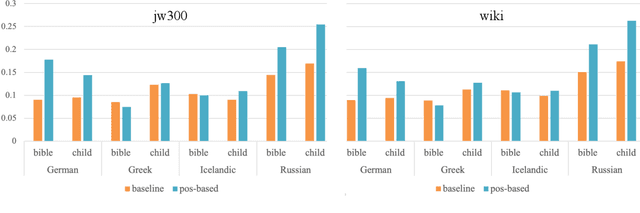
Automatic morphological processing can aid downstream natural language processing applications, especially for low-resource languages, and assist language documentation efforts for endangered languages. Having long been multilingual, the field of computational morphology is increasingly moving towards approaches suitable for languages with minimal or no annotated resources. First, we survey recent developments in computational morphology with a focus on low-resource languages. Second, we argue that the field is ready to tackle the logical next challenge: understanding a language's morphology from raw text alone. We perform an empirical study on a truly unsupervised version of the paradigm completion task and show that, while existing state-of-the-art models bridged by two newly proposed models we devise perform reasonably, there is still much room for improvement. The stakes are high: solving this task will increase the language coverage of morphological resources by a number of magnitudes.