 Add to Chrome
 Add to Firefox
 Add to Edge
Multiple Hypothesis Dropout: Estimating the Parameters of Multi-Modal Output Distributions
Dec 18, 2023
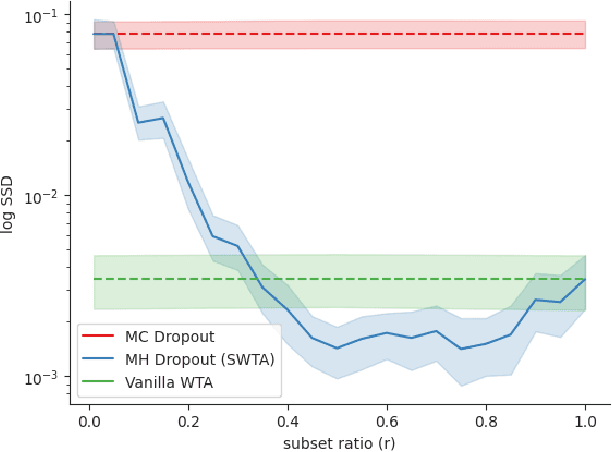
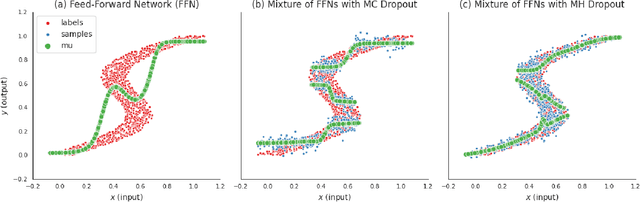
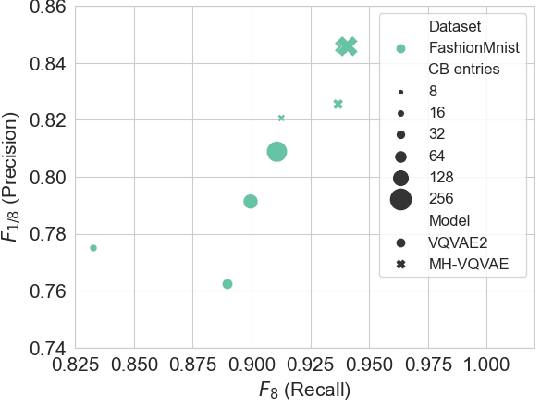
In many real-world applications, from robotics to pedestrian trajectory prediction, there is a need to predict multiple real-valued outputs to represent several potential scenarios. Current deep learning techniques to address multiple-output problems are based on two main methodologies: (1) mixture density networks, which suffer from poor stability at high dimensions, or (2) multiple choice learning (MCL), an approach that uses $M$ single-output functions, each only producing a point estimate hypothesis. This paper presents a Mixture of Multiple-Output functions (MoM) approach using a novel variant of dropout, Multiple Hypothesis Dropout. Unlike traditional MCL-based approaches, each multiple-output function not only estimates the mean but also the variance for its hypothesis. This is achieved through a novel stochastic winner-take-all loss which allows each multiple-output function to estimate variance through the spread of its subnetwork predictions. Experiments on supervised learning problems illustrate that our approach outperforms existing solutions for reconstructing multimodal output distributions. Additional studies on unsupervised learning problems show that estimating the parameters of latent posterior distributions within a discrete autoencoder significantly improves codebook efficiency, sample quality, precision and recall.

Parameter-Saving Adversarial Training: Reinforcing Multi-Perturbation Robustness via Hypernetworks
Sep 28, 2023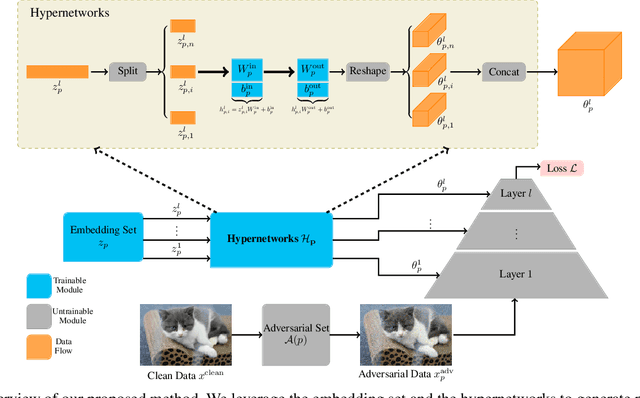

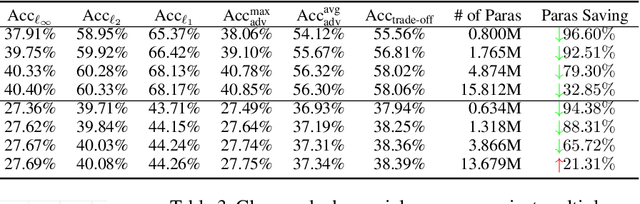
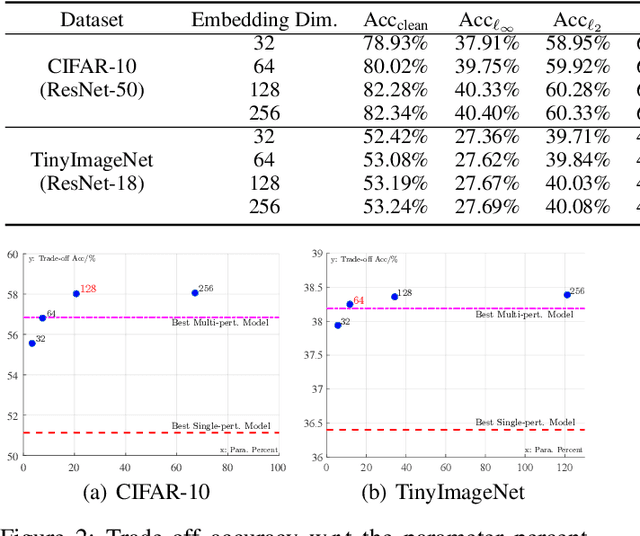
Adversarial training serves as one of the most popular and effective methods to defend against adversarial perturbations. However, most defense mechanisms only consider a single type of perturbation while various attack methods might be adopted to perform stronger adversarial attacks against the deployed model in real-world scenarios, e.g., $\ell_2$ or $\ell_\infty$. Defending against various attacks can be a challenging problem since multi-perturbation adversarial training and its variants only achieve suboptimal robustness trade-offs, due to the theoretical limit to multi-perturbation robustness for a single model. Besides, it is impractical to deploy large models in some storage-efficient scenarios. To settle down these drawbacks, in this paper we propose a novel multi-perturbation adversarial training framework, parameter-saving adversarial training (PSAT), to reinforce multi-perturbation robustness with an advantageous side effect of saving parameters, which leverages hypernetworks to train specialized models against a single perturbation and aggregate these specialized models to defend against multiple perturbations. Eventually, we extensively evaluate and compare our proposed method with state-of-the-art single/multi-perturbation robust methods against various latest attack methods on different datasets, showing the robustness superiority and parameter efficiency of our proposed method, e.g., for the CIFAR-10 dataset with ResNet-50 as the backbone, PSAT saves approximately 80\% of parameters with achieving the state-of-the-art robustness trade-off accuracy.
RAI4IoE: Responsible AI for Enabling the Internet of Energy
Sep 20, 2023


This paper plans to develop an Equitable and Responsible AI framework with enabling techniques and algorithms for the Internet of Energy (IoE), in short, RAI4IoE. The energy sector is going through substantial changes fueled by two key drivers: building a zero-carbon energy sector and the digital transformation of the energy infrastructure. We expect to see the convergence of these two drivers resulting in the IoE, where renewable distributed energy resources (DERs), such as electric cars, storage batteries, wind turbines and photovoltaics (PV), can be connected and integrated for reliable energy distribution by leveraging advanced 5G-6G networks and AI technology. This allows DER owners as prosumers to participate in the energy market and derive economic incentives. DERs are inherently asset-driven and face equitable challenges (i.e., fair, diverse and inclusive). Without equitable access, privileged individuals, groups and organizations can participate and benefit at the cost of disadvantaged groups. The real-time management of DER resources not only brings out the equity problem to the IoE, it also collects highly sensitive location, time, activity dependent data, which requires to be handled responsibly (e.g., privacy, security and safety), for AI-enhanced predictions, optimization and prioritization services, and automated management of flexible resources. The vision of our project is to ensure equitable participation of the community members and responsible use of their data in IoE so that it could reap the benefits of advances in AI to provide safe, reliable and sustainable energy services.
Stealthy Physical Masked Face Recognition Attack via Adversarial Style Optimization
Sep 18, 2023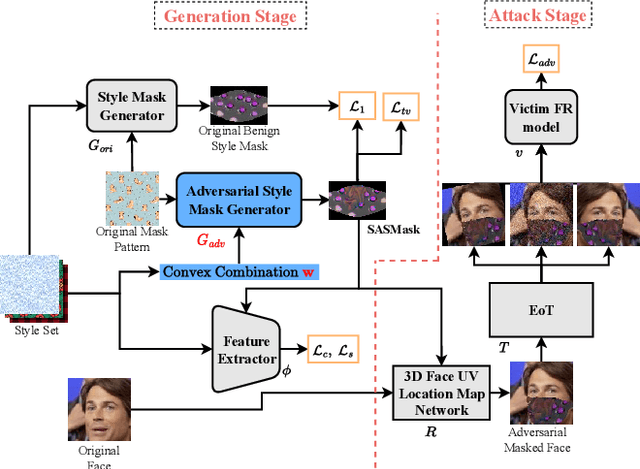
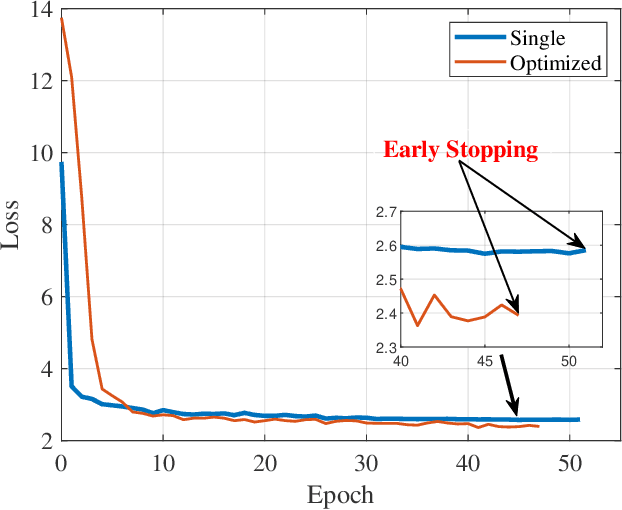
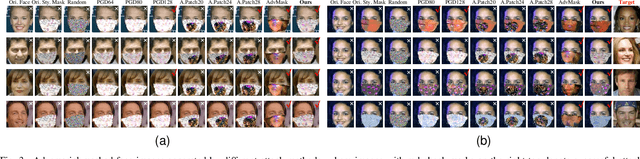
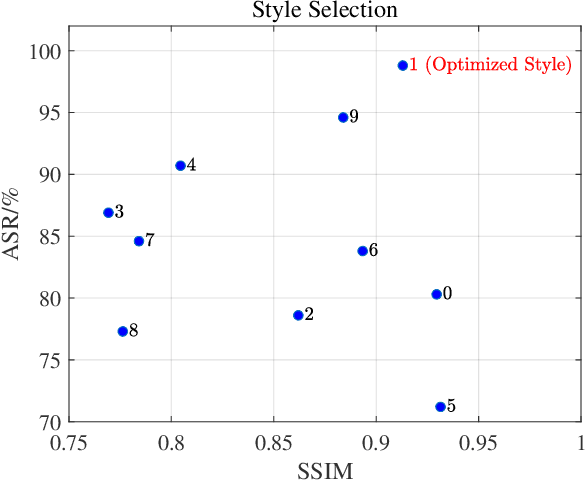
Deep neural networks (DNNs) have achieved state-of-the-art performance on face recognition (FR) tasks in the last decade. In real scenarios, the deployment of DNNs requires taking various face accessories into consideration, like glasses, hats, and masks. In the COVID-19 pandemic era, wearing face masks is one of the most effective ways to defend against the novel coronavirus. However, DNNs are known to be vulnerable to adversarial examples with a small but elaborated perturbation. Thus, a facial mask with adversarial perturbations may pose a great threat to the widely used deep learning-based FR models. In this paper, we consider a challenging adversarial setting: targeted attack against FR models. We propose a new stealthy physical masked FR attack via adversarial style optimization. Specifically, we train an adversarial style mask generator that hides adversarial perturbations inside style masks. Moreover, to ameliorate the phenomenon of sub-optimization with one fixed style, we propose to discover the optimal style given a target through style optimization in a continuous relaxation manner. We simultaneously optimize the generator and the style selection for generating strong and stealthy adversarial style masks. We evaluated the effectiveness and transferability of our proposed method via extensive white-box and black-box digital experiments. Furthermore, we also conducted physical attack experiments against local FR models and online platforms.
Reducing Adversarial Training Cost with Gradient Approximation
Sep 18, 2023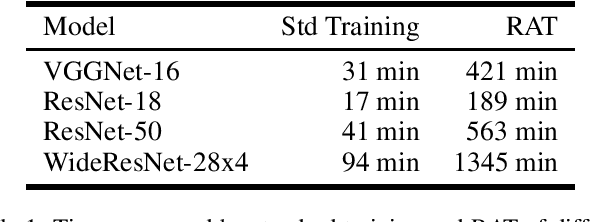
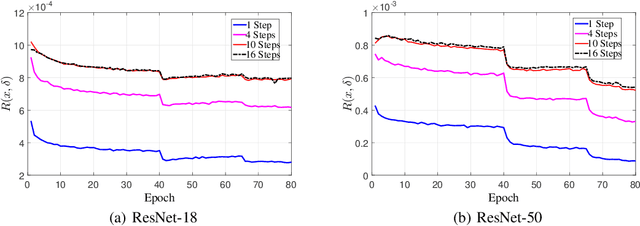
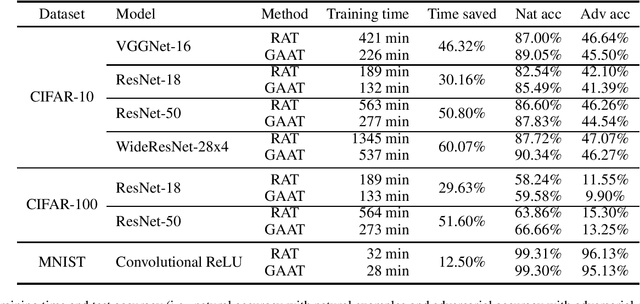
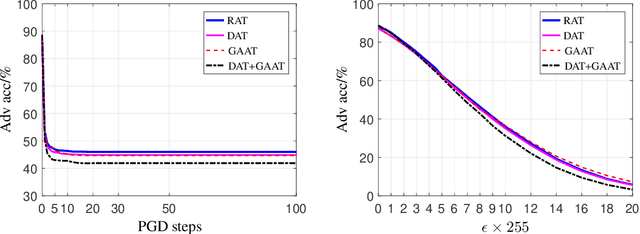
Deep learning models have achieved state-of-the-art performances in various domains, while they are vulnerable to the inputs with well-crafted but small perturbations, which are named after adversarial examples (AEs). Among many strategies to improve the model robustness against AEs, Projected Gradient Descent (PGD) based adversarial training is one of the most effective methods. Unfortunately, the prohibitive computational overhead of generating strong enough AEs, due to the maximization of the loss function, sometimes makes the regular PGD adversarial training impractical when using larger and more complicated models. In this paper, we propose that the adversarial loss can be approximated by the partial sum of Taylor series. Furthermore, we approximate the gradient of adversarial loss and propose a new and efficient adversarial training method, adversarial training with gradient approximation (GAAT), to reduce the cost of building up robust models. Additionally, extensive experiments demonstrate that this efficiency improvement can be achieved without any or with very little loss in accuracy on natural and adversarial examples, which show that our proposed method saves up to 60\% of the training time with comparable model test accuracy on MNIST, CIFAR-10 and CIFAR-100 datasets.
Two-in-one Knowledge Distillation for Efficient Facial Forgery Detection
Feb 21, 2023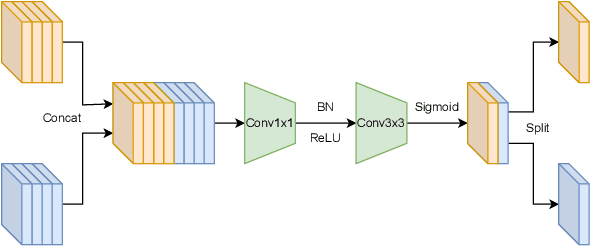
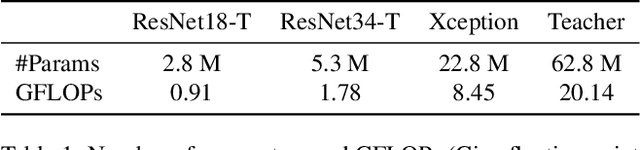
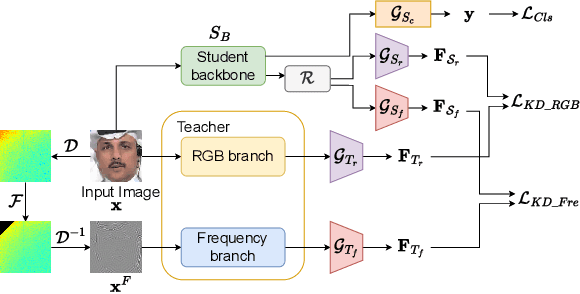
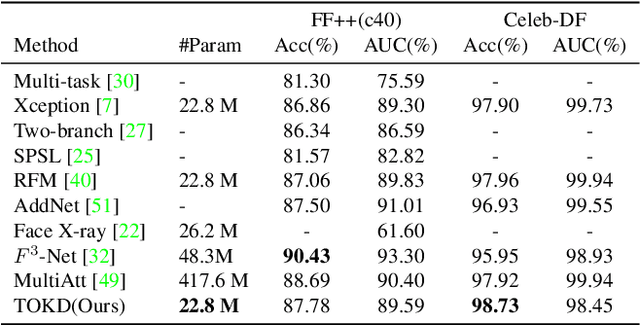
Facial forgery detection is a crucial but extremely challenging topic, with the fast development of forgery techniques making the synthetic artefact highly indistinguishable. Prior works show that by mining both spatial and frequency information the forgery detection performance of deep learning models can be vastly improved. However, leveraging multiple types of information usually requires more than one branch in the neural network, which makes the model heavy and cumbersome. Knowledge distillation, as an important technique for efficient modelling, could be a possible remedy. We find that existing knowledge distillation methods have difficulties distilling a dual-branch model into a single-branch model. More specifically, knowledge distillation on both the spatial and frequency branches has degraded performance than distillation only on the spatial branch. To handle such problem, we propose a novel two-in-one knowledge distillation framework which can smoothly merge the information from a large dual-branch network into a small single-branch network, with the help of different dedicated feature projectors and the gradient homogenization technique. Experimental analysis on two datasets, FaceForensics++ and Celeb-DF, shows that our proposed framework achieves superior performance for facial forgery detection with much fewer parameters.
Anti-Compression Contrastive Facial Forgery Detection
Feb 13, 2023Forgery facial images and videos have increased the concern of digital security. It leads to the significant development of detecting forgery data recently. However, the data, especially the videos published on the Internet, are usually compressed with lossy compression algorithms such as H.264. The compressed data could significantly degrade the performance of recent detection algorithms. The existing anti-compression algorithms focus on enhancing the performance in detecting heavily compressed data but less consider the compression adaption to the data from various compression levels. We believe creating a forgery detection model that can handle the data compressed with unknown levels is important. To enhance the performance for such models, we consider the weak compressed and strong compressed data as two views of the original data and they should have similar representation and relationships with other samples. We propose a novel anti-compression forgery detection framework by maintaining closer relations within data under different compression levels. Specifically, the algorithm measures the pair-wise similarity within data as the relations, and forcing the relations of weak and strong compressed data close to each other, thus improving the discriminate power for detecting strong compressed data. To achieve a better strong compressed data relation guided by the less compressed one, we apply video level contrastive learning for weak compressed data, which forces the model to produce similar representations within the same video and far from the negative samples. The experiment results show that the proposed algorithm could boost performance for strong compressed data while improving the accuracy rate when detecting the clean data.
Diverse Multimedia Layout Generation with Multi Choice Learning
Jan 16, 2023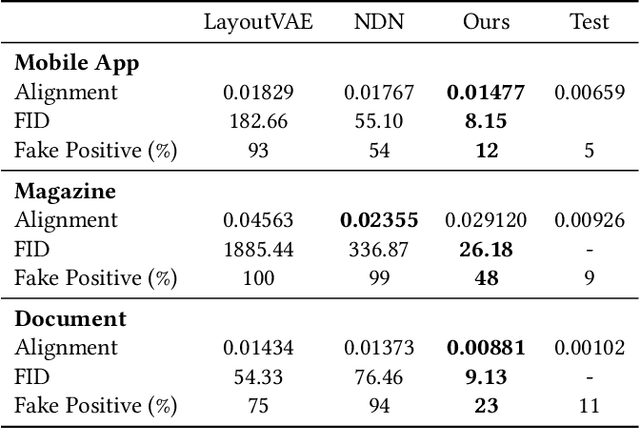
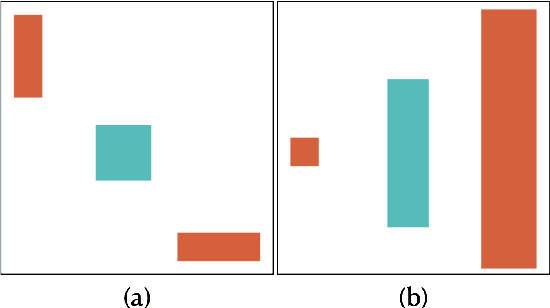
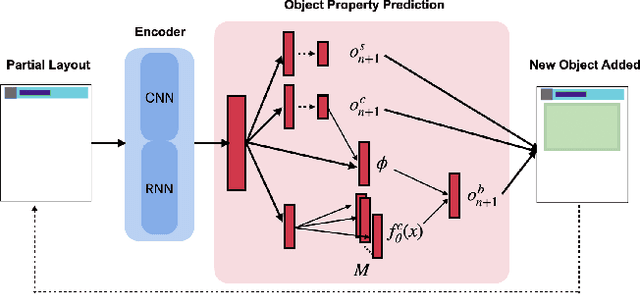
Designing visually appealing layouts for multimedia documents containing text, graphs and images requires a form of creative intelligence. Modelling the generation of layouts has recently gained attention due to its importance in aesthetics and communication style. In contrast to standard prediction tasks, there are a range of acceptable layouts which depend on user preferences. For example, a poster designer may prefer logos on the top-left while another prefers logos on the bottom-right. Both are correct choices yet existing machine learning models treat layouts as a single choice prediction problem. In such situations, these models would simply average over all possible choices given the same input forming a degenerate sample. In the above example, this would form an unacceptable layout with a logo in the centre. In this paper, we present an auto-regressive neural network architecture, called LayoutMCL, that uses multi-choice prediction and winner-takes-all loss to effectively stabilise layout generation. LayoutMCL avoids the averaging problem by using multiple predictors to learn a range of possible options for each layout object. This enables LayoutMCL to generate multiple and diverse layouts from a single input which is in contrast with existing approaches which yield similar layouts with minor variations. Through quantitative benchmarks on real data (magazine, document and mobile app layouts), we demonstrate that LayoutMCL reduces Fr\'echet Inception Distance (FID) by 83-98% and generates significantly more diversity in comparison to existing approaches.
* 9 pages
Masked Vector Quantization
Jan 16, 2023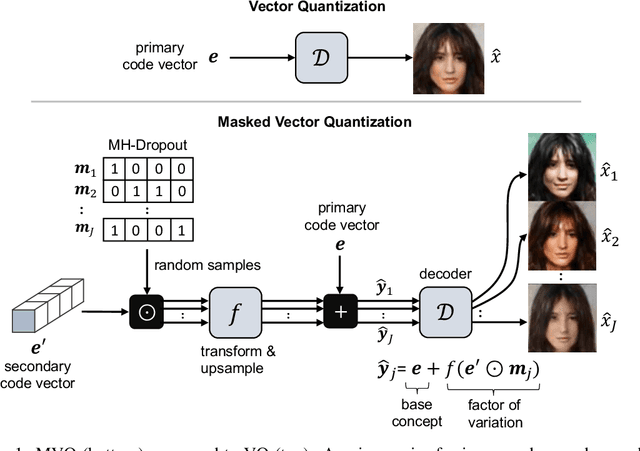
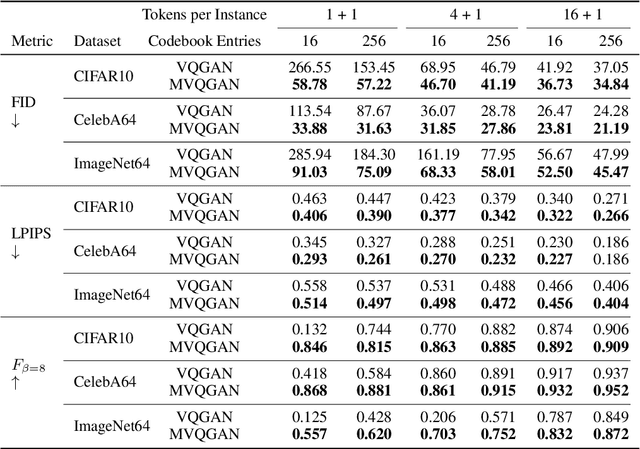
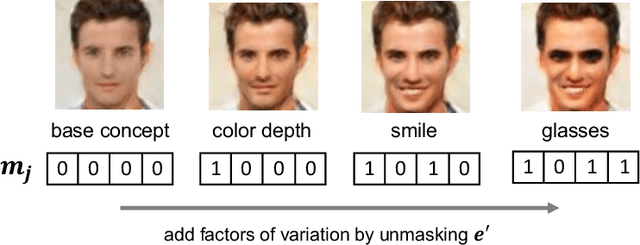
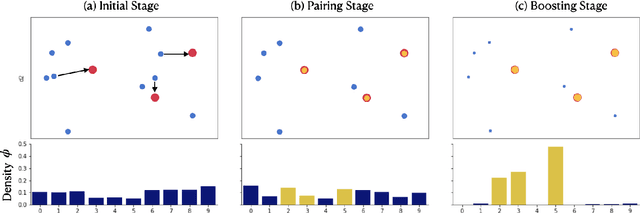
Generative models with discrete latent representations have recently demonstrated an impressive ability to learn complex high-dimensional data distributions. However, their performance relies on a long sequence of tokens per instance and a large number of codebook entries, resulting in long sampling times and considerable computation to fit the categorical posterior. To address these issues, we propose the Masked Vector Quantization (MVQ) framework which increases the representational capacity of each code vector by learning mask configurations via a stochastic winner-takes-all training regime called Multiple Hypothese Dropout (MH-Dropout). On ImageNet 64$\times$64, MVQ reduces FID in existing vector quantization architectures by up to $68\%$ at 2 tokens per instance and $57\%$ at 5 tokens. These improvements widen as codebook entries is reduced and allows for $7\textit{--}45\times$ speed-up in token sampling during inference. As an additional benefit, we find that smaller latent spaces lead to MVQ identifying transferable visual representations where multiple can be smoothly combined.
Tracking Dataset IP Use in Deep Neural Networks
Nov 24, 2022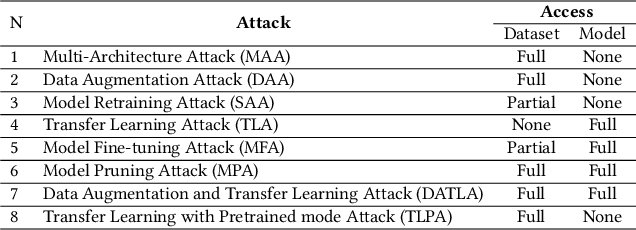
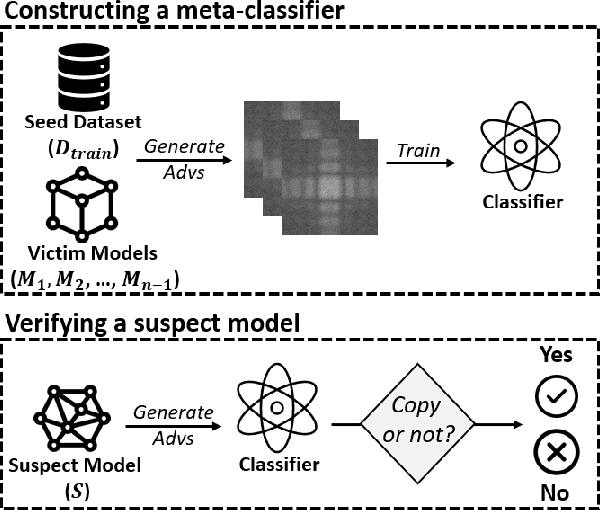
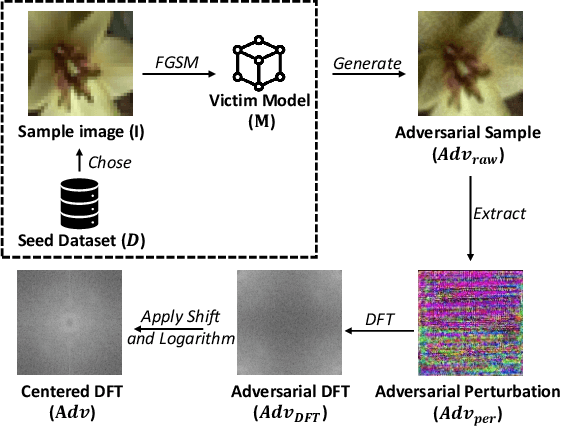
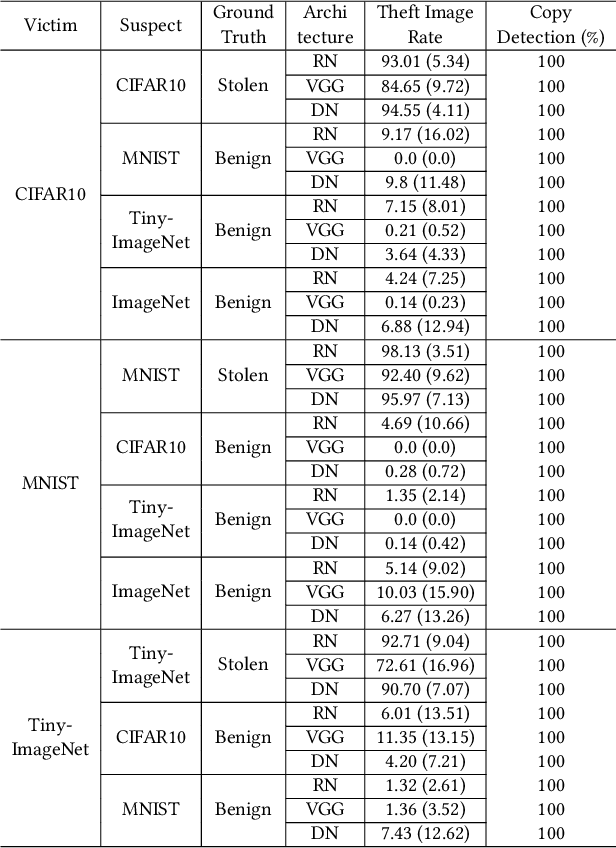
Training highly performant deep neural networks (DNNs) typically requires the collection of a massive dataset and the use of powerful computing resources. Therefore, unauthorized redistribution of private pre-trained DNNs may cause severe economic loss for model owners. For protecting the ownership of DNN models, DNN watermarking schemes have been proposed by embedding secret information in a DNN model and verifying its presence for model ownership. However, existing DNN watermarking schemes compromise the model utility and are vulnerable to watermark removal attacks because a model is modified with a watermark. Alternatively, a new approach dubbed DEEPJUDGE was introduced to measure the similarity between a suspect model and a victim model without modifying the victim model. However, DEEPJUDGE would only be designed to detect the case where a suspect model's architecture is the same as a victim model's. In this work, we propose a novel DNN fingerprinting technique dubbed DEEPTASTER to prevent a new attack scenario in which a victim's data is stolen to build a suspect model. DEEPTASTER can effectively detect such data theft attacks even when a suspect model's architecture differs from a victim model's. To achieve this goal, DEEPTASTER generates a few adversarial images with perturbations, transforms them into the Fourier frequency domain, and uses the transformed images to identify the dataset used in a suspect model. The intuition is that those adversarial images can be used to capture the characteristics of DNNs built on a specific dataset. We evaluated the detection accuracy of DEEPTASTER on three datasets with three model architectures under various attack scenarios, including transfer learning, pruning, fine-tuning, and data augmentation. Overall, DEEPTASTER achieves a balanced accuracy of 94.95%, which is significantly better than 61.11% achieved by DEEPJUDGE in the same settings.