 Add to Chrome
 Add to Firefox
 Add to Edge
Linear Recurrent Unit with Semantic Modulation for Image Super-Resolution
Jun 18, 2026
Linear recurrent unit (LRU), designed with a principled formulation for stable linear recurrence, has demonstrated promising accuracy and robustness on long-range dependency tasks. However, its static parameterization and single-scan method limits its applicability to 2D vision tasks. In this study, we propose a LRU-based restoration network with a semantic modulating unit (SMU) to achieve a harmonious balance between performance and efficiency in single-image super-resolution. The SMU plays three key roles: LRU modulation, spatial categorization, and feature enhancement through learned prototype. Extensive experiments demonstrate that our method quantitatively and qualitatively surpasses recent state-of-the-art methods. Notably, our approach achieves superior performance with computational complexity on par with existing methods. The source code and models are available at https://github.com/MingyuChoi-run/LSM

Balancing Fidelity and Diversity in Diffusion Models via Symmetric Attention Decomposition: Hopfield Perspective
May 26, 2026We characterize the pre-softmax attention matrix $\mathbf{QK^\top}$ in transformers as an associative memory matrix encoding pairwise associations between input features. By decomposing this matrix into its symmetric and skew-symmetric parts, we interpret the symmetric component as governing the structure of the energy landscape, and the skew-symmetric component as driving circulation on that landscape. Leveraging the energy formulation induced by the symmetric component, we derive Hopfield-style stability measures that quantify the stability of retrieved features. We observe meaningful correlations between Hopfield-style stability measures and the fidelity-diversity trade-offs in generation. Finally, we propose a controllable knob to modulate this trade-off by modifying the circulation of the underlying dynamics. Code is available at our GitHub (https://github.com/hyeon-cho/Attention-Symmetric-Decomposition).
Towards Lossless Implicit Neural Representation via Bit Plane Decomposition
Feb 28, 2025
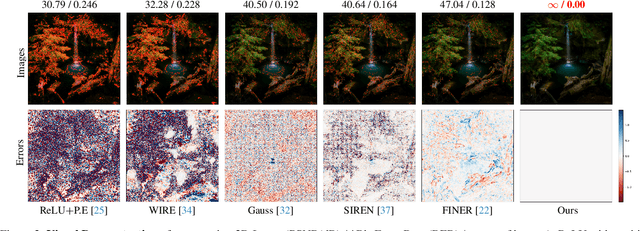
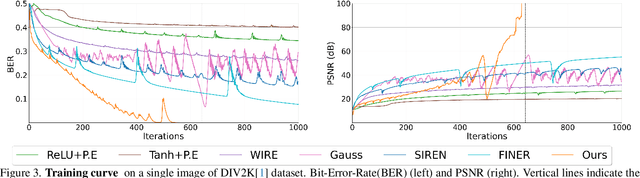
We quantify the upper bound on the size of the implicit neural representation (INR) model from a digital perspective. The upper bound of the model size increases exponentially as the required bit-precision increases. To this end, we present a bit-plane decomposition method that makes INR predict bit-planes, producing the same effect as reducing the upper bound of the model size. We validate our hypothesis that reducing the upper bound leads to faster convergence with constant model size. Our method achieves lossless representation in 2D image and audio fitting, even for high bit-depth signals, such as 16-bit, which was previously unachievable. We pioneered the presence of bit bias, which INR prioritizes as the most significant bit (MSB). We expand the application of the INR task to bit depth expansion, lossless image compression, and extreme network quantization. Our source code is available at https://github.com/WooKyoungHan/LosslessINR
JDEC: JPEG Decoding via Enhanced Continuous Cosine Coefficients
Apr 03, 2024


We propose a practical approach to JPEG image decoding, utilizing a local implicit neural representation with continuous cosine formulation. The JPEG algorithm significantly quantizes discrete cosine transform (DCT) spectra to achieve a high compression rate, inevitably resulting in quality degradation while encoding an image. We have designed a continuous cosine spectrum estimator to address the quality degradation issue that restores the distorted spectrum. By leveraging local DCT formulations, our network has the privilege to exploit dequantization and upsampling simultaneously. Our proposed model enables decoding compressed images directly across different quality factors using a single pre-trained model without relying on a conventional JPEG decoder. As a result, our proposed network achieves state-of-the-art performance in flexible color image JPEG artifact removal tasks. Our source code is available at https://github.com/WooKyoungHan/JDEC.
Learning Residual Elastic Warps for Image Stitching under Dirichlet Boundary Condition
Sep 07, 2023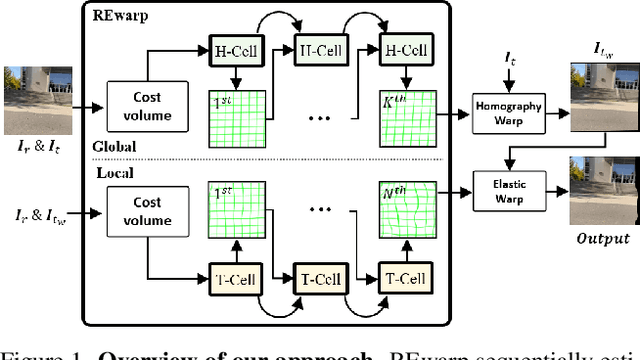
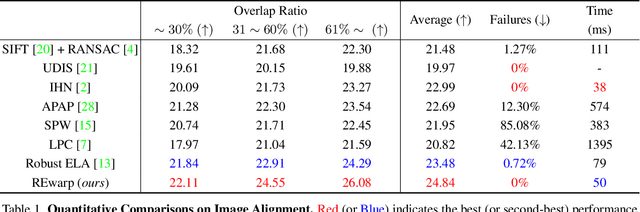
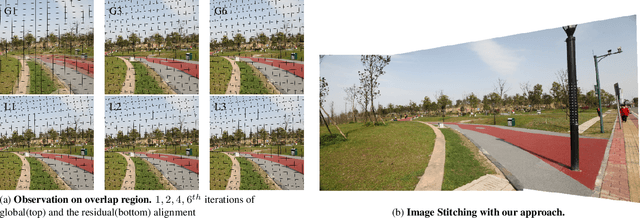
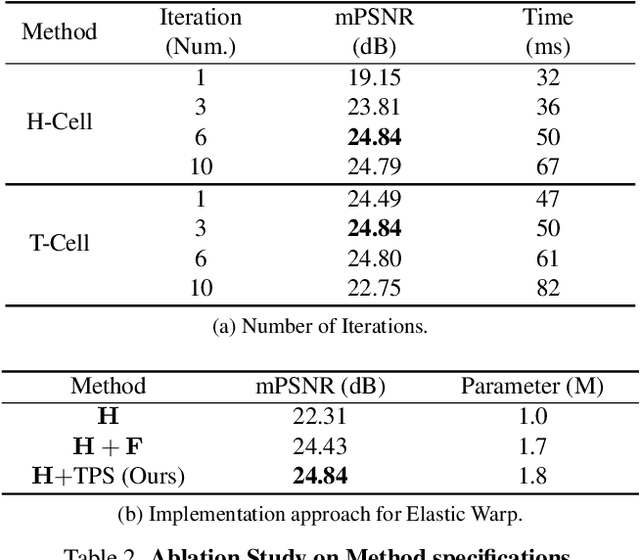
Trendy suggestions for learning-based elastic warps enable the deep image stitchings to align images exposed to large parallax errors. Despite the remarkable alignments, the methods struggle with occasional holes or discontinuity between overlapping and non-overlapping regions of a target image as the applied training strategy mostly focuses on overlap region alignment. As a result, they require additional modules such as seam finder and image inpainting for hiding discontinuity and filling holes, respectively. In this work, we suggest Recurrent Elastic Warps (REwarp) that address the problem with Dirichlet boundary condition and boost performances by residual learning for recurrent misalign correction. Specifically, REwarp predicts a homography and a Thin-plate Spline (TPS) under the boundary constraint for discontinuity and hole-free image stitching. Our experiments show the favorable aligns and the competitive computational costs of REwarp compared to the existing stitching methods. Our source code is available at https://github.com/minshu-kim/REwarp.