 Add to Chrome
 Add to Firefox
 Add to Edge
RobOralScan: Learning Active Intraoral Scanning for Robotic Dental Reconstruction
Jun 25, 2026
Intraoral scanning is widely used for digital optical impressions in prosthodontic, implant, and orthodontic treatment, but full-arch and long-span scanning remain labor-intensive tasks with limited automation. In the confined oral cavity, operators must continuously adjust scanner motion while accumulating narrow field-of-view observations, making reconstruction quality sensitive to missing tooth surfaces and operator workload. We propose RobOralScan, which, to the best of our knowledge, is the first reinforcement learning (RL)-based pipeline for robotic automatic intraoral scanning. RobOralScan introduces a geometric memory-based observation space that accumulates partial scan observations into a tri-state geometric representation, allowing the policy to reason over scan history and insufficiently observed regions. It further introduces tooth-wise coverage learning, combining coverage-aware reward signals and a progressive training scheme to improve global reconstruction coverage while reducing uneven coverage across individual teeth. The learned policy selects relative scanner motions from accumulated geometric memory and robot proprioception for closed-loop scan control within the oral workspace. RobOralScan achieves a Chamfer Distance of 0.00838, an average coverage of 92.58%, a lower-tail per-tooth coverage of 88.45%, and a normalized AUC of 0.6674, completing the scan criterion in 8 of 10 evaluation episodes. Furthermore, zero-shot sim-to-real experiments demonstrate its practical feasibility on a physical robot-scanner setup.

CVA: Context-aware Video-text Alignment for Video Temporal Grounding
Mar 26, 2026We propose Context-aware Video-text Alignment (CVA), a novel framework to address a significant challenge in video temporal grounding: achieving temporally sensitive video-text alignment that remains robust to irrelevant background context. Our framework is built on three key components. First, we propose Query-aware Context Diversification (QCD), a new data augmentation strategy that ensures only semantically unrelated content is mixed in. It builds a video-text similarity-based pool of replacement clips to simulate diverse contexts while preventing the ``false negative" caused by query-agnostic mixing. Second, we introduce the Context-invariant Boundary Discrimination (CBD) loss, a contrastive loss that enforces semantic consistency at challenging temporal boundaries, making their representations robust to contextual shifts and hard negatives. Third, we introduce the Context-enhanced Transformer Encoder (CTE), a hierarchical architecture that combines windowed self-attention and bidirectional cross-attention with learnable queries to capture multi-scale temporal context. Through the synergy of these data-centric and architectural enhancements, CVA achieves state-of-the-art performance on major VTG benchmarks, including QVHighlights and Charades-STA. Notably, our method achieves a significant improvement of approximately 5 points in Recall@1 (R1) scores over state-of-the-art methods, highlighting its effectiveness in mitigating false negatives.
MonoFormer: Towards Generalization of self-supervised monocular depth estimation with Transformers
May 23, 2022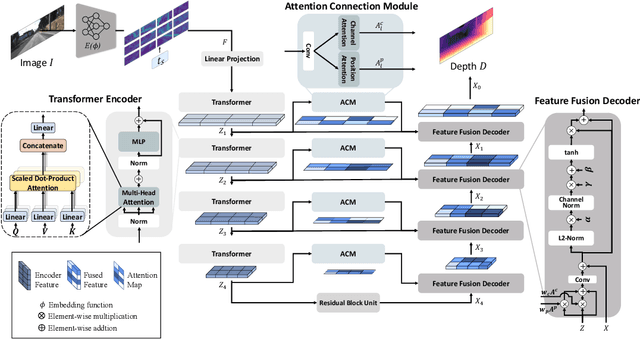
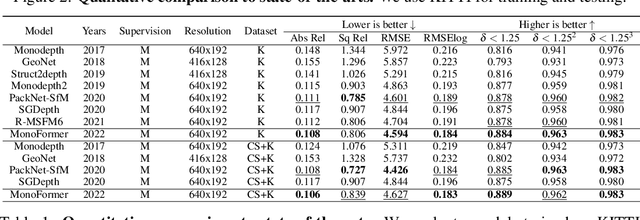
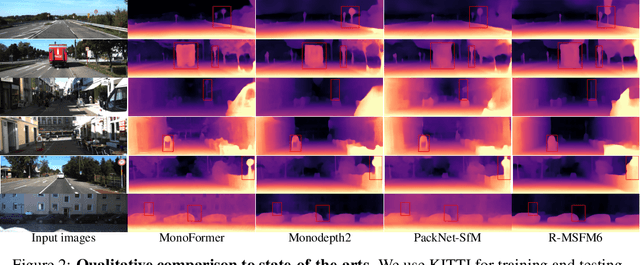
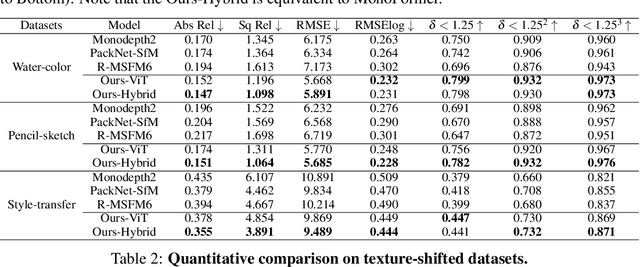
Self-supervised monocular depth estimation has been widely studied recently. Most of the work has focused on improving performance on benchmark datasets, such as KITTI, but has offered a few experiments on generalization performance. In this paper, we investigate the backbone networks (e.g. CNNs, Transformers, and CNN-Transformer hybrid models) toward the generalization of monocular depth estimation. We first evaluate state-of-the-art models on diverse public datasets, which have never been seen during the network training. Next, we investigate the effects of texture-biased and shape-biased representations using the various texture-shifted datasets that we generated. We observe that Transformers exhibit a strong shape bias and CNNs do a strong texture-bias. We also find that shape-biased models show better generalization performance for monocular depth estimation compared to texture-biased models. Based on these observations, we newly design a CNN-Transformer hybrid network with a multi-level adaptive feature fusion module, called MonoFormer. The design intuition behind MonoFormer is to increase shape bias by employing Transformers while compensating for the weak locality bias of Transformers by adaptively fusing multi-level representations. Extensive experiments show that the proposed method achieves state-of-the-art performance with various public datasets. Our method also shows the best generalization ability among the competitive methods.