 Add to Chrome
 Add to Firefox
 Add to Edge
Scale-invariant and View-relational Representation Learning for Full Surround Monocular Depth
Dec 09, 2025
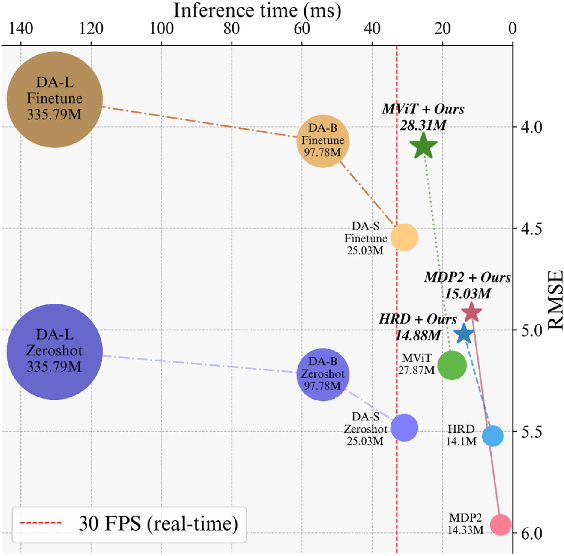
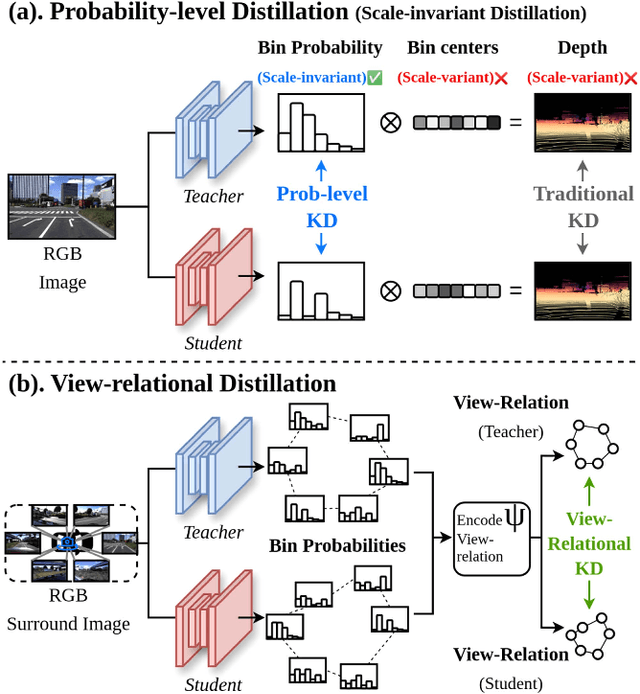
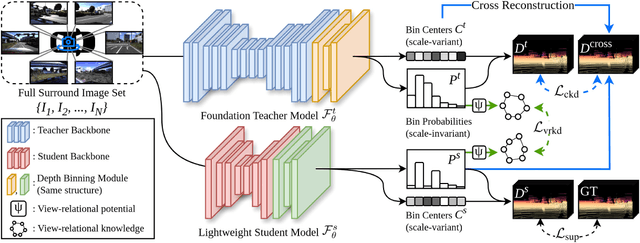
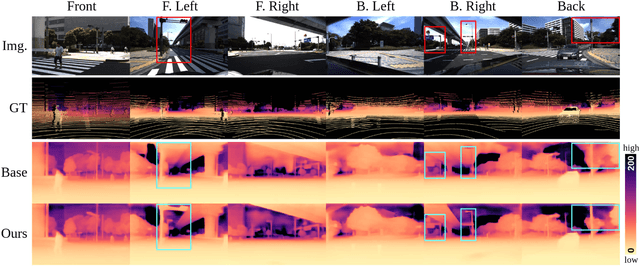
Recent foundation models demonstrate strong generalization capabilities in monocular depth estimation. However, directly applying these models to Full Surround Monocular Depth Estimation (FSMDE) presents two major challenges: (1) high computational cost, which limits real-time performance, and (2) difficulty in estimating metric-scale depth, as these models are typically trained to predict only relative depth. To address these limitations, we propose a novel knowledge distillation strategy that transfers robust depth knowledge from a foundation model to a lightweight FSMDE network. Our approach leverages a hybrid regression framework combining the knowledge distillation scheme--traditionally used in classification--with a depth binning module to enhance scale consistency. Specifically, we introduce a cross-interaction knowledge distillation scheme that distills the scale-invariant depth bin probabilities of a foundation model into the student network while guiding it to infer metric-scale depth bin centers from ground-truth depth. Furthermore, we propose view-relational knowledge distillation, which encodes structural relationships among adjacent camera views and transfers them to enhance cross-view depth consistency. Experiments on DDAD and nuScenes demonstrate the effectiveness of our method compared to conventional supervised methods and existing knowledge distillation approaches. Moreover, our method achieves a favorable trade-off between performance and efficiency, meeting real-time requirements.

Maximum margin learning of t-SPNs for cell classification with filtered input
Mar 21, 2023An algorithm based on a deep probabilistic architecture referred to as a tree-structured sum-product network (t-SPN) is considered for cell classification. The t-SPN is constructed such that the unnormalized probability is represented as conditional probabilities of a subset of most similar cell classes. The constructed t-SPN architecture is learned by maximizing the margin, which is the difference in the conditional probability between the true and the most competitive false label. To enhance the generalization ability of the architecture, L2-regularization (REG) is considered along with the maximum margin (MM) criterion in the learning process. To highlight cell features, this paper investigates the effectiveness of two generic high-pass filters: ideal high-pass filtering and the Laplacian of Gaussian (LOG) filtering. On both HEp-2 and Feulgen benchmark datasets, the t-SPN architecture learned based on the max-margin criterion with regularization produced the highest accuracy rate compared to other state-of-the-art algorithms that include convolutional neural network (CNN) based algorithms. The ideal high-pass filter was more effective on the HEp-2 dataset, which is based on immunofluorescence staining, while the LOG was more effective on the Feulgen dataset, which is based on Feulgen staining.