 Add to Chrome
 Add to Firefox
 Add to Edge
Breast Cancer Neoadjuvant Chemotherapy Treatment Response Prediction Using Aligned Longitudinal MRI and Clinical Data
Dec 19, 2025
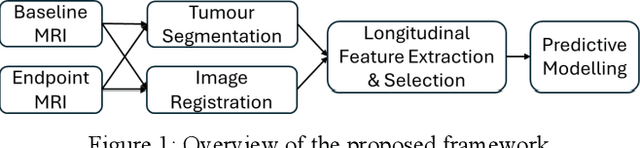
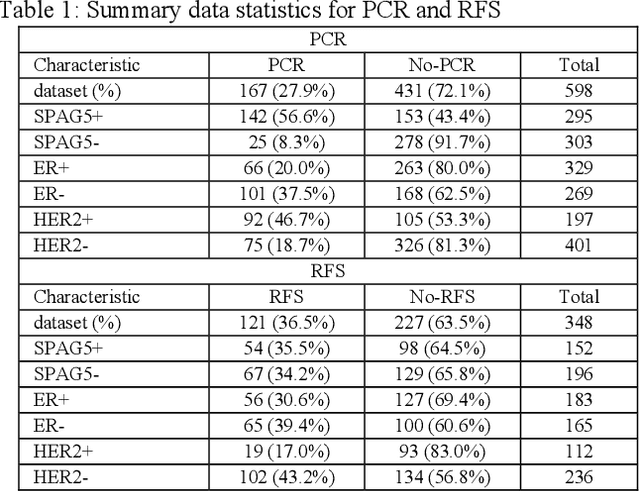
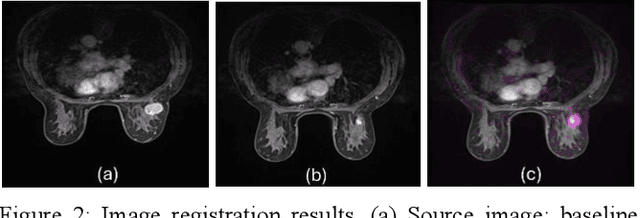
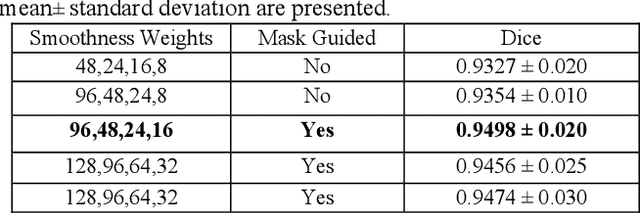
Aim: This study investigates treatment response prediction to neoadjuvant chemotherapy (NACT) in breast cancer patients, using longitudinal contrast-enhanced magnetic resonance images (CE-MRI) and clinical data. The goal is to develop machine learning (ML) models to predict pathologic complete response (PCR binary classification) and 5-year relapse-free survival status (RFS binary classification). Method: The proposed framework includes tumour segmentation, image registration, feature extraction, and predictive modelling. Using the image registration method, MRI image features can be extracted and compared from the original tumour site at different time points, therefore monitoring the intratumor changes during NACT process. Four feature extractors, including one radiomics and three deep learning-based (MedicalNet, Segformer3D, SAM-Med3D) were implemented and compared. In combination with three feature selection methods and four ML models, predictive models are built and compared. Results: The proposed image registration-based feature extraction consistently improves the predictive models. In the PCR and RFS classification tasks logistic regression model trained on radiomic features performed the best with an AUC of 0.88 and classification accuracy of 0.85 for PCR classification, and AUC of 0.78 and classification accuracy of 0.72 for RFS classification. Conclusions: It is evidenced that the image registration method has significantly improved performance in longitudinal feature learning in predicting PCR and RFS. The radiomics feature extractor is more effective than the pre-trained deep learning feature extractors, with higher performance and better interpretability.

Extending Isolation Forest for Anomaly Detection in Big Data via K-Means
Apr 27, 2021
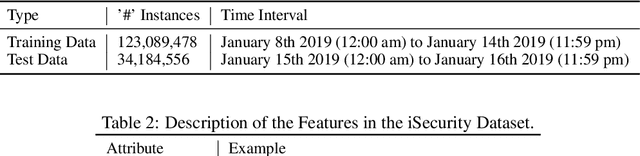
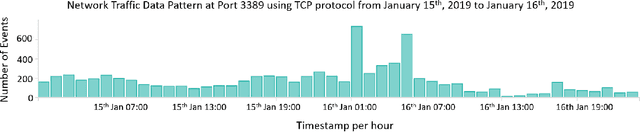
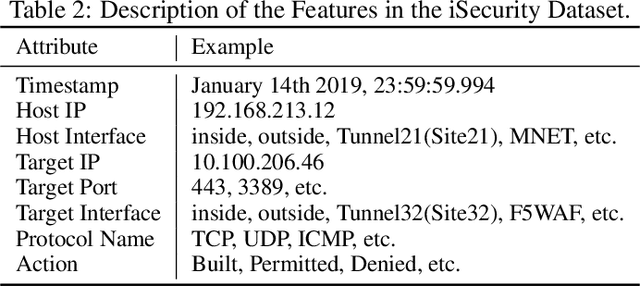
Industrial Information Technology (IT) infrastructures are often vulnerable to cyberattacks. To ensure security to the computer systems in an industrial environment, it is required to build effective intrusion detection systems to monitor the cyber-physical systems (e.g., computer networks) in the industry for malicious activities. This paper aims to build such intrusion detection systems to protect the computer networks from cyberattacks. More specifically, we propose a novel unsupervised machine learning approach that combines the K-Means algorithm with the Isolation Forest for anomaly detection in industrial big data scenarios. Since our objective is to build the intrusion detection system for the big data scenario in the industrial domain, we utilize the Apache Spark framework to implement our proposed model which was trained in large network traffic data (about 123 million instances of network traffic) stored in Elasticsearch. Moreover, we evaluate our proposed model on the live streaming data and find that our proposed system can be used for real-time anomaly detection in the industrial setup. In addition, we address different challenges that we face while training our model on large datasets and explicitly describe how these issues were resolved. Based on our empirical evaluation in different use-cases for anomaly detection in real-world network traffic data, we observe that our proposed system is effective to detect anomalies in big data scenarios. Finally, we evaluate our proposed model on several academic datasets to compare with other models and find that it provides comparable performance with other state-of-the-art approaches.