 Add to Chrome
 Add to Firefox
 Add to Edge
Suppressing Pink Elephants with Direct Principle Feedback
Feb 13, 2024
Existing methods for controlling language models, such as RLHF and Constitutional AI, involve determining which LLM behaviors are desirable and training them into a language model. However, in many cases, it is desirable for LLMs to be controllable at inference time, so that they can be used in multiple contexts with diverse needs. We illustrate this with the Pink Elephant Problem: instructing an LLM to avoid discussing a certain entity (a ``Pink Elephant''), and instead discuss a preferred entity (``Grey Elephant''). We apply a novel simplification of Constitutional AI, Direct Principle Feedback, which skips the ranking of responses and uses DPO directly on critiques and revisions. Our results show that after DPF fine-tuning on our synthetic Pink Elephants dataset, our 13B fine-tuned LLaMA 2 model significantly outperforms Llama-2-13B-Chat and a prompted baseline, and performs as well as GPT-4 in on our curated test set assessing the Pink Elephant Problem.

The Case for Co-Designing Model Architectures with Hardware
Jan 30, 2024


While GPUs are responsible for training the vast majority of state-of-the-art deep learning models, the implications of their architecture are often overlooked when designing new deep learning (DL) models. As a consequence, modifying a DL model to be more amenable to the target hardware can significantly improve the runtime performance of DL training and inference. In this paper, we provide a set of guidelines for users to maximize the runtime performance of their transformer models. These guidelines have been created by carefully considering the impact of various model hyperparameters controlling model shape on the efficiency of the underlying computation kernels executed on the GPU. We find the throughput of models with efficient model shapes is up to 39\% higher while preserving accuracy compared to models with a similar number of parameters but with unoptimized shapes.
Transformer-Based Models Are Not Yet Perfect At Learning to Emulate Structural Recursion
Jan 23, 2024
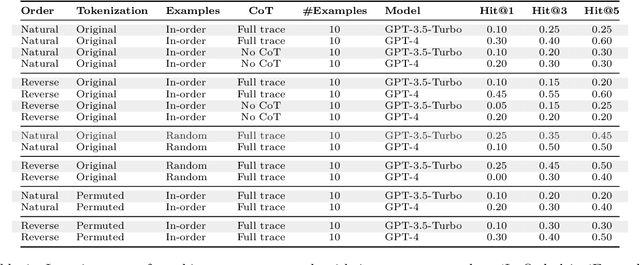
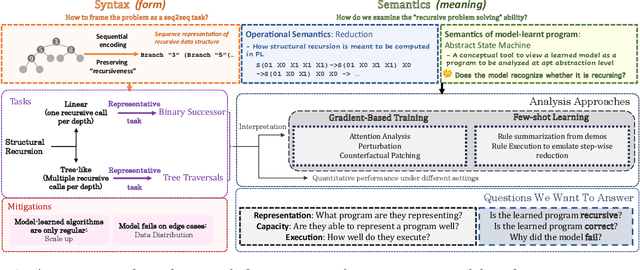
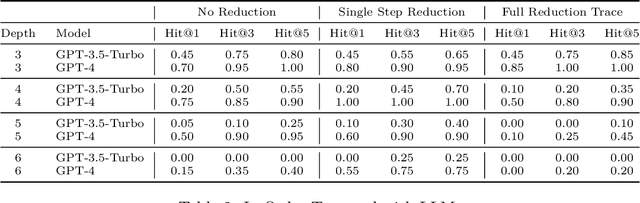
This paper investigates the ability of transformer-based models to learn structural recursion from examples. Recursion is a universal concept in both natural and formal languages. Structural recursion is central to the programming language and formal mathematics tasks where symbolic tools currently excel beyond neural models, such as inferring semantic relations between datatypes and emulating program behavior. We introduce a general framework that nicely connects the abstract concepts of structural recursion in the programming language domain to concrete sequence modeling problems and learned models' behavior. The framework includes a representation that captures the general \textit{syntax} of structural recursion, coupled with two different frameworks for understanding their \textit{semantics} -- one that is more natural from a programming languages perspective and one that helps bridge that perspective with a mechanistic understanding of the underlying transformer architecture. With our framework as a powerful conceptual tool, we identify different issues under various set-ups. The models trained to emulate recursive computations cannot fully capture the recursion yet instead fit short-cut algorithms and thus cannot solve certain edge cases that are under-represented in the training distribution. In addition, it is difficult for state-of-the-art large language models (LLMs) to mine recursive rules from in-context demonstrations. Meanwhile, these LLMs fail in interesting ways when emulating reduction (step-wise computation) of the recursive function.
Grokking Group Multiplication with Cosets
Dec 11, 2023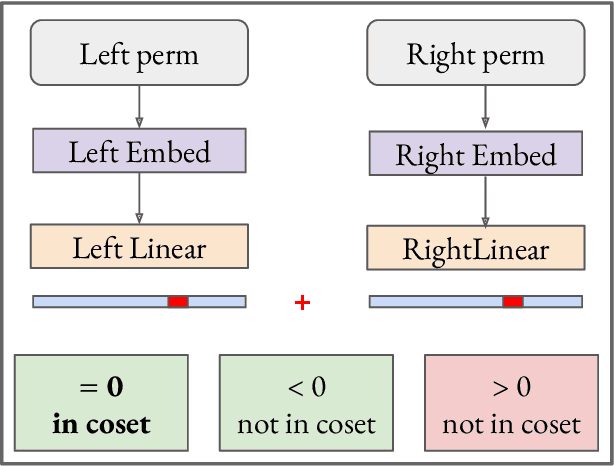
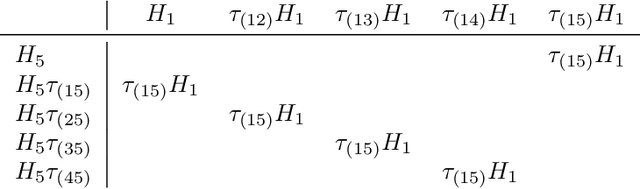
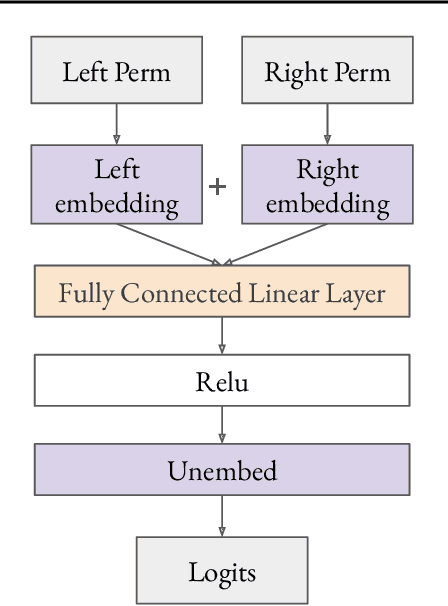
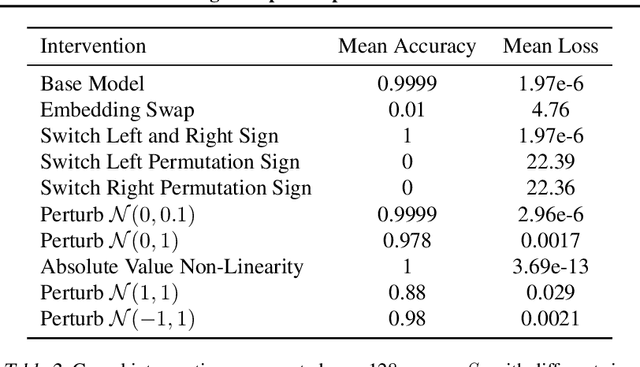
We use the group Fourier transform over the symmetric group $S_n$ to reverse engineer a 1-layer feedforward network that has "grokked" the multiplication of $S_5$ and $S_6$. Each model discovers the true subgroup structure of the full group and converges on circuits that decompose the group multiplication into the multiplication of the group's conjugate subgroups. We demonstrate the value of using the symmetries of the data and models to understand their mechanisms and hold up the ``coset circuit'' that the model uses as a fascinating example of the way neural networks implement computations. We also draw attention to current challenges in conducting mechanistic interpretability research by comparing our work to Chughtai et al. [6] which alleges to find a different algorithm for this same problem.
Llemma: An Open Language Model For Mathematics
Oct 16, 2023
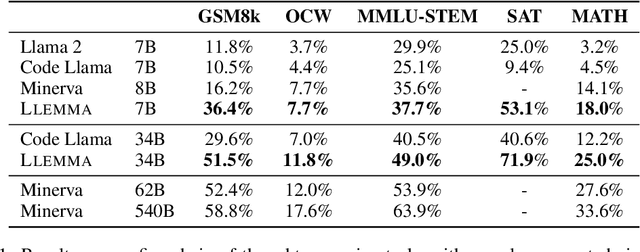
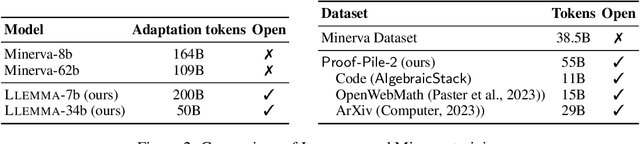
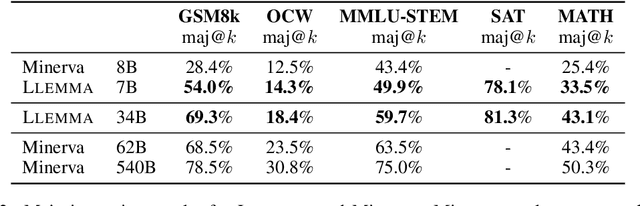
We present Llemma, a large language model for mathematics. We continue pretraining Code Llama on the Proof-Pile-2, a mixture of scientific papers, web data containing mathematics, and mathematical code, yielding Llemma. On the MATH benchmark Llemma outperforms all known open base models, as well as the unreleased Minerva model suite on an equi-parameter basis. Moreover, Llemma is capable of tool use and formal theorem proving without any further finetuning. We openly release all artifacts, including 7 billion and 34 billion parameter models, the Proof-Pile-2, and code to replicate our experiments.
Stay on topic with Classifier-Free Guidance
Jun 30, 2023


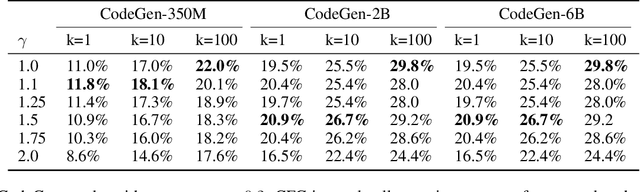
Classifier-Free Guidance (CFG) has recently emerged in text-to-image generation as a lightweight technique to encourage prompt-adherence in generations. In this work, we demonstrate that CFG can be used broadly as an inference-time technique in pure language modeling. We show that CFG (1) improves the performance of Pythia, GPT-2 and LLaMA-family models across an array of tasks: Q\&A, reasoning, code generation, and machine translation, achieving SOTA on LAMBADA with LLaMA-7B over PaLM-540B; (2) brings improvements equivalent to a model with twice the parameter-count; (3) can stack alongside other inference-time methods like Chain-of-Thought and Self-Consistency, yielding further improvements in difficult tasks; (4) can be used to increase the faithfulness and coherence of assistants in challenging form-driven and content-driven prompts: in a human evaluation we show a 75\% preference for GPT4All using CFG over baseline.
LEACE: Perfect linear concept erasure in closed form
Jun 23, 2023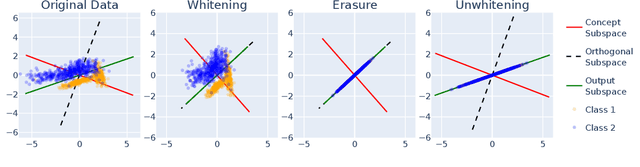
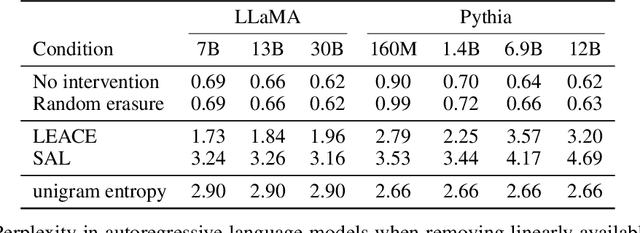
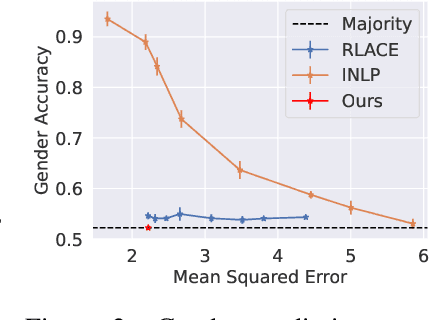
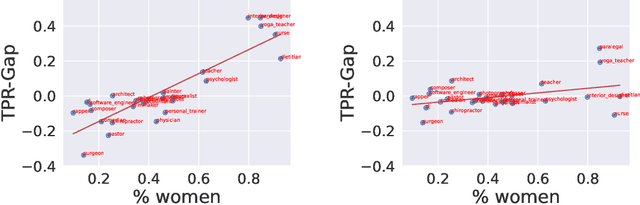
Concept erasure aims to remove specified features from a representation. It can improve fairness (e.g. preventing a classifier from using gender or race) and interpretability (e.g. removing a concept to observe changes in model behavior). We introduce LEAst-squares Concept Erasure (LEACE), a closed-form method which provably prevents all linear classifiers from detecting a concept while changing the representation as little as possible, as measured by a broad class of norms. We apply LEACE to large language models with a novel procedure called "concept scrubbing," which erases target concept information from every layer in the network. We demonstrate our method on two tasks: measuring the reliance of language models on part-of-speech information, and reducing gender bias in BERT embeddings. Code is available at https://github.com/EleutherAI/concept-erasure.
GAIA Search: Hugging Face and Pyserini Interoperability for NLP Training Data Exploration
Jun 02, 2023Noticing the urgent need to provide tools for fast and user-friendly qualitative analysis of large-scale textual corpora of the modern NLP, we propose to turn to the mature and well-tested methods from the domain of Information Retrieval (IR) - a research field with a long history of tackling TB-scale document collections. We discuss how Pyserini - a widely used toolkit for reproducible IR research can be integrated with the Hugging Face ecosystem of open-source AI libraries and artifacts. We leverage the existing functionalities of both platforms while proposing novel features further facilitating their integration. Our goal is to give NLP researchers tools that will allow them to develop retrieval-based instrumentation for their data analytics needs with ease and agility. We include a Jupyter Notebook-based walk through the core interoperability features, available on GitHub at https://github.com/huggingface/gaia. We then demonstrate how the ideas we present can be operationalized to create a powerful tool for qualitative data analysis in NLP. We present GAIA Search - a search engine built following previously laid out principles, giving access to four popular large-scale text collections. GAIA serves a dual purpose of illustrating the potential of methodologies we discuss but also as a standalone qualitative analysis tool that can be leveraged by NLP researchers aiming to understand datasets prior to using them in training. GAIA is hosted live on Hugging Face Spaces - https://huggingface.co/spaces/spacerini/gaia.
Recasting Self-Attention with Holographic Reduced Representations
May 31, 2023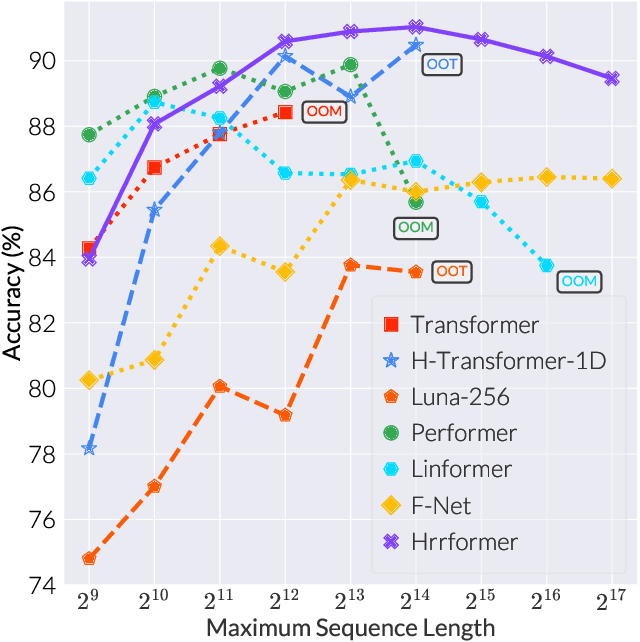
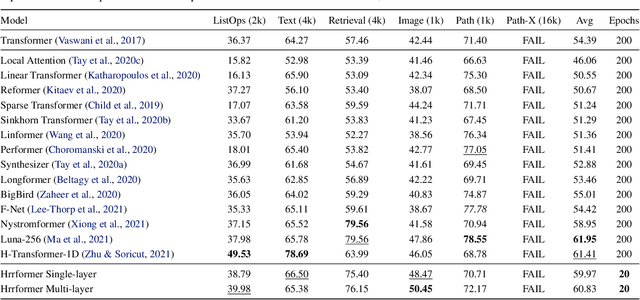
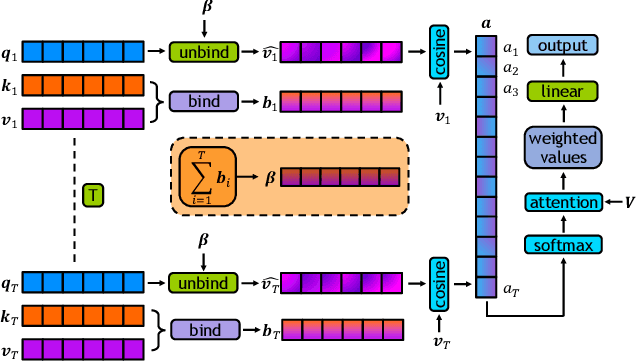
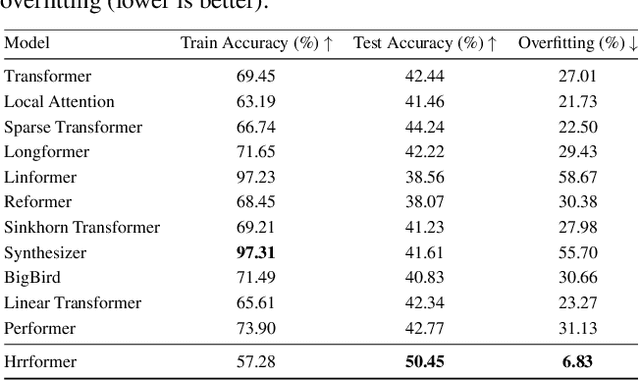
In recent years, self-attention has become the dominant paradigm for sequence modeling in a variety of domains. However, in domains with very long sequence lengths the $\mathcal{O}(T^2)$ memory and $\mathcal{O}(T^2 H)$ compute costs can make using transformers infeasible. Motivated by problems in malware detection, where sequence lengths of $T \geq 100,000$ are a roadblock to deep learning, we re-cast self-attention using the neuro-symbolic approach of Holographic Reduced Representations (HRR). In doing so we perform the same high-level strategy of the standard self-attention: a set of queries matching against a set of keys, and returning a weighted response of the values for each key. Implemented as a ``Hrrformer'' we obtain several benefits including $\mathcal{O}(T H \log H)$ time complexity, $\mathcal{O}(T H)$ space complexity, and convergence in $10\times$ fewer epochs. Nevertheless, the Hrrformer achieves near state-of-the-art accuracy on LRA benchmarks and we are able to learn with just a single layer. Combined, these benefits make our Hrrformer the first viable Transformer for such long malware classification sequences and up to $280\times$ faster to train on the Long Range Arena benchmark. Code is available at \url{https://github.com/NeuromorphicComputationResearchProgram/Hrrformer}
Can Transformers Learn to Solve Problems Recursively?
May 24, 2023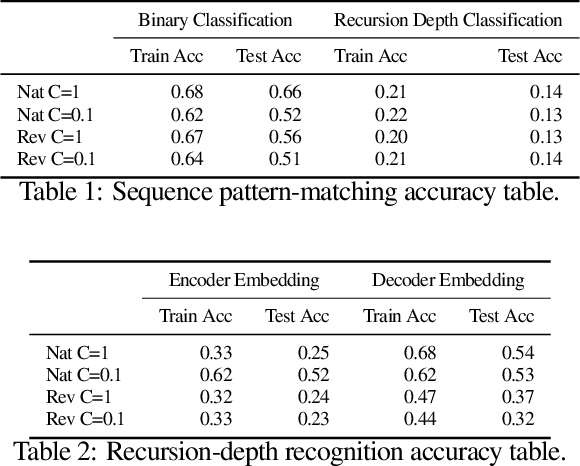
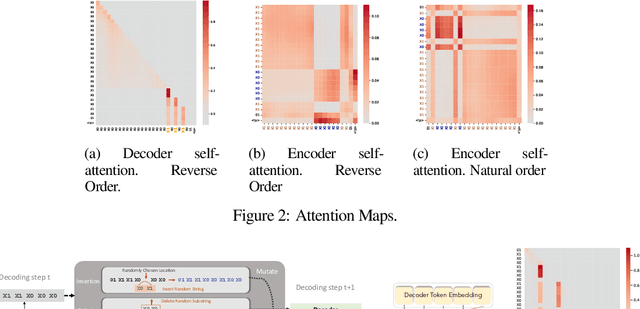
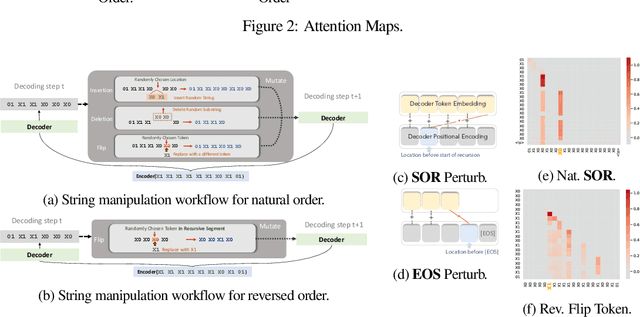
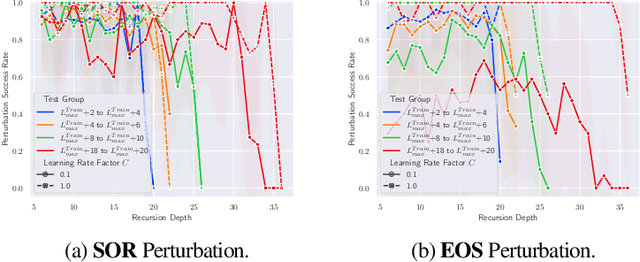
Neural networks have in recent years shown promise for helping software engineers write programs and even formally verify them. While semantic information plays a crucial part in these processes, it remains unclear to what degree popular neural architectures like transformers are capable of modeling that information. This paper examines the behavior of neural networks learning algorithms relevant to programs and formal verification proofs through the lens of mechanistic interpretability, focusing in particular on structural recursion. Structural recursion is at the heart of tasks on which symbolic tools currently outperform neural models, like inferring semantic relations between datatypes and emulating program behavior. We evaluate the ability of transformer models to learn to emulate the behavior of structurally recursive functions from input-output examples. Our evaluation includes empirical and conceptual analyses of the limitations and capabilities of transformer models in approximating these functions, as well as reconstructions of the ``shortcut" algorithms the model learns. By reconstructing these algorithms, we are able to correctly predict 91 percent of failure cases for one of the approximated functions. Our work provides a new foundation for understanding the behavior of neural networks that fail to solve the very tasks they are trained for.