 Add to Chrome
 Add to Firefox
 Add to Edge
SADGE: Structure and Appearance Domain Gap Estimation of Synthetic and Real Data
May 21, 2026
We propose SADGE, a quantitative similarity metric that predicts the performance of synthetic image datasets for common computer vision tasks without downstream model training. Estimating whether a synthetic dataset will lead to a model that performs well on real-world data remains a bottleneck in model development. Existing evaluation metrics (e.g., PSNR, FID, CLIP) primarily measure semantic alignment between real and synthetic images (Appearance Similarity Score). Less commonly, structural similarity between images is considered to assess the domain gap (Geometric Similarity Score). However, to the best of our knowledge there exists no studies that evaluate which similarity metric is the best downstream predictor for a given synthetic dataset. In this paper, we show over a wide variety of different synthetic datasets and downstream tasks that neither appearance nor geometry alone can reliably predict downstream performance; rather, it is their non-linear interplay that dictates synthetic data utility. Specifically, we measure how commonly used Appearance and Geometric Similarity metrics computed between synthetic and real images correlate with downstream performance in object detection, semantic segmentation, and pose estimation. Across five public synthetic-to-real benchmark families and 15 dataset-level variants (79k image pairs), SADGE achieves the strongest association with downstream transfer performance under both linear and rank-based criteria, reaching Pearson r=0.88 and Spearman rho=0.77. We compute for each combination of geometry-based methods and appearance-based approaches SADGE scores across all benchmark families. The best configuration is obtained by fusing DINOv3 appearance similarity with MASt3R geometric consistency through a constrained bilinear interaction, outperforming both the strongest geometry-only baseline and the strongest appearance-only baseline .

MaSC: A Masked Similarity Metric for Evaluating Concept-Driven Generation
May 21, 2026Evaluating single-concept personalization in text-to-image diffusion requires measuring both concept preservation, which captures identity fidelity to a reference, and prompt following, which captures whether the generated scene matches the prompt. Existing metrics commonly compute these signals using global image or text-image embeddings, such as CLIP-I, DINO, and CLIP-T. We show that such metrics correlate poorly with human perception because they attend to the image as a whole instead of separating the concept subject from the background. We introduce MaSC, a masked similarity metric that uses externally provided foreground concept masks to decompose evaluation into subject-specific concept preservation and background-based prompt following. MaSC computes both scores from frozen SigLIP2 SO400M-NaFlex features: concept preservation is measured by masked max-cosine matching between foreground reference patches and generated-image patches, while prompt following is measured by comparing a background-only pooled image embedding to a subject-stripped prompt embedding. On DreamBench++ human ratings, MaSC achieves Krippendorff alpha = 0.471 for concept preservation, outperforming all tested non-LLM baselines and GPT-4V, and approaching GPT-4o. On ORIDa, a real-photo identity-preservation benchmark across physical environments, MaSC achieves AUC = 0.992, nearly perfectly distinguishing same-subject from cross-subject pairs. Its prompt-following score also outperforms the CLIP-T baseline shipped with DreamBench++. These results show that spatially decomposed aggregation is a strong design principle for evaluating concept-driven generation.
3DMiner: Discovering Shapes from Large-Scale Unannotated Image Datasets
Oct 29, 2023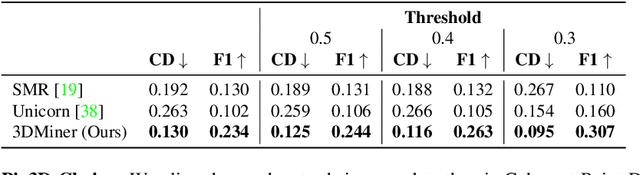
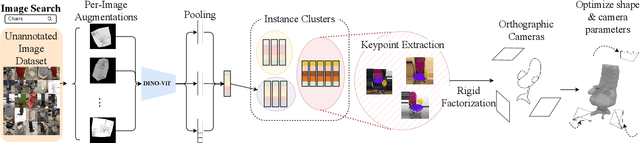

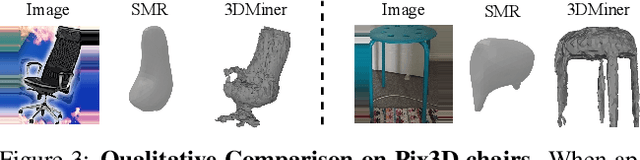
We present 3DMiner -- a pipeline for mining 3D shapes from challenging large-scale unannotated image datasets. Unlike other unsupervised 3D reconstruction methods, we assume that, within a large-enough dataset, there must exist images of objects with similar shapes but varying backgrounds, textures, and viewpoints. Our approach leverages the recent advances in learning self-supervised image representations to cluster images with geometrically similar shapes and find common image correspondences between them. We then exploit these correspondences to obtain rough camera estimates as initialization for bundle-adjustment. Finally, for every image cluster, we apply a progressive bundle-adjusting reconstruction method to learn a neural occupancy field representing the underlying shape. We show that this procedure is robust to several types of errors introduced in previous steps (e.g., wrong camera poses, images containing dissimilar shapes, etc.), allowing us to obtain shape and pose annotations for images in-the-wild. When using images from Pix3D chairs, our method is capable of producing significantly better results than state-of-the-art unsupervised 3D reconstruction techniques, both quantitatively and qualitatively. Furthermore, we show how 3DMiner can be applied to in-the-wild data by reconstructing shapes present in images from the LAION-5B dataset. Project Page: https://ttchengab.github.io/3dminerOfficial
GRIP: Generating Interaction Poses Using Latent Consistency and Spatial Cues
Aug 22, 2023Hands are dexterous and highly versatile manipulators that are central to how humans interact with objects and their environment. Consequently, modeling realistic hand-object interactions, including the subtle motion of individual fingers, is critical for applications in computer graphics, computer vision, and mixed reality. Prior work on capturing and modeling humans interacting with objects in 3D focuses on the body and object motion, often ignoring hand pose. In contrast, we introduce GRIP, a learning-based method that takes, as input, the 3D motion of the body and the object, and synthesizes realistic motion for both hands before, during, and after object interaction. As a preliminary step before synthesizing the hand motion, we first use a network, ANet, to denoise the arm motion. Then, we leverage the spatio-temporal relationship between the body and the object to extract two types of novel temporal interaction cues, and use them in a two-stage inference pipeline to generate the hand motion. In the first stage, we introduce a new approach to enforce motion temporal consistency in the latent space (LTC), and generate consistent interaction motions. In the second stage, GRIP generates refined hand poses to avoid hand-object penetrations. Given sequences of noisy body and object motion, GRIP upgrades them to include hand-object interaction. Quantitative experiments and perceptual studies demonstrate that GRIP outperforms baseline methods and generalizes to unseen objects and motions from different motion-capture datasets.