 Add to Chrome
 Add to Firefox
 Add to Edge
WearWow: Native 2K Multi-Garment Virtual Try-On via Adaptive Token Packing and Preference Alignment
Jul 22, 2026
Synthesizing native 2K multi-garment virtual try-on is a formidable frontier in digital fashion, critically bottlenecked by two fundamental limitations: the O(N^2) memory explosion induced by 2k conditions, and the spectral bias of diffusion models that over-smooths high-frequency fabric details. We present WearWow, an end-to-end, mask-free generative framework that pioneers ultra-high-resolution multi-garment synthesis. To mitigate the memory explosion , we propose Adaptive 2D Token Packing (ATP). ATP leverages inherent garment sparsity to algorithmically pack heterogeneous items onto a unified 2D canvas and prune uninformative background tokens, minimizing the effective sequence length and subsequent memory overhead while rigorously preserving 2D spatial priors. To rectify texture degradation, we introduce the Multi-dimensional Try-on Reward (MTR) system. MTR synergizes a Semantic Guidance Reward to explicitly drive tactile restoration with a Cloth Distribution Reward to implicitly anchor the physical distribution, a joint formulation that effectively mitigates the severe reward hacking. Furthermore, we curate WearWow-2K, an extreme-quality dataset comprising native 2K triplets, providing physically correct spatial interactions that naturally empower the model's mask-free generation. Extensive experiments demonstrate that WearWow establishes a new state-of-the-art, exceeding existing commercial baselines in native 2K multi-garment synthesis.

Light Field Raindrop Removal via 4D Re-sampling
May 26, 2022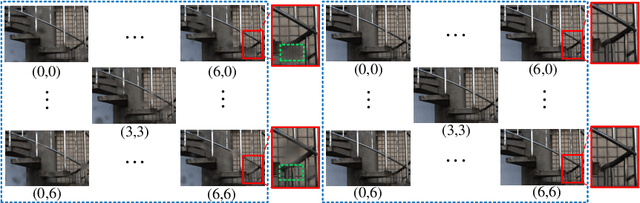

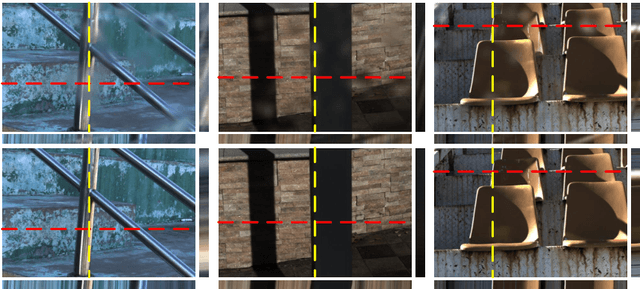
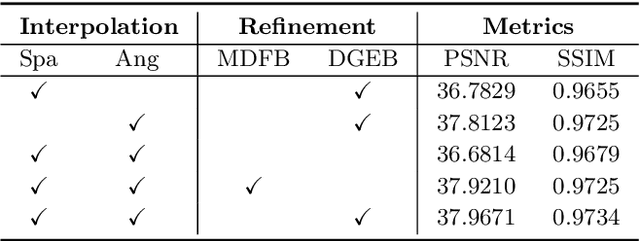
The Light Field Raindrop Removal (LFRR) aims to restore the background areas obscured by raindrops in the Light Field (LF). Compared with single image, the LF provides more abundant information by regularly and densely sampling the scene. Since raindrops have larger disparities than the background in the LF, the majority of texture details occluded by raindrops are visible in other views. In this paper, we propose a novel LFRR network by directly utilizing the complementary pixel information of raindrop-free areas in the input raindrop LF, which consists of the re-sampling module and the refinement module. Specifically, the re-sampling module generates a new LF which is less polluted by raindrops through re-sampling position predictions and the proposed 4D interpolation. The refinement module improves the restoration of the completely occluded background areas and corrects the pixel error caused by 4D interpolation. Furthermore, we carefully build the first real scene LFRR dataset for model training and validation. Experiments demonstrate that the proposed method can effectively remove raindrops and achieves state-of-the-art performance in both background restoration and view consistency maintenance.
Multi-Dimension Fusion Network for Light Field Spatial Super-Resolution using Dynamic Filters
Aug 26, 2020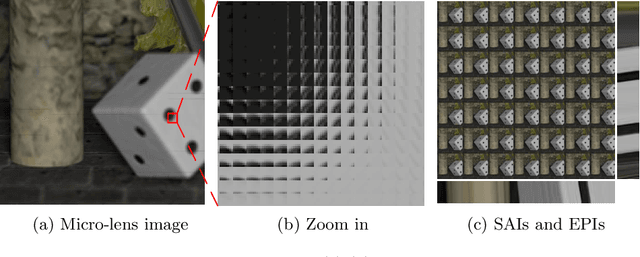

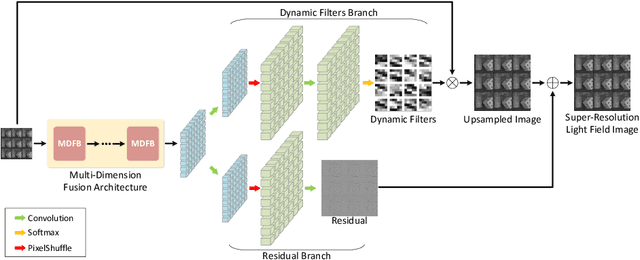

Light field cameras have been proved to be powerful tools for 3D reconstruction and virtual reality applications. However, the limited resolution of light field images brings a lot of difficulties for further information display and extraction. In this paper, we introduce a novel learning-based framework to improve the spatial resolution of light fields. First, features from different dimensions are parallelly extracted and fused together in our multi-dimension fusion architecture. These features are then used to generate dynamic filters, which extract subpixel information from micro-lens images and also implicitly consider the disparity information. Finally, more high-frequency details learned in the residual branch are added to the upsampled images and the final super-resolved light fields are obtained. Experimental results show that the proposed method uses fewer parameters but achieves better performances than other state-of-the-art methods in various kinds of datasets. Our reconstructed images also show sharp details and distinct lines in both sub-aperture images and epipolar plane images.