 Add to Chrome
 Add to Firefox
 Add to Edge
Do Coding Agents Deceive Us? Detecting and Preventing Cheating via Capped Evaluation with Randomized Tests
Jun 05, 2026
A growing failure mode in agent evaluation and training is that models can achieve high evaluation scores by exploiting shortcuts instead of solving the intended task, producing deceptive performance. This makes evaluation scores unreliable as measures of true task-solving ability. We propose CapCode, a framework for constructing coding datasets with randomized tests whose best achievable non-cheating performance is deliberately capped below one. This capped-performance design gives evaluation scores a clearer interpretation: scores substantially above the cap are implausible and therefore provide evidence of cheating. To prevent cheating, we propose CapReward, a reward design based on the CapCode principle to discourage optimization beyond the cap. Experiments across multiple datasets show that CapCode detects cheating while preserving performance ranking of models, and CapReward reduces cheating behavior, yielding models that better follow the intended task specification.

Retry Policy Gradients in Continuous Action Spaces
Jun 04, 2026Retry-based objectives such as pass@K and max@K optimize the best return obtained from multiple sampled trajectories, and recent work has shown that they can promote exploration without explicit exploration bonuses. In discrete action spaces, ReMax was shown to do so by adapting to return uncertainty. In this work, we introduce pathwise derivative estimators for retry objectives and use them to extend ReMax to continuous action spaces. We study the resulting learning dynamics and show that, even with deterministic rewards, ReMax can encourage stochastic exploration by reshaping the policy-gradient landscape. In particular, it alters gradients both in direction, biasing updates toward higher policy entropy, and in magnitude, damping gradients and slowing convergence. We further show that Adam's adaptive normalization can mitigate this damping, depending on its numerical stabilization parameter. Empirically, we instantiate this objective as ReMax Actor-Critic (ReMAC), an off-policy actor--critic algorithm that optimizes the ReMax objective using a pathwise derivative estimator. Our experiments show that ReMAC can promote higher policy entropy without entropy regularization and achieves performance comparable to SAC.
OrderGrad: Optimizing Beyond the Mean with Order-Statistic Policy Gradient Estimation
Jun 04, 2026Policy-gradient methods usually optimize expected return, but many real world applications care about distributional properties of returns: tail risk, outlier robustness, or best-of-K discovery. We introduce OrderGrad, a family of likelihood-ratio and reparameterization gradient estimators for order-statistic objectives. OrderGrad optimizes finite-sample L-statistics, i.e., weighted averages of sorted rewards or costs, recovering objectives such as VaR, CVaR, trimmed means, medians, and top-m/best-of-K criteria by changing only the rank weights. For any fixed sample size and rank-weight vector, OrderGrad provides an unbiased gradient estimator for the corresponding order-statistic objective. The method is implemented as a simple reward transformation that can then be used in an otherwise standard policy-gradient or reparameterized update. We study the resulting estimator's variance behavior and evaluate it on tasks where mean optimization is mismatched to the deployment objective, including LLM math post-training and other tasks. OrderGrad provides a unified, plug-and-play route to risk-averse, robust, and exploratory learning. Code: https://github.com/paavo5/ordergrad
On Advantage Estimates for Max@K Policy Gradients
Jun 04, 2026Reinforcement learning with verifiable rewards is widely used for post-training reasoning models, but sparse outcome rewards make exploration difficult. A complementary approach is to optimize inference-time objectives such as pass@K and max@K directly, yet existing policy-gradient estimators for these objectives use different signals, baselines, and normalizations, making their relationships unclear. We study this issue through baseline design and advantage centering. Starting from the advantage estimator of a leading method in the field, we show that it is policy-gradient unbiased but yields a non-centered advantage. We then introduce a Leave-Two-Out baseline that preserves policy-gradient unbiasedness while making realized batch advantages exactly centered. The resulting method, MaxPO, has an efficient quadratic-time implementation and integrates naturally into group-based RL for LLM post-training. We further derive the canonical finite-batch advantage for max@K, providing a unified view of existing advantage estimators. Empirically, we verify that the L2O baseline reduces gradient variance and outperforms non-centered alternatives.
Emergence of Exploration in Policy Gradient Reinforcement Learning via Retrying
May 29, 2026In reinforcement learning (RL), agents benefit from exploration only because they repeatedly encounter similar states: trying different actions can improve performance or reduce uncertainty; without such retries, a greedy policy is optimal. We formalize this intuition with ReMax, an objective that evaluates a policy by the expected maximum return over $M$ samples, where $M$ is a positive integer, while accounting for return uncertainty. Optimizing this objective induces stochastic exploration as an emergent property, without explicit bonus terms. For efficient policy optimization, we derive a new policy-gradient formulation for ReMax and introduce ReMax PPO (RePPO), a PPO variant that optimizes ReMax while generalizing the discrete retry count $M$ to a continuous parameter $m > 0$, enabling fine-grained control of exploration. Empirically, RePPO promotes exploration, without any explicit exploration bonuses, on the MinAtar and Craftax benchmarks.
Finite-Time Regret Analysis of Retry-Aware Bandits
May 20, 2026We study a stochastic bandit algorithm motivated by retry-aware objectives that value the best outcome among multiple attempts, such as pass@$k$ and max@$k$. Given a posterior over arm values, ReMax chooses a sampling distribution that maximizes the posterior expected maximum reward over $M$ virtual draws. Although this objective was introduced in reinforcement learning as an exploration mechanism under uncertainty, its regret properties in bandit problems have remained unclear. For Gaussian rewards and the first nontrivial case $M=2$, we characterize the optimal ReMax distribution through an expected-improvement balance condition and prove the first sublinear regret bound for ReMax. Our analysis separates the usual saturation behavior of suboptimal arms from a ReMax-specific underestimation effect, in which the optimal arm may be sampled too rarely after an unfavorable estimate. This explains why ReMax can be more exploitative than Thompson sampling (TS) and why its regret analysis is technically delicate. Experiments support this picture: ReMax often outperforms KL-UCB and Thompson sampling under mild underestimation, while posterior-variance scaling empirically mitigates severe underestimation.
Mahjax: A GPU-Accelerated Mahjong Simulator for Reinforcement Learning in JAX
May 20, 2026Riichi Mahjong is a multi-player, imperfect-information game characterized by stochasticity and high-dimensional state spaces. These attributes present a unique combination of challenges that mirror complex real-world decision-making problems in reinforcement learning. While prior research has heavily relied on supervised learning from human play logs to pre-train the policy, algorithms capable of learning \textit{tabula rasa} (from scratch) offer greater potential for general applicability, as evidenced by the AlphaZero lineage. To facilitate such research, we introduce \textbf{Mahjax}, a fully vectorized Riichi Mahjong environment implemented in JAX to enable large-scale rollout parallelization on Graphics Processing Units (GPUs). We also provide a high-quality visualization tool to streamline debugging and interaction with trained agents. Experimental results demonstrate that Mahjax achieves throughputs of up to \textbf{2 million} and \textbf{1 million steps per second} on eight NVIDIA A100 GPUs under the no-red and red rules, respectively. Furthermore, we validate the environment's utility for reinforcement learning by showing that agents can be trained effectively to improve their rank against baseline policies.
On Symmetric Losses for Robust Policy Optimization with Noisy Preferences
May 30, 2025Optimizing policies based on human preferences is key to aligning language models with human intent. This work focuses on reward modeling, a core component in reinforcement learning from human feedback (RLHF), and offline preference optimization, such as direct preference optimization. Conventional approaches typically assume accurate annotations. However, real-world preference data often contains noise due to human errors or biases. We propose a principled framework for robust policy optimization under noisy preferences, viewing reward modeling as a classification problem. This allows us to leverage symmetric losses, known for their robustness to label noise in classification, leading to our Symmetric Preference Optimization (SymPO) method. We prove that symmetric losses enable successful policy optimization even under noisy labels, as the resulting reward remains rank-preserving -- a property sufficient for policy improvement. Experiments on synthetic and real-world tasks demonstrate the effectiveness of SymPO.
A Batch Sequential Halving Algorithm without Performance Degradation
Jun 01, 2024In this paper, we investigate the problem of pure exploration in the context of multi-armed bandits, with a specific focus on scenarios where arms are pulled in fixed-size batches. Batching has been shown to enhance computational efficiency, but it can potentially lead to a degradation compared to the original sequential algorithm's performance due to delayed feedback and reduced adaptability. We introduce a simple batch version of the Sequential Halving (SH) algorithm (Karnin et al., 2013) and provide theoretical evidence that batching does not degrade the performance of the original algorithm under practical conditions. Furthermore, we empirically validate our claim through experiments, demonstrating the robust nature of the SH algorithm in fixed-size batch settings.
Leveraging Domain-Unlabeled Data in Offline Reinforcement Learning across Two Domains
Apr 11, 2024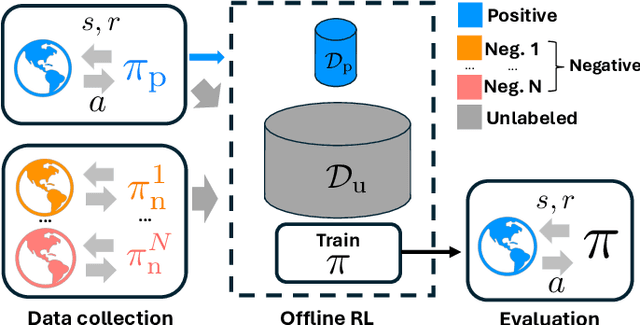
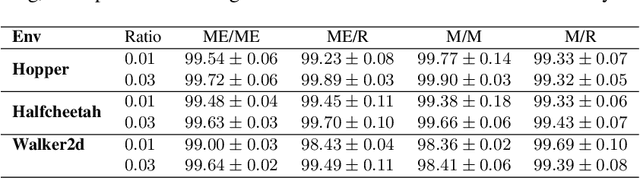
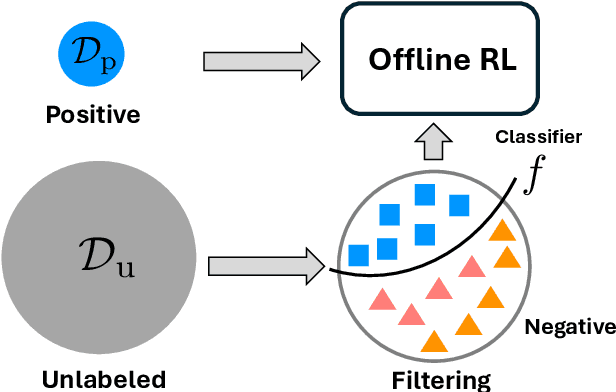
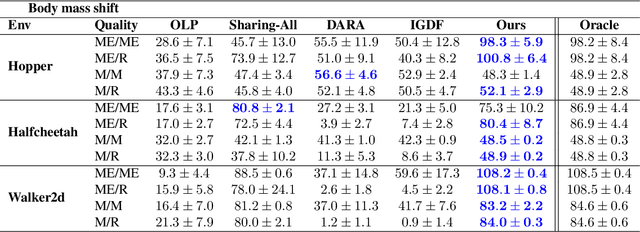
In this paper, we investigate an offline reinforcement learning (RL) problem where datasets are collected from two domains. In this scenario, having datasets with domain labels facilitates efficient policy training. However, in practice, the task of assigning domain labels can be resource-intensive or infeasible at a large scale, leading to a prevalence of domain-unlabeled data. To formalize this challenge, we introduce a novel offline RL problem setting named Positive-Unlabeled Offline RL (PUORL), which incorporates domain-unlabeled data. To address PUORL, we develop an offline RL algorithm utilizing positive-unlabeled learning to predict the domain labels of domain-unlabeled data, enabling the integration of this data into policy training. Our experiments show the effectiveness of our method in accurately identifying domains and learning policies that outperform baselines in the PUORL setting, highlighting its capability to leverage domain-unlabeled data effectively.