 Add to Chrome
 Add to Firefox
 Add to Edge
Bridging Spherical Black-Box Optimizers
Jun 24, 2026
When gradient information is unavailable, black-box optimization (BBO) methods provide a practical alternative. While Evolution Strategies (ES), Consensus-Based Optimization (CBO), Optimization via Integration (OVI), and related methods have each been studied independently, their connections remain underexplored. We unify these approaches within a common theoretical framework, revealing that they differ primarily in two design choices: fitness aggregation (controlling sharpness preference) and consensus scope (controlling modality). Leveraging these insights, we introduce hybrid optimizers that interpolate between existing methods. Our ES-OVI hybrid allows explicit control over the preference for flat minima, enabling a trade-off between performance and robustness in continuous control tasks. Our CBO-OVI hybrids combine the higher-dimensional efficiency of parametric methods with the multimodal capabilities of particle-based approaches, achieving competitive results on language model merging under limited evaluation budgets. We validate our methods on standard BBO benchmarks and higher-dimensional locomotion tasks, demonstrating that the hybrid methods can outperform their constituent algorithms.

Do Coding Agents Deceive Us? Detecting and Preventing Cheating via Capped Evaluation with Randomized Tests
Jun 05, 2026A growing failure mode in agent evaluation and training is that models can achieve high evaluation scores by exploiting shortcuts instead of solving the intended task, producing deceptive performance. This makes evaluation scores unreliable as measures of true task-solving ability. We propose CapCode, a framework for constructing coding datasets with randomized tests whose best achievable non-cheating performance is deliberately capped below one. This capped-performance design gives evaluation scores a clearer interpretation: scores substantially above the cap are implausible and therefore provide evidence of cheating. To prevent cheating, we propose CapReward, a reward design based on the CapCode principle to discourage optimization beyond the cap. Experiments across multiple datasets show that CapCode detects cheating while preserving performance ranking of models, and CapReward reduces cheating behavior, yielding models that better follow the intended task specification.
Offline Reinforcement Learning from Datasets with Structured Non-Stationarity
May 23, 2024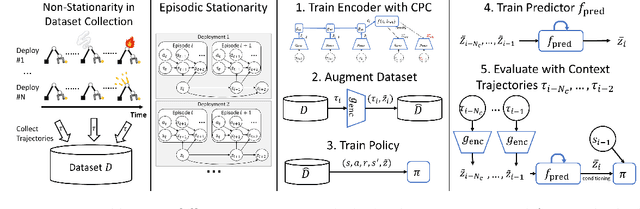


Current Reinforcement Learning (RL) is often limited by the large amount of data needed to learn a successful policy. Offline RL aims to solve this issue by using transitions collected by a different behavior policy. We address a novel Offline RL problem setting in which, while collecting the dataset, the transition and reward functions gradually change between episodes but stay constant within each episode. We propose a method based on Contrastive Predictive Coding that identifies this non-stationarity in the offline dataset, accounts for it when training a policy, and predicts it during evaluation. We analyze our proposed method and show that it performs well in simple continuous control tasks and challenging, high-dimensional locomotion tasks. We show that our method often achieves the oracle performance and performs better than baselines.
Leveraging Domain-Unlabeled Data in Offline Reinforcement Learning across Two Domains
Apr 11, 2024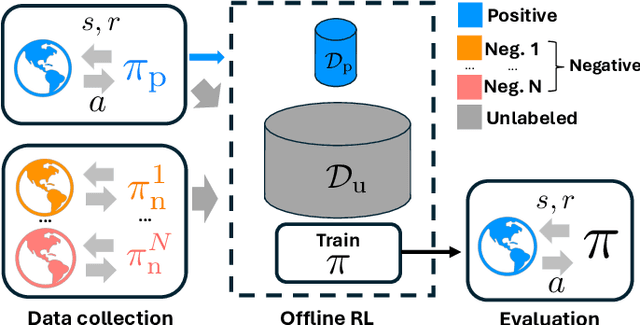
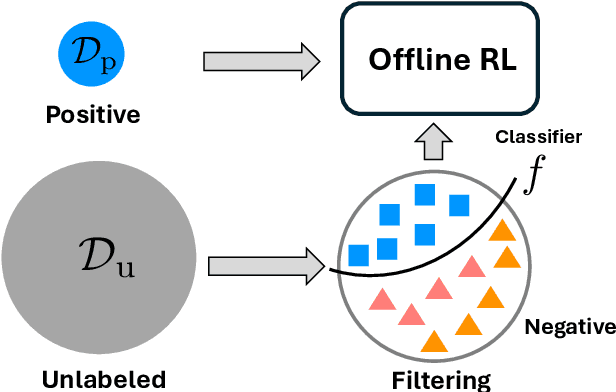
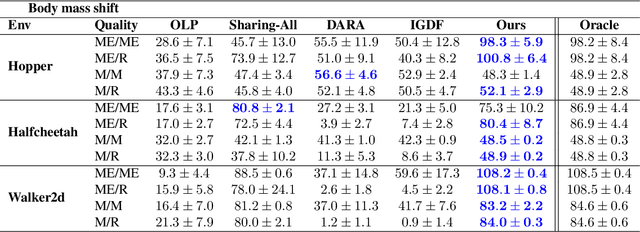
In this paper, we investigate an offline reinforcement learning (RL) problem where datasets are collected from two domains. In this scenario, having datasets with domain labels facilitates efficient policy training. However, in practice, the task of assigning domain labels can be resource-intensive or infeasible at a large scale, leading to a prevalence of domain-unlabeled data. To formalize this challenge, we introduce a novel offline RL problem setting named Positive-Unlabeled Offline RL (PUORL), which incorporates domain-unlabeled data. To address PUORL, we develop an offline RL algorithm utilizing positive-unlabeled learning to predict the domain labels of domain-unlabeled data, enabling the integration of this data into policy training. Our experiments show the effectiveness of our method in accurately identifying domains and learning policies that outperform baselines in the PUORL setting, highlighting its capability to leverage domain-unlabeled data effectively.
High-Resolution Image Editing via Multi-Stage Blended Diffusion
Oct 24, 2022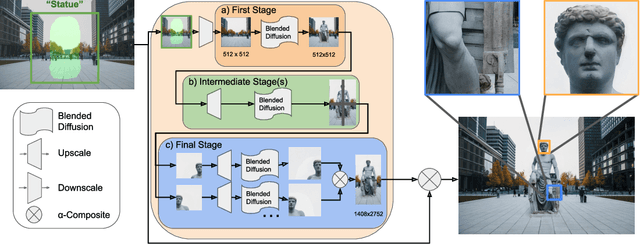
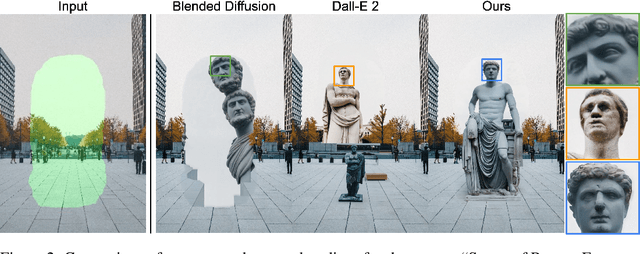
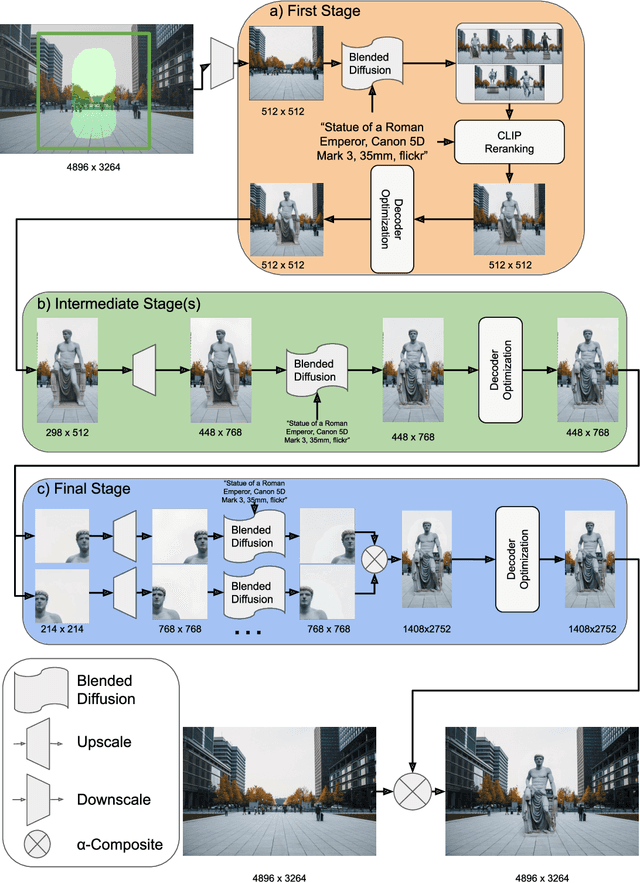

Diffusion models have shown great results in image generation and in image editing. However, current approaches are limited to low resolutions due to the computational cost of training diffusion models for high-resolution generation. We propose an approach that uses a pre-trained low-resolution diffusion model to edit images in the megapixel range. We first use Blended Diffusion to edit the image at a low resolution, and then upscale it in multiple stages, using a super-resolution model and Blended Diffusion. Using our approach, we achieve higher visual fidelity than by only applying off the shelf super-resolution methods to the output of the diffusion model. We also obtain better global consistency than directly using the diffusion model at a higher resolution.
Reducing Overestimation Bias in Multi-Agent Domains Using Double Centralized Critics
Oct 03, 2019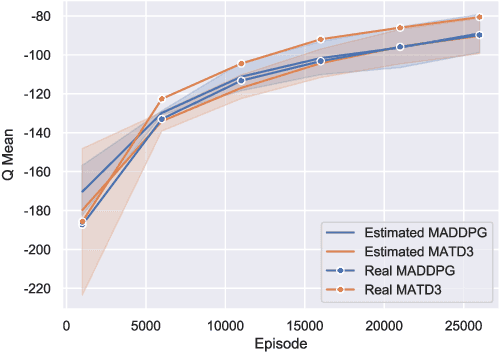
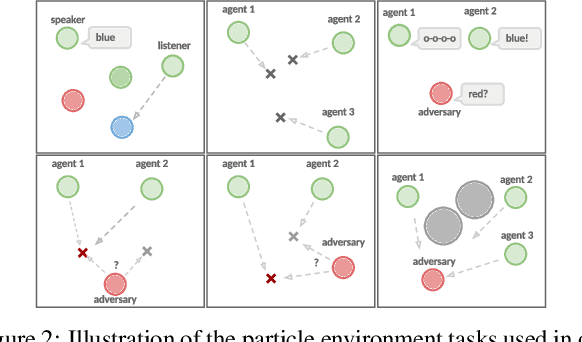
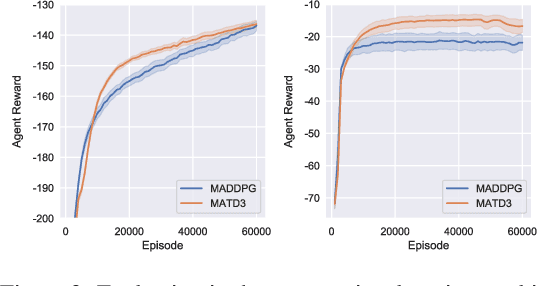
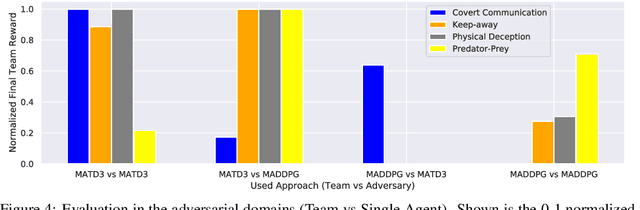
Many real world tasks require multiple agents to work together. Multi-agent reinforcement learning (RL) methods have been proposed in recent years to solve these tasks, but current methods often fail to efficiently learn policies. We thus investigate the presence of a common weakness in single-agent RL, namely value function overestimation bias, in the multi-agent setting. Based on our findings, we propose an approach that reduces this bias by using double centralized critics. We evaluate it on six mixed cooperative-competitive tasks, showing a significant advantage over current methods. Finally, we investigate the application of multi-agent methods to high-dimensional robotic tasks and show that our approach can be used to learn decentralized policies in this domain.