 Add to Chrome
 Add to Firefox
 Add to Edge
StructureClaw: Traceable LLM Agents and an Executable Benchmark for Structural Engineering Workflows
Jul 16, 2026
Addressing a structural-engineering request requires more than a single answer; it requires a chain of interdependent artifacts: interpreted requirements, a computable model, validation records, solver outputs, code-check records, and a final report. Evaluations centered on question answering or script generation rarely verify this complete evidence chain and may therefore reward fluent outputs even when the underlying engineering workflow is incomplete, internally inconsistent, or non-executable. To address this limitation, we present StructureClaw, an artifact-centered workbench in which LLM agents operate through governed engineering skills, typed tools, shared artifact state, and local analysis backends. We also introduce StructureClaw-Bench, an executable benchmark of 150 controlled scenarios spanning standard workflow execution, interactive robustness, and multimodal structural-model reconstruction. A scenario succeeds only when all required artifact- and execution-level assertions pass in a single run. Across ten agent-model configurations, each evaluated on the same 50 standard cases, the average Success Rate rises from 56.8% with the generic-skill baseline to 88.6% with the full automatic workflow. The interactive and multimodal evaluations identify two prominent remaining challenges: safe handling of invalid numerical inputs and fixture-consistent reconstruction of structural models. These findings show that artifact-centered evaluation can expose workflow-level failures that are difficult to identify from final responses alone, providing a more rigorous basis for evaluating and improving structural-engineering agents. The code and benchmark are available at https://github.com/structureclaw/structureclaw.

AutoCut: End-to-end advertisement video editing based on multimodal discretization and controllable generation
Mar 30, 2026Short-form videos have become a primary medium for digital advertising, requiring scalable and efficient content creation. However, current workflows and AI tools remain disjoint and modality-specific, leading to high production costs and low overall efficiency. To address this issue, we propose AutoCut, an end-to-end advertisement video editing framework based on multimodal discretization and controllable editing. AutoCut employs dedicated encoders to extract video and audio features, then applies residual vector quantization to discretize them into unified tokens aligned with textual representations, constructing a shared video-audio-text token space. Built upon a foundation model, we further develop a multimodal large language model for video editing through combined multimodal alignment and supervised fine-tuning, supporting tasks covering video selection and ordering, script generation, and background music selection within a unified editing framework. Finally, a complete production pipeline converts the predicted token sequences into deployable long video outputs. Experiments on real-world advertisement datasets show that AutoCut reduces production cost and iteration time while substantially improving consistency and controllability, paving the way for scalable video creation.
Tokenization Allows Multimodal Large Language Models to Understand, Generate and Edit Architectural Floor Plans
Mar 12, 2026Architectural floor plan design demands joint reasoning over geometry, semantics, and spatial hierarchy, which remains a major challenge for current AI systems. Although recent diffusion and language models improve visual fidelity, they still struggle with coherent spatial reasoning and controllable generation. We present HouseMind, a multimodal large language model that unifies floor plan understanding, generation, and editing in one framework. We introduce discrete room-instance tokens to construct a unified vocabulary that bridges layouts and symbolic reasoning. With multimodal alignment and instruction tuning, the model synthesizes coherent, controllable layouts from text instructions. Experiments show how the framework achieves superior geometric validity and controllability while remaining efficient and locally deployable.
ChatHouseDiffusion: Prompt-Guided Generation and Editing of Floor Plans
Oct 15, 2024
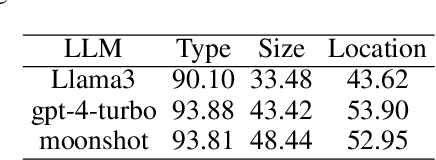
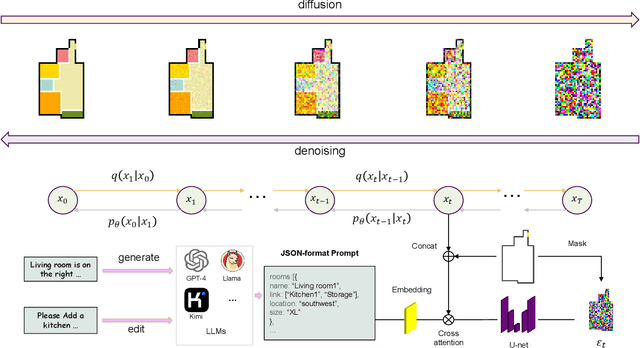

The generation and editing of floor plans are critical in architectural planning, requiring a high degree of flexibility and efficiency. Existing methods demand extensive input information and lack the capability for interactive adaptation to user modifications. This paper introduces ChatHouseDiffusion, which leverages large language models (LLMs) to interpret natural language input, employs graphormer to encode topological relationships, and uses diffusion models to flexibly generate and edit floor plans. This approach allows iterative design adjustments based on user ideas, significantly enhancing design efficiency. Compared to existing models, ChatHouseDiffusion achieves higher Intersection over Union (IoU) scores, permitting precise, localized adjustments without the need for complete redesigns, thus offering greater practicality. Experiments demonstrate that our model not only strictly adheres to user specifications but also facilitates a more intuitive design process through its interactive capabilities.