 Add to Chrome
 Add to Firefox
 Add to Edge
Tokenization Allows Multimodal Large Language Models to Understand, Generate and Edit Architectural Floor Plans
Mar 12, 2026
Architectural floor plan design demands joint reasoning over geometry, semantics, and spatial hierarchy, which remains a major challenge for current AI systems. Although recent diffusion and language models improve visual fidelity, they still struggle with coherent spatial reasoning and controllable generation. We present HouseMind, a multimodal large language model that unifies floor plan understanding, generation, and editing in one framework. We introduce discrete room-instance tokens to construct a unified vocabulary that bridges layouts and symbolic reasoning. With multimodal alignment and instruction tuning, the model synthesizes coherent, controllable layouts from text instructions. Experiments show how the framework achieves superior geometric validity and controllability while remaining efficient and locally deployable.

ChatHouseDiffusion: Prompt-Guided Generation and Editing of Floor Plans
Oct 15, 2024
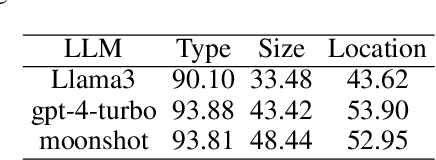
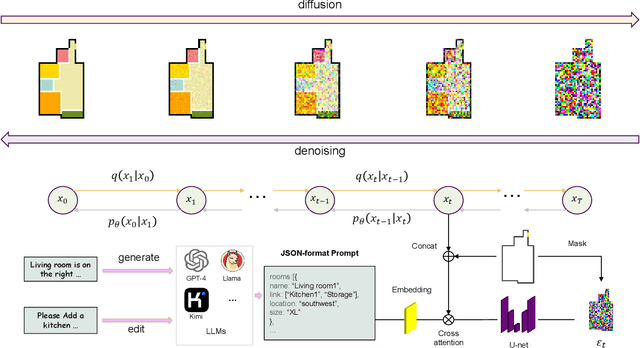

The generation and editing of floor plans are critical in architectural planning, requiring a high degree of flexibility and efficiency. Existing methods demand extensive input information and lack the capability for interactive adaptation to user modifications. This paper introduces ChatHouseDiffusion, which leverages large language models (LLMs) to interpret natural language input, employs graphormer to encode topological relationships, and uses diffusion models to flexibly generate and edit floor plans. This approach allows iterative design adjustments based on user ideas, significantly enhancing design efficiency. Compared to existing models, ChatHouseDiffusion achieves higher Intersection over Union (IoU) scores, permitting precise, localized adjustments without the need for complete redesigns, thus offering greater practicality. Experiments demonstrate that our model not only strictly adheres to user specifications but also facilitates a more intuitive design process through its interactive capabilities.
Iterative self-transfer learning: A general methodology for response time-history prediction based on small dataset
Jun 14, 2023
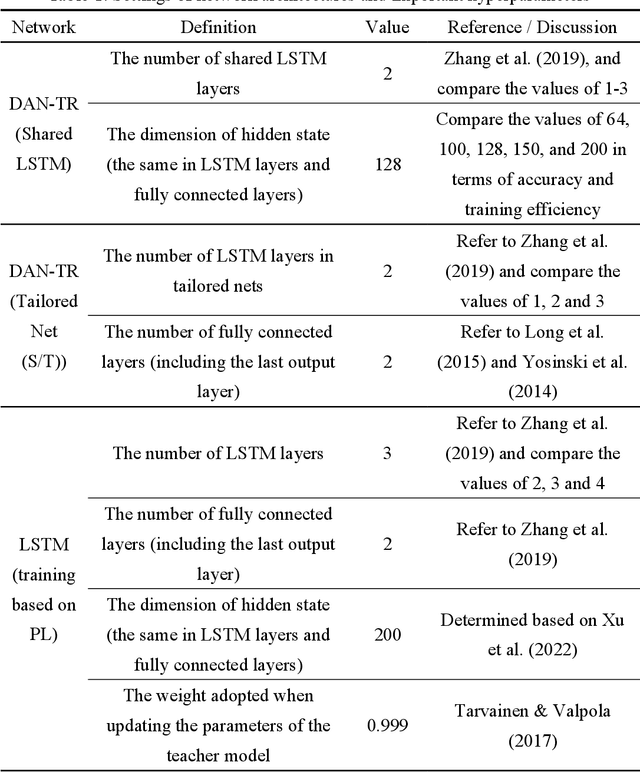

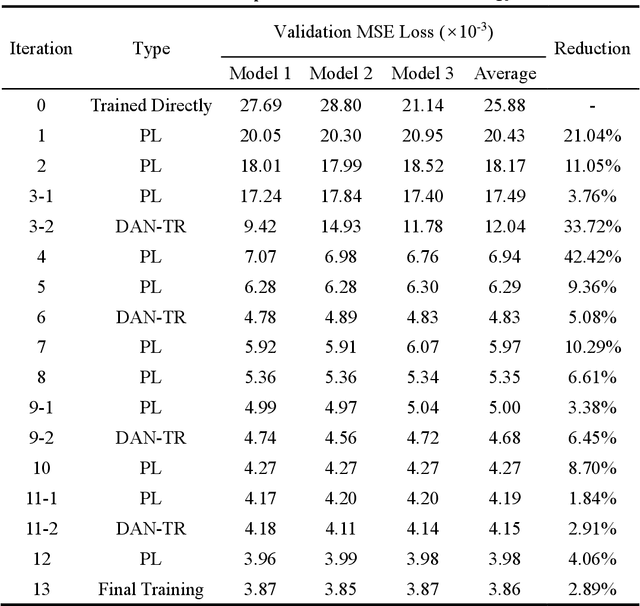
There are numerous advantages of deep neural network surrogate modeling for response time-history prediction. However, due to the high cost of refined numerical simulations and actual experiments, the lack of data has become an unavoidable bottleneck in practical applications. An iterative self-transfer learningmethod for training neural networks based on small datasets is proposed in this study. A new mapping-based transfer learning network, named as deep adaptation network with three branches for regression (DAN-TR), is proposed. A general iterative network training strategy is developed by coupling DAN-TR and the pseudo-label strategy, and the establishment of corresponding datasets is also discussed. Finally, a complex component is selected as a case study. The results show that the proposed method can improve the model performance by near an order of magnitude on small datasets without the need of external labeled samples,well behaved pre-trainedmodels, additional artificial labeling, and complex physical/mathematical analysis.
* 14 pages, 8 figures; Published on Journal of Computational Design and Engineering, 9(5), 2089-2102