 Add to Chrome
 Add to Firefox
 Add to Edge
Boogu-Image-0.1: Boosting Open-Source Unified Multimodal Understanding and Generation
Jul 14, 2026
We introduce Boogu-Image-0.1, an open-source unified multimodal understanding and generation model family, comprising Base, Turbo, Edit, and Edit-Turbo variants. It delivers competitive performance in high-quality text-to-image generation, fast inference, instruction-based editing, and bilingual (Chinese-English) text rendering. Closed-source multimodal systems like Nano-Banana-Pro and GPT-Image-2 achieve strong performance through system-level integration rather than a single model, yet their internal practices remain largely undisclosed. In this work, we demonstrate that targeted improvements in model understanding, data quality, and training pipelines, coupled with agentic inference-time scaling, can substantially enhance generation and editing performance even under highly constrained compute budgets. Comprehensive evaluations show that Boogu-Image-0.1 consistently matches or surpasses other open-source models across standard benchmarks, and achieves results approaching leading closed-source systems. Notably, this is accomplished with only 208.62 million unique images. The base model's theoretical training cost is only approximately \$400K. We share practical discussions that we believe are valuable to the broader research community, and release weights, code, and recipes under Apache 2.0 to advance the open ecosystem for unified multimodal understanding and generation. Our code is available here: https://github.com/Boogu-Project/Boogu-Image.

CRoC: Context Refactoring Contrast for Graph Anomaly Detection with Limited Supervision
Aug 17, 2025Graph Neural Networks (GNNs) are widely used as the engine for various graph-related tasks, with their effectiveness in analyzing graph-structured data. However, training robust GNNs often demands abundant labeled data, which is a critical bottleneck in real-world applications. This limitation severely impedes progress in Graph Anomaly Detection (GAD), where anomalies are inherently rare, costly to label, and may actively camouflage their patterns to evade detection. To address these problems, we propose Context Refactoring Contrast (CRoC), a simple yet effective framework that trains GNNs for GAD by jointly leveraging limited labeled and abundant unlabeled data. Different from previous works, CRoC exploits the class imbalance inherent in GAD to refactor the context of each node, which builds augmented graphs by recomposing the attributes of nodes while preserving their interaction patterns. Furthermore, CRoC encodes heterogeneous relations separately and integrates them into the message-passing process, enhancing the model's capacity to capture complex interaction semantics. These operations preserve node semantics while encouraging robustness to adversarial camouflage, enabling GNNs to uncover intricate anomalous cases. In the training stage, CRoC is further integrated with the contrastive learning paradigm. This allows GNNs to effectively harness unlabeled data during joint training, producing richer, more discriminative node embeddings. CRoC is evaluated on seven real-world GAD datasets with varying scales. Extensive experiments demonstrate that CRoC achieves up to 14% AUC improvement over baseline GNNs and outperforms state-of-the-art GAD methods under limited-label settings.
GTEA: Representation Learning for Temporal Interaction Graphs via Edge Aggregation
Sep 28, 2020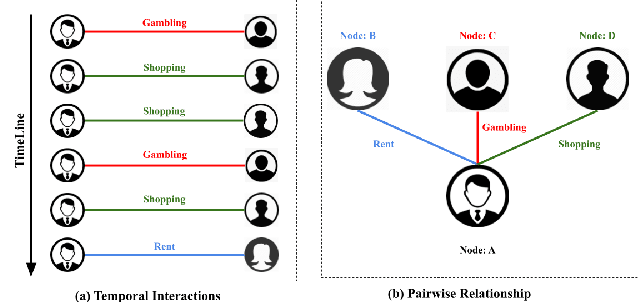

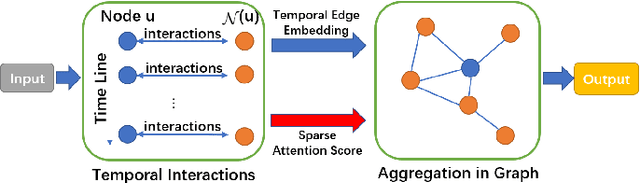
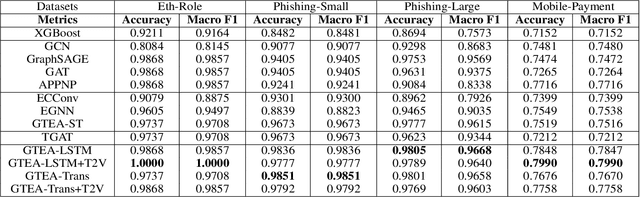
We consider the problem of representation learning for temporal interaction graphs where a network of entities with complex interactions over an extended period of time is modeled as a graph with a rich set of node and edge attributes. In particular, an edge between a node-pair within the graph corresponds to a multi-dimensional time-series. To fully capture and model the dynamics of the network, we propose GTEA, a framework of representation learning for temporal interaction graphs with per-edge time-based aggregation. Under GTEA, a Graph Neural Network (GNN) is integrated with a state-of-the-art sequence model, such as LSTM, Transformer and their time-aware variants. The sequence model generates edge embeddings to encode temporal interaction patterns between each pair of nodes, while the GNN-based backbone learns the topological dependencies and relationships among different nodes. GTEA also incorporates a sparsity-inducing self-attention mechanism to distinguish and focus on the more important neighbors of each node during the aggregation process. By capturing temporal interactive dynamics together with multi-dimensional node and edge attributes in a network, GTEA can learn fine-grained representations for a temporal interaction graph to enable or facilitate other downstream data analytic tasks. Experimental results show that GTEA outperforms state-of-the-art schemes including GraphSAGE, APPNP, and TGAT by delivering higher accuracy (100.00%, 98.51%, 98.05% ,79.90%) and macro-F1 score (100.00%, 98.51%, 96.68% ,79.90%) over four large-scale real-world datasets for binary/ multi-class node classification.