 Add to Chrome
 Add to Firefox
 Add to Edge
FLAP: FOV-Constrained Active Perception Planning for Prior-Map-Free 3D Navigation
Jun 16, 2026
Safe and efficient trajectory planning in unknown, cluttered 3D environments constitutes a critical bottleneck for deploying Unmanned Aerial Vehicles (UAVs) in real-world applications. This challenge is further exacerbated by the limited field-of-view (FOV) and sensing range of onboard sensors. Many existing methods either make simplistic assumptions about unexplored space or rely on conservative heuristics such as speed limits or fixed perception patterns, reducing efficiency and generalizing poorly across different sensor types. In this work, we propose a novel planning framework that directly integrates active perception into trajectory optimization, thereby improving safety while preserving efficiency. The perception constraints are derived from the UAV's dynamic model and formulated in the sensor coordinate frame, which enables precise handling of FOV geometry. The velocity-triggered activation mechanism enables the planner to balance perception and motion efficiency. We introduce an active perception sub-trajectory segment with parametric start-time optimization, mitigating collision risks from late obstacle detection. Our formulation enables active perception during arbitrary 3D maneuvers, extending beyond prior methods designed mainly for horizontal motion. All constraints and penalties are incorporated into a differentiable optimization problem, so the planner requires only a simple front-end global path for guidance, rather than a computationally expensive perception-aware path generator. Extensive simulations and real-world experiments demonstrate robust performance across diverse unknown environments with varying sensor configurations.

Enhancing Out-of-Distribution Detection with Multitesting-based Layer-wise Feature Fusion
Mar 16, 2024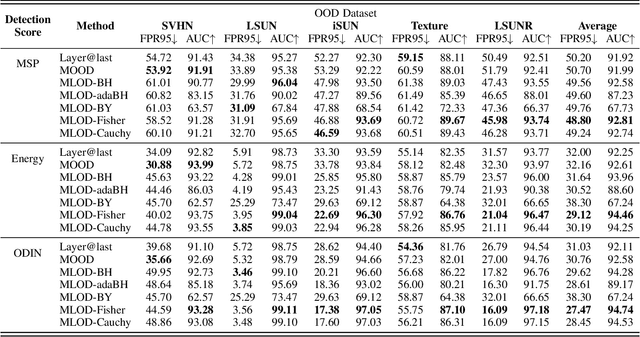
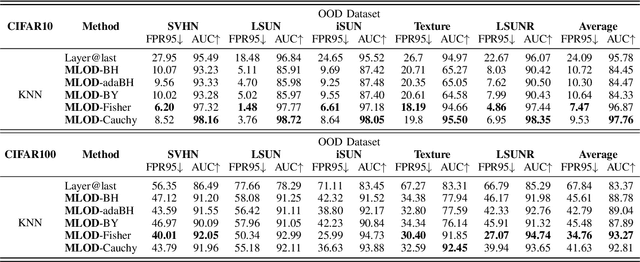
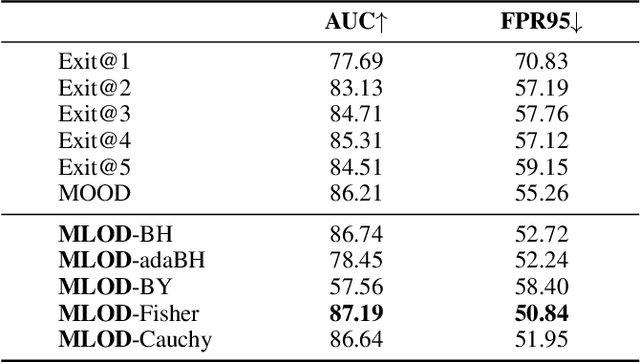
Deploying machine learning in open environments presents the challenge of encountering diverse test inputs that differ significantly from the training data. These out-of-distribution samples may exhibit shifts in local or global features compared to the training distribution. The machine learning (ML) community has responded with a number of methods aimed at distinguishing anomalous inputs from original training data. However, the majority of previous studies have primarily focused on the output layer or penultimate layer of pre-trained deep neural networks. In this paper, we propose a novel framework, Multitesting-based Layer-wise Out-of-Distribution (OOD) Detection (MLOD), to identify distributional shifts in test samples at different levels of features through rigorous multiple testing procedure. Our approach distinguishes itself from existing methods as it does not require modifying the structure or fine-tuning of the pre-trained classifier. Through extensive experiments, we demonstrate that our proposed framework can seamlessly integrate with any existing distance-based inspection method while efficiently utilizing feature extractors of varying depths. Our scheme effectively enhances the performance of out-of-distribution detection when compared to baseline methods. In particular, MLOD-Fisher achieves superior performance in general. When trained using KNN on CIFAR10, MLOD-Fisher significantly lowers the false positive rate (FPR) from 24.09% to 7.47% on average compared to merely utilizing the features of the last layer.
Context-Semantic Quality Awareness Network for Fine-Grained Visual Categorization
Mar 15, 2024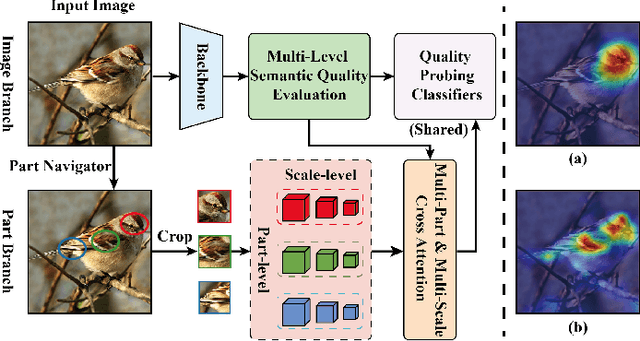
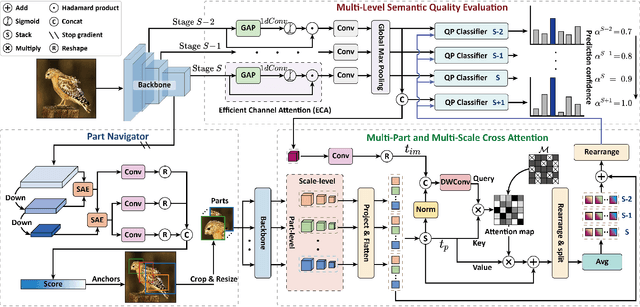

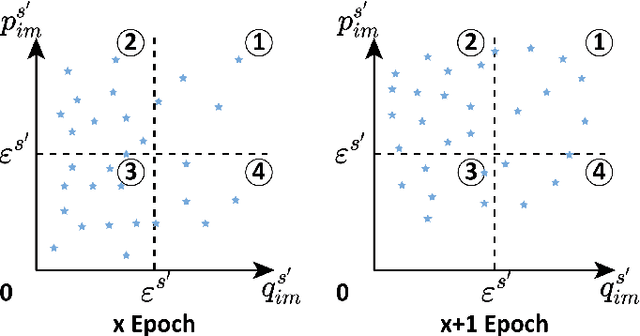
Exploring and mining subtle yet distinctive features between sub-categories with similar appearances is crucial for fine-grained visual categorization (FGVC). However, less effort has been devoted to assessing the quality of extracted visual representations. Intuitively, the network may struggle to capture discriminative features from low-quality samples, which leads to a significant decline in FGVC performance. To tackle this challenge, we propose a weakly supervised Context-Semantic Quality Awareness Network (CSQA-Net) for FGVC. In this network, to model the spatial contextual relationship between rich part descriptors and global semantics for capturing more discriminative details within the object, we design a novel multi-part and multi-scale cross-attention (MPMSCA) module. Before feeding to the MPMSCA module, the part navigator is developed to address the scale confusion problems and accurately identify the local distinctive regions. Furthermore, we propose a generic multi-level semantic quality evaluation module (MLSQE) to progressively supervise and enhance hierarchical semantics from different levels of the backbone network. Finally, context-aware features from MPMSCA and semantically enhanced features from MLSQE are fed into the corresponding quality probing classifiers to evaluate their quality in real-time, thus boosting the discriminability of feature representations. Comprehensive experiments on four popular and highly competitive FGVC datasets demonstrate the superiority of the proposed CSQA-Net in comparison with the state-of-the-art methods.