 Add to Chrome
 Add to Firefox
 Add to Edge
A General Framework for Dynamic Consistent Submodular Maximization
Jun 03, 2026
Consistency is an important property in dynamic submodular maximization and entails maintaining a near-optimal solution at all times, making only a small number of adjustments to the solution in each step. Prior work has explored this question for the insertion-only case, where the algorithm faces a stream of $n$ insertions, and has established lower and upper bounds for the cardinality-constrained version of the problem. We consider this question in the fully dynamic setting, where the stream of operations may contain both insertions and deletions. We develop a general framework for designing algorithms for this setting, and instantiate it to obtain the first constant-factor approximations with sublinear consistency. For cardinality constraints, we propose a $\frac 12 - O(\varepsilon)$ approximation that is $O\left(\frac{1}{\varepsilon^2}\right)$ consistent. For rank-$k$ matroid constraints, we construct a $\frac 14 - O(\varepsilon)$ approximation to the dynamic optimum that is $O\left(\frac{\log k}{\varepsilon^2}\right)$ consistent.

Retriever Portfolios: A Principled Approach to Adaptive RAG
May 29, 2026Retrieval-augmented generation (RAG) systems typically rely on a single retriever and a single set of hyperparameters, despite facing highly heterogeneous queries that range from simple factoid questions to complex multi-hop reasoning. We propose a method that automatically selects a small, diverse subset of retrievers (a portfolio) from a large pool of candidates, to cover different regions of the target query distribution. We formalize this setting via an expected best-of-$k$ objective over the query distribution and show that it admits an efficient portfolio construction algorithm with near-optimal guarantees. Across multiple QA benchmarks, our learned portfolios and router pipeline consistently outperform single-retriever and naive multi-retriever baselines on both retrieval metrics and answer quality. In addition, compared to inference-time hyperparameter tuning approaches, fixed portfolios enable parallel retrieval and LLM calls, achieving comparable (and sometimes better) accuracy with substantially lower latency and token cost.
Accelerating Scientific Research with Gemini: Case Studies and Common Techniques
Feb 03, 2026Recent advances in large language models (LLMs) have opened new avenues for accelerating scientific research. While models are increasingly capable of assisting with routine tasks, their ability to contribute to novel, expert-level mathematical discovery is less understood. We present a collection of case studies demonstrating how researchers have successfully collaborated with advanced AI models, specifically Google's Gemini-based models (in particular Gemini Deep Think and its advanced variants), to solve open problems, refute conjectures, and generate new proofs across diverse areas in theoretical computer science, as well as other areas such as economics, optimization, and physics. Based on these experiences, we extract common techniques for effective human-AI collaboration in theoretical research, such as iterative refinement, problem decomposition, and cross-disciplinary knowledge transfer. While the majority of our results stem from this interactive, conversational methodology, we also highlight specific instances that push beyond standard chat interfaces. These include deploying the model as a rigorous adversarial reviewer to detect subtle flaws in existing proofs, and embedding it within a "neuro-symbolic" loop that autonomously writes and executes code to verify complex derivations. Together, these examples highlight the potential of AI not just as a tool for automation, but as a versatile, genuine partner in the creative process of scientific discovery.
Learning Multinomial Logits in $O(n \log n)$ time
Jan 07, 2026A Multinomial Logit (MNL) model is composed of a finite universe of items $[n]=\{1,..., n\}$, each assigned a positive weight. A query specifies an admissible subset -- called a slate -- and the model chooses one item from that slate with probability proportional to its weight. This query model is also known as the Plackett-Luce model or conditional sampling oracle in the literature. Although MNLs have been studied extensively, a basic computational question remains open: given query access to slates, how efficiently can we learn weights so that, for every slate, the induced choice distribution is within total variation distance $\varepsilon$ of the ground truth? This question is central to MNL learning and has direct implications for modern recommender system interfaces. We provide two algorithms for this task, one with adaptive queries and one with non-adaptive queries. Each algorithm outputs an MNL $M'$ that induces, for each slate $S$, a distribution $M'_S$ on $S$ that is within $\varepsilon$ total variation distance of the true distribution. Our adaptive algorithm makes $O\left(\frac{n}{\varepsilon^{3}}\log n\right)$ queries, while our non-adaptive algorithm makes $O\left(\frac{n^{2}}{\varepsilon^{3}}\log n \log\frac{n}{\varepsilon}\right)$ queries. Both algorithms query only slates of size two and run in time proportional to their query complexity. We complement these upper bounds with lower bounds of $Ω\left(\frac{n}{\varepsilon^{2}}\log n\right)$ for adaptive queries and $Ω\left(\frac{n^{2}}{\varepsilon^{2}}\log n\right)$ for non-adaptive queries, thus proving that our adaptive algorithm is optimal in its dependence on the support size $n$, while the non-adaptive one is tight within a $\log n$ factor.
Clustering with Label Consistency
Dec 22, 2025Designing efficient, effective, and consistent metric clustering algorithms is a significant challenge attracting growing attention. Traditional approaches focus on the stability of cluster centers; unfortunately, this neglects the real-world need for stable point labels, i.e., stable assignments of points to named sets (clusters). In this paper, we address this gap by initiating the study of label-consistent metric clustering. We first introduce a new notion of consistency, measuring the label distance between two consecutive solutions. Then, armed with this new definition, we design new consistent approximation algorithms for the classical $k$-center and $k$-median problems.
The Cost of Consistency: Submodular Maximization with Constant Recourse
Dec 03, 2024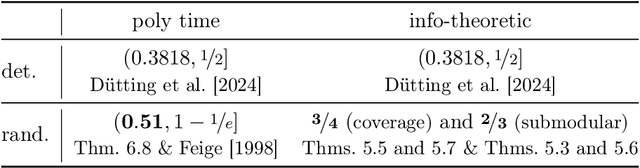
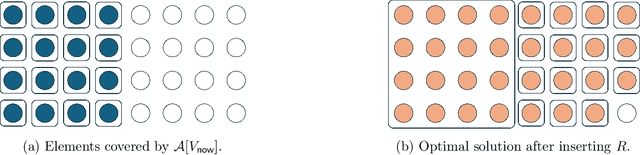
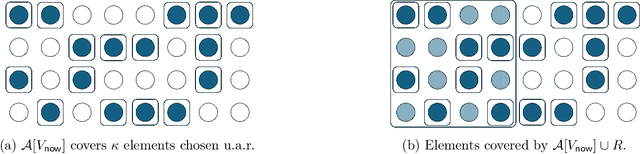
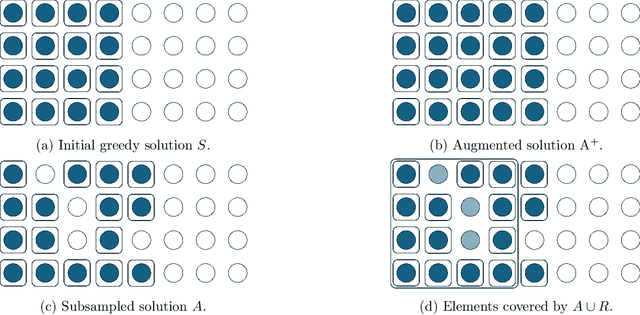
In this work, we study online submodular maximization, and how the requirement of maintaining a stable solution impacts the approximation. In particular, we seek bounds on the best-possible approximation ratio that is attainable when the algorithm is allowed to make at most a constant number of updates per step. We show a tight information-theoretic bound of $\tfrac{2}{3}$ for general monotone submodular functions, and an improved (also tight) bound of $\tfrac{3}{4}$ for coverage functions. Since both these bounds are attained by non poly-time algorithms, we also give a poly-time randomized algorithm that achieves a $0.51$-approximation. Combined with an information-theoretic hardness of $\tfrac{1}{2}$ for deterministic algorithms from prior work, our work thus shows a separation between deterministic and randomized algorithms, both information theoretically and for poly-time algorithms.
Dynamic Correlation Clustering in Sublinear Update Time
Jun 13, 2024We study the classic problem of correlation clustering in dynamic node streams. In this setting, nodes are either added or randomly deleted over time, and each node pair is connected by a positive or negative edge. The objective is to continuously find a partition which minimizes the sum of positive edges crossing clusters and negative edges within clusters. We present an algorithm that maintains an $O(1)$-approximation with $O$(polylog $n$) amortized update time. Prior to our work, Behnezhad, Charikar, Ma, and L. Tan achieved a $5$-approximation with $O(1)$ expected update time in edge streams which translates in node streams to an $O(D)$-update time where $D$ is the maximum possible degree. Finally we complement our theoretical analysis with experiments on real world data.
Multi-View Stochastic Block Models
Jun 07, 2024Graph clustering is a central topic in unsupervised learning with a multitude of practical applications. In recent years, multi-view graph clustering has gained a lot of attention for its applicability to real-world instances where one has access to multiple data sources. In this paper we formalize a new family of models, called \textit{multi-view stochastic block models} that captures this setting. For this model, we first study efficient algorithms that naively work on the union of multiple graphs. Then, we introduce a new efficient algorithm that provably outperforms previous approaches by analyzing the structure of each graph separately. Furthermore, we complement our results with an information-theoretic lower bound studying the limits of what can be done in this model. Finally, we corroborate our results with experimental evaluations.
Consistent Submodular Maximization
May 30, 2024


Maximizing monotone submodular functions under cardinality constraints is a classic optimization task with several applications in data mining and machine learning. In this paper we study this problem in a dynamic environment with consistency constraints: elements arrive in a streaming fashion and the goal is maintaining a constant approximation to the optimal solution while having a stable solution (i.e., the number of changes between two consecutive solutions is bounded). We provide algorithms in this setting with different trade-offs between consistency and approximation quality. We also complement our theoretical results with an experimental analysis showing the effectiveness of our algorithms in real-world instances.
A Scalable Algorithm for Individually Fair K-means Clustering
Feb 09, 2024


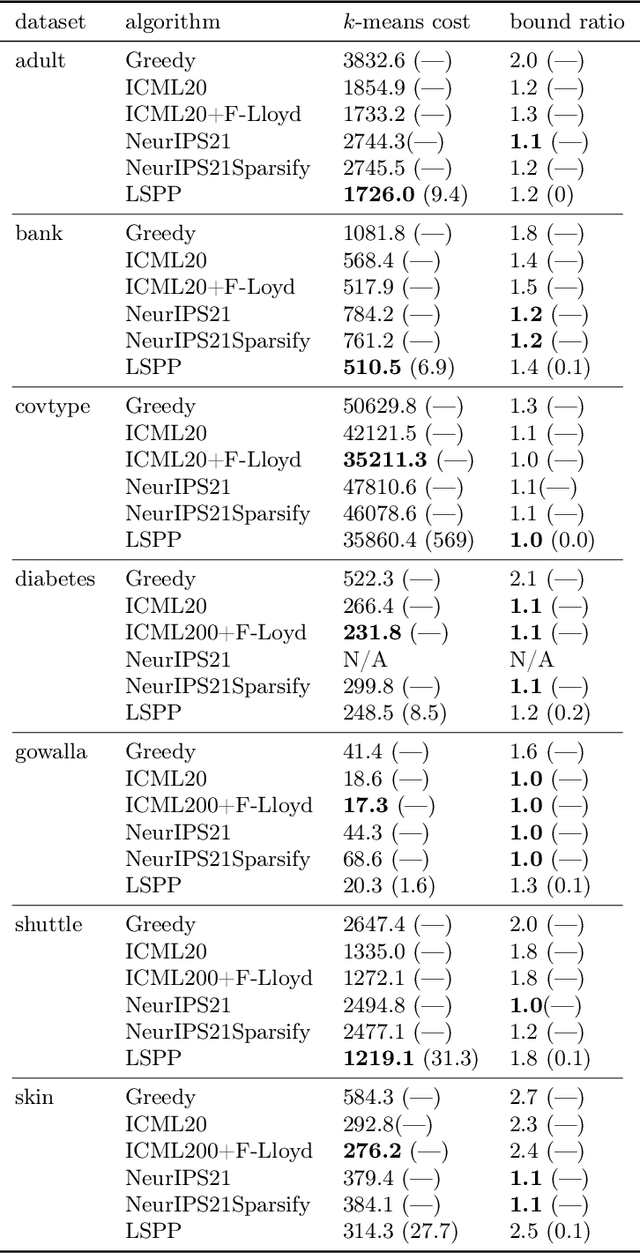
We present a scalable algorithm for the individually fair ($p$, $k$)-clustering problem introduced by Jung et al. and Mahabadi et al. Given $n$ points $P$ in a metric space, let $\delta(x)$ for $x\in P$ be the radius of the smallest ball around $x$ containing at least $n / k$ points. A clustering is then called individually fair if it has centers within distance $\delta(x)$ of $x$ for each $x\in P$. While good approximation algorithms are known for this problem no efficient practical algorithms with good theoretical guarantees have been presented. We design the first fast local-search algorithm that runs in ~$O(nk^2)$ time and obtains a bicriteria $(O(1), 6)$ approximation. Then we show empirically that not only is our algorithm much faster than prior work, but it also produces lower-cost solutions.