 Add to Chrome
 Add to Firefox
 Add to Edge
Mendel Gödel Machine: Recursive Self-Improving Coding Agents via Comparative Evolution
Aug 07, 2026
Self-improving coding agents that iteratively rewrite their own source code have demonstrated impressive performance on coding tasks. However, existing solutions generally derive self-modification from a single failure trajectory at a time, overlooking rich comparative signals available in the agent's expanding archive of past attempts. According to Mendelian principles of controlled inheritance, we introduce Mendel Gödel Machine (MGM). In addition to the general single-trajectory clonal mutation, MGM includes two new types of self-modification that better utilizes evidences accumulated: the reaction-norm mutation edits an agent based on its trajectories on multiple tasks simultaneously, and the cross-lineage hybridization edits an agent using the trajectory of a reference agent from another lineage on the same task. Under an additive fitness landscape model, we prove theoretically and demonstrate via controlled surrogate simulation that the new strategies facilitate a faster and better convergence over single-trajectory baselines. Experiments on SWE-bench and Polyglot confirm MGM's consistent improvement in performance, efficiency, and generalizability.

MemWM: Memory-Augmented Text-Based World Model
Aug 07, 2026World models are increasingly used to support planning in agents by predicting how environment states evolve in response to agent actions. Yet fluent next-state predictions can still omit task-critical facts, corrupt product attributes, or apply incorrect transition rules. To address such systematic prediction errors, we introduce MemWM, a memory-augmented text-based world model. MemWM uses world memory, a curated memory bank of transition rules, state caches, and hard-to-predict facts, to condition next-state imagination. We evaluate factual state preservation with Structured State Fidelity (SSF), which scores predicted states through benchmark-specific facts and fields. Compared with SFT, memory-augmented training improves SSF by up to 206.3%. In the full planning setting, we keep the policy model frozen and provide policy-side world skill: retrieved task-level skills and step-wise corrective guidance for action selection. Across ALFWorld, WebShop, and ScienceWorld, memory-augmented agents improve downstream success over an SFT-trained world-model agent, with up to a 65.4% relative gain. Sensitivity analyses further show that retrieved memory improves task success and efficiency under different memory and action-budget settings.
MetaSkill-Evolve: Recursive Self-Improvement of LLM Agents via Two-Timescale Meta-Skill Evolution
Jul 06, 2026Recent LLM agents tackle increasingly long-horizon, open-ended tasks, and external skills, reusable procedural knowledge supplied to the agent, further extend this capability. However, a fixed, hand-authored skill is rarely optimal, and cannot adapt to the diversity of tasks an agent encounters. Self-improving agents address this by rewriting their own skill files from execution traces, yielding meaningful gains on challenging benchmarks. Yet such self-evolution remains non-recursive: it improves only the task skill (what the agent does) while the improvement procedure (how it improves) is authored once and held fixed. We introduce MetaSkill-Evolve, a two-timescale framework that makes agentic skill improvement recursive: every branch carries both a task skill $s$ and a branch-local meta-skill $m=(ψ,σ,α,π,\varepsilon)$ whose five components parameterise the Analyzer, Retriever, Allocator, Proposer, and Evolver agents of the improvement pipeline. Task skills evolve on a fast loop while the meta-skill evolves on a slower one under the same pipeline applied to itself, with no additional model or objective. With all five pipeline agents sharing a single frozen backbone, MetaSkill-Evolve outperforms no-skill, static-skill, and single-level evolution baselines on three agentic benchmarks (OfficeQA, SealQA, ALFWorld), improving held-out test accuracy over the raw backbone by +23.54, +16.09, and +1.92 points respectively.
EchoRL: Reinforcement Learning via Rollout Echoing
May 29, 2026Reinforcement Learning with Verifiable Rewards is an effective route for post-training to strengthen the reasoning capability of large language models. However, as training proceeds, the learning signal can collapse thus makes the training gain become marginal and ineffective. Specifically, a growing fraction of prompts' rollouts become advantage-degenerated: all the self-generated rollouts show verified-success, making the standard deviation over their rewards be zero; accordingly each rollout's advantage becomes degenerated (zero) as well. Given such rollouts' advantages, the policy-gradient for model optimization eventually vanishes, capping the training performance. We argue that some of these rollouts still contain valuable learning signals but unfortunately omitted with the existing RLVR methods. In this paper, inspired through analyzing the entropy pattern behind golden trajectories produced by external expert models, we propose EchoRL for better exploiting the advantage-degenerated rollouts to further improve the training performance. EchoRL is a lightweight module that first identifies an EchoClip from verified-success rollouts based on their step-level entropy values, and then feeds this clip back as an auxiliary supervision signal in the RL objective. Extensive experiments across 10 benchmarks, 5 LLM backbones, and 4 popular RLVR post-training methods demonstrate that EchoRL consistently improves RLVR post-training with minimal overhead.
Memory-R2: Fair Credit Assignment for Long-Horizon Memory-Augmented LLM Agents
May 20, 2026Memory-augmented LLM agents enable interactions that extend beyond finite context windows by storing, updating, and reusing information across sessions. However, training such agents with reinforcement learning in multi-session environments is challenging because memory turns the agent's past actions into part of its future environment. Once different rollouts write, update, or delete different memories, they no longer share the same intermediate memory state, making trajectory-level comparisons fundamentally unfair. This violates a key assumption behind group-relative methods such as GRPO, where rollouts are compared as if they were sampled from the same effective environment. Consequently, trajectory-level rewards provide noisy or biased credit signals for long-horizon memory operations. To address this challenge, we introduce Memory-R2, a training framework for long-horizon memory-augmented LLM agents. Its core algorithm, LoGo-GRPO, combines local and global group-relative optimization. The global objective preserves end-to-end learning from long-horizon trajectory-level rewards, while local rerollouts compare different memory-operation outcomes from the same intermediate memory state, yielding fairer group comparisons and more precise supervision for memory construction. Beyond credit assignment, Memory-R2 jointly optimizes memory formation and memory evolution with a shared-parameter co-learning design, where a fact extractor and a memory manager are instantiated from the same LLM backbone through role-specific prompts. To stabilize multi-step RL over long memory horizons, we adopt a progressive curriculum that increases the training horizon from 8 to 16 to 32 sessions. Together, these components provide an effective training paradigm for memory-augmented LLM agents in long-horizon multi-session settings.
Routing-Free Mixture-of-Experts
Apr 01, 2026Standard Mixture-of-Experts (MoE) models rely on centralized routing mechanisms that introduce rigid inductive biases. We propose Routing-Free MoE which eliminates any hard-coded centralized designs including external routers, Softmax, Top-K and load balancing, instead encapsulating all activation functionalities within individual experts and directly optimized through continuous gradient flow, enabling each expert to determine its activation entirely on its own. We introduce a unified adaptive load-balancing framework to simultaneously optimize both expert-balancing and token-balancing objectives through a configurable interpolation, allowing flexible and customizable resource allocation. Extensive experiments show that Routing-Free MoE can consistently outperform baselines with better scalability and robustness. We analyze its behavior in detail and offer insights that may facilitate future MoE design ad optimization.
Memory-R1: Enhancing Large Language Model Agents to Manage and Utilize Memories via Reinforcement Learning
Aug 27, 2025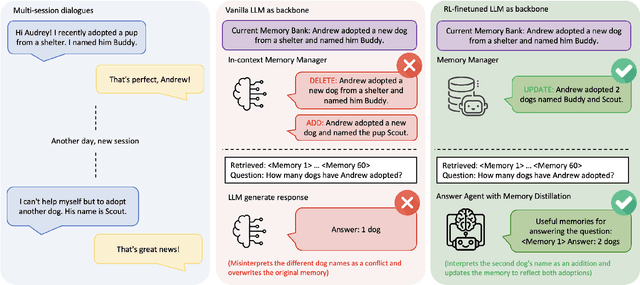
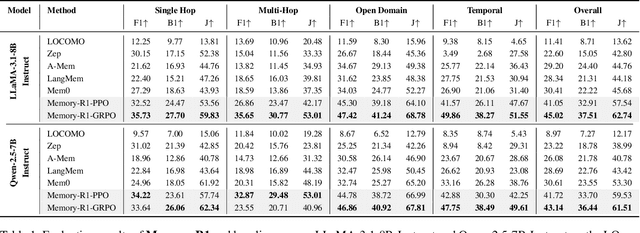
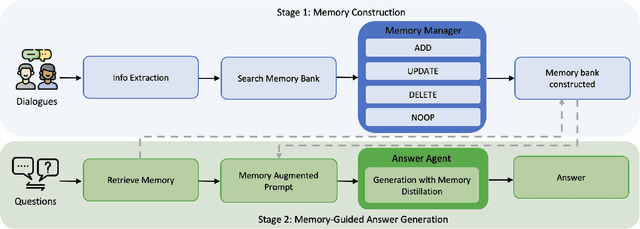
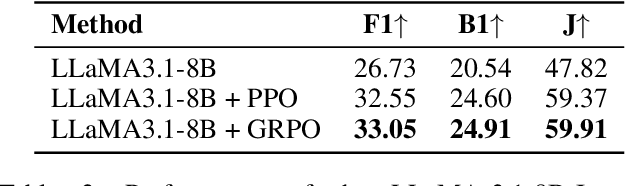
Large Language Models (LLMs) have demonstrated impressive capabilities across a wide range of NLP tasks, but they remain fundamentally stateless, constrained by limited context windows that hinder long-horizon reasoning. Recent efforts to address this limitation often augment LLMs with an external memory bank, yet most existing pipelines are static and heuristic-driven, lacking any learned mechanism for deciding what to store, update, or retrieve. We present Memory-R1, a reinforcement learning (RL) framework that equips LLMs with the ability to actively manage and utilize external memory through two specialized agents: a Memory Manager that learns to perform structured memory operations {ADD, UPDATE, DELETE, NOOP}, and an Answer Agent that selects the most relevant entries and reasons over them to produce an answer. Both agents are fine-tuned with outcome-driven RL (PPO and GRPO), enabling adaptive memory management and use with minimal supervision. With as few as 152 question-answer pairs and a corresponding temporal memory bank for training, Memory-R1 outperforms the most competitive existing baseline and demonstrates strong generalization across diverse question types and LLM backbones. Beyond presenting an effective approach, this work provides insights into how RL can unlock more agentic, memory-aware behaviors in LLMs, pointing toward richer, more persistent reasoning systems.
TCP: a Benchmark for Temporal Constraint-Based Planning
May 26, 2025Temporal reasoning and planning are essential capabilities for large language models (LLMs), yet most existing benchmarks evaluate them in isolation and under limited forms of complexity. To address this gap, we introduce the Temporal Constraint-based Planning (TCP) benchmark, that jointly assesses both capabilities. Each instance in TCP features a naturalistic dialogue around a collaborative project, where diverse and interdependent temporal constraints are explicitly or implicitly expressed, and models must infer an optimal schedule that satisfies all constraints. To construct TCP, we first generate abstract problem prototypes that are paired with realistic scenarios from various domains and enriched into dialogues using an LLM. A human quality check is performed on a sampled subset to confirm the reliability of our benchmark. We evaluate state-of-the-art LLMs and find that even the strongest models struggle with TCP, highlighting its difficulty and revealing limitations in LLMs' temporal constraint-based planning abilities. We analyze underlying failure cases, open source our benchmark, and hope our findings can inspire future research.