 Add to Chrome
 Add to Firefox
 Add to Edge
SciCode-Verified: How Benchmark Defects Underestimated the Scientific-Coding Ability of Language Models
Aug 05, 2026
SciCode is the standard measure of the scientific-coding ability of language models: research-level problems that demand both frontier scientific theory and its implementation as working numerical code. It is a component of the Artificial Analysis Intelligence Index and a standing evaluation in government and national-laboratory suites. Yet its scores have recently plateaued: the strongest 2026 models cluster tightly around 60\% subproblem accuracy, and a successor model ties its predecessor. We trace this stagnation to defects in the benchmark itself. A per-problem, domain-expert audit of all 65 test problems uncovers 263 defects; 192 of them, spread across 91\% of the main problems, cause correct, instruction-following solutions to be wrongly rejected---through non-reproducible gold answers, over-tight tolerances, or self-contradictory specifications. Critically, 78\% of these score-suppressing defects require specialized physics or mathematics knowledge to detect, not mere clerical proofreading. We corrected every confirmable defect to produce SciCode-Verified. The corrections add only the specifications a well-posed problem requires, repair grading, and tighten the tests that were too lenient; every change is recorded with its justification and independently re-checked by a second domain expert. We re-evaluate twelve frontier model snapshots on the corrected benchmark and find a substantial recovery: subproblem accuracy rises from 45--60\% to 84--98\%, and main-problem accuracy from 9--27\% to 69--92\%. State-of-the-art models are far more proficient in scientific coding than SciCode has suggested---the bottleneck was not model capability, but the quality of the evaluation instrument. We release SciCode-Verified with its complete audit trail as the corrected public standard.

Innovator-VL: A Multimodal Large Language Model for Scientific Discovery
Jan 27, 2026We present Innovator-VL, a scientific multimodal large language model designed to advance understanding and reasoning across diverse scientific domains while maintaining excellent performance on general vision tasks. Contrary to the trend of relying on massive domain-specific pretraining and opaque pipelines, our work demonstrates that principled training design and transparent methodology can yield strong scientific intelligence with substantially reduced data requirements. (i) First, we provide a fully transparent, end-to-end reproducible training pipeline, covering data collection, cleaning, preprocessing, supervised fine-tuning, reinforcement learning, and evaluation, along with detailed optimization recipes. This facilitates systematic extension by the community. (ii) Second, Innovator-VL exhibits remarkable data efficiency, achieving competitive performance on various scientific tasks using fewer than five million curated samples without large-scale pretraining. These results highlight that effective reasoning can be achieved through principled data selection rather than indiscriminate scaling. (iii) Third, Innovator-VL demonstrates strong generalization, achieving competitive performance on general vision, multimodal reasoning, and scientific benchmarks. This indicates that scientific alignment can be integrated into a unified model without compromising general-purpose capabilities. Our practices suggest that efficient, reproducible, and high-performing scientific multimodal models can be built even without large-scale data, providing a practical foundation for future research.
Inverse Knowledge Search over Verifiable Reasoning: Synthesizing a Scientific Encyclopedia from a Long Chains-of-Thought Knowledge Base
Oct 30, 2025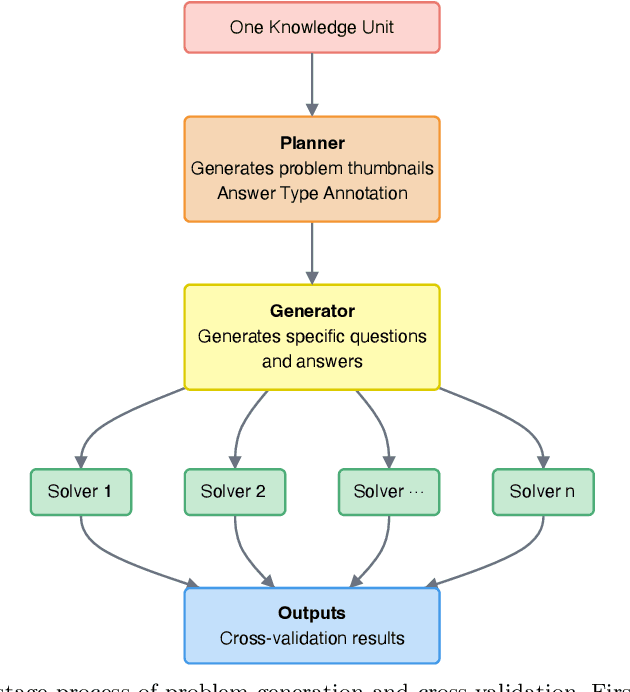
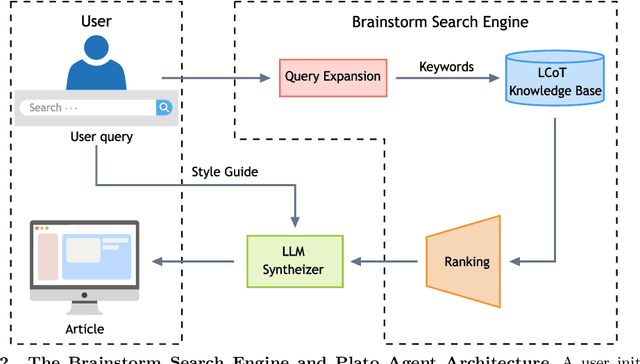
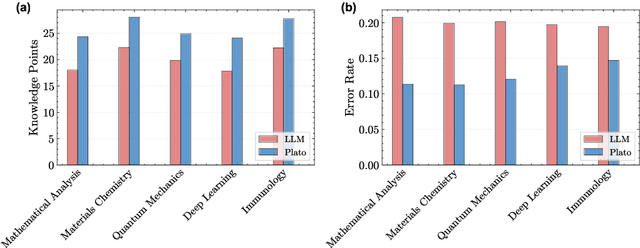
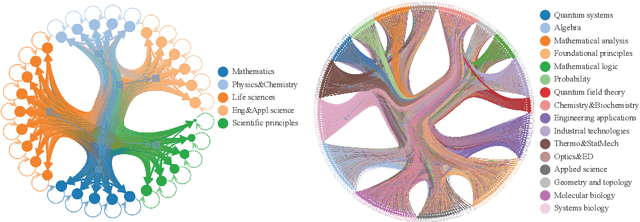
Most scientific materials compress reasoning, presenting conclusions while omitting the derivational chains that justify them. This compression hinders verification by lacking explicit, step-wise justifications and inhibits cross-domain links by collapsing the very pathways that establish the logical and causal connections between concepts. We introduce a scalable framework that decompresses scientific reasoning, constructing a verifiable Long Chain-of-Thought (LCoT) knowledge base and projecting it into an emergent encyclopedia, SciencePedia. Our pipeline operationalizes an endpoint-driven, reductionist strategy: a Socratic agent, guided by a curriculum of around 200 courses, generates approximately 3 million first-principles questions. To ensure high fidelity, multiple independent solver models generate LCoTs, which are then rigorously filtered by prompt sanitization and cross-model answer consensus, retaining only those with verifiable endpoints. This verified corpus powers the Brainstorm Search Engine, which performs inverse knowledge search -- retrieving diverse, first-principles derivations that culminate in a target concept. This engine, in turn, feeds the Plato synthesizer, which narrates these verified chains into coherent articles. The initial SciencePedia comprises approximately 200,000 fine-grained entries spanning mathematics, physics, chemistry, biology, engineering, and computation. In evaluations across six disciplines, Plato-synthesized articles (conditioned on retrieved LCoTs) exhibit substantially higher knowledge-point density and significantly lower factual error rates than an equally-prompted baseline without retrieval (as judged by an external LLM). Built on this verifiable LCoT knowledge base, this reasoning-centric approach enables trustworthy, cross-domain scientific synthesis at scale and establishes the foundation for an ever-expanding encyclopedia.