 Add to Chrome
 Add to Firefox
 Add to Edge
Kohn-Sham Hamiltonian from Effective Field Theory: Quasiparticle Band Narrowing from Frozen Core Dynamics
Apr 28, 2026
Kohn-Sham (KS) eigenvalues are routinely compared with angle-resolved photoemission (ARPES) and used as input for many-body methods, yet density functional theory (DFT) assigns them no physical meaning. For alkali and alkaline-earth metals, KS bandwidths overestimate ARPES measurements by 20-35%, a discrepancy that persists across all exchange-correlation functionals. We construct an effective field theory (EFT) of the inhomogeneous electron gas and show that two conditions imply KS bands are the quasiparticle bands, up to a frozen-core renormalization factor zcore: a scale separation between core excitation energies and the valence Fermi energy, and an approximate Galilean invariance of the uniform electron gas confirmed by diagrammatic Monte Carlo. This factor reflects dynamical core excitations that conventional pseudopotentials freeze out and no static potential can capture. The correction 1-zcore reaches 20-35% for alkali metals but falls below 5% for Al and Si, explaining both the failure and success of KS band theory. We derive a closed-form post-SCF formula and validate it for Li, Na, K, Ca, Mg, Al, and Si; the predicted quasiparticle bands resolve the long-standing ARPES bandwidth discrepancy, matching embedded dynamical mean-field theory at negligible cost. This work also exemplifies first-principles agentic science, a direction particularly suited to the AGI-for-Science paradigm: an LLM-co-developed derivation with controlled approximations, verified symbolically and against a few experiments, becomes a deterministic harness for agentic scale-out, resolving simultaneously the LLM audit bottleneck and the non-falsifiability of fit-based AI-for-science.

Inverse Knowledge Search over Verifiable Reasoning: Synthesizing a Scientific Encyclopedia from a Long Chains-of-Thought Knowledge Base
Oct 30, 2025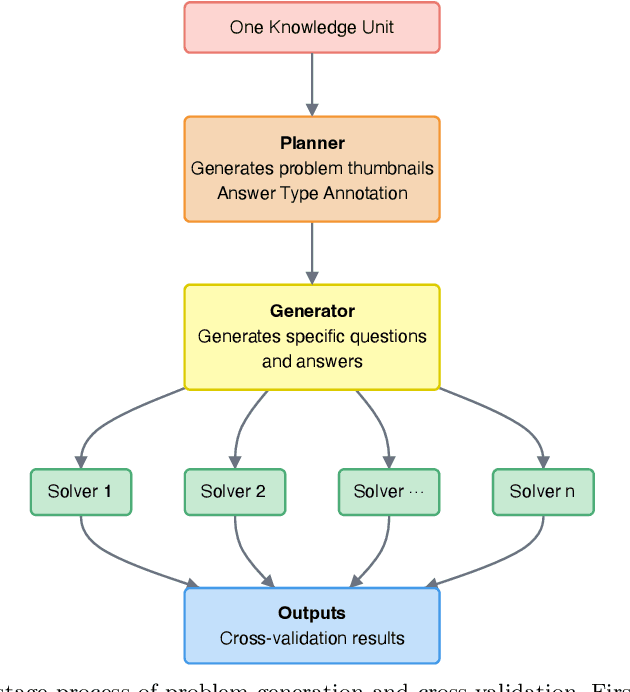
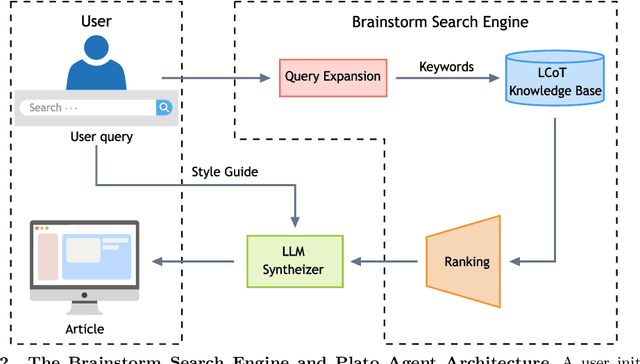
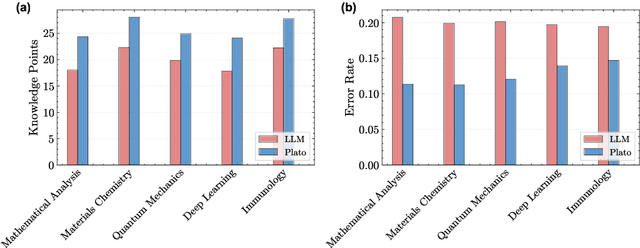
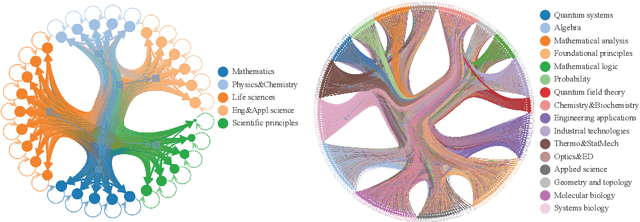
Most scientific materials compress reasoning, presenting conclusions while omitting the derivational chains that justify them. This compression hinders verification by lacking explicit, step-wise justifications and inhibits cross-domain links by collapsing the very pathways that establish the logical and causal connections between concepts. We introduce a scalable framework that decompresses scientific reasoning, constructing a verifiable Long Chain-of-Thought (LCoT) knowledge base and projecting it into an emergent encyclopedia, SciencePedia. Our pipeline operationalizes an endpoint-driven, reductionist strategy: a Socratic agent, guided by a curriculum of around 200 courses, generates approximately 3 million first-principles questions. To ensure high fidelity, multiple independent solver models generate LCoTs, which are then rigorously filtered by prompt sanitization and cross-model answer consensus, retaining only those with verifiable endpoints. This verified corpus powers the Brainstorm Search Engine, which performs inverse knowledge search -- retrieving diverse, first-principles derivations that culminate in a target concept. This engine, in turn, feeds the Plato synthesizer, which narrates these verified chains into coherent articles. The initial SciencePedia comprises approximately 200,000 fine-grained entries spanning mathematics, physics, chemistry, biology, engineering, and computation. In evaluations across six disciplines, Plato-synthesized articles (conditioned on retrieved LCoTs) exhibit substantially higher knowledge-point density and significantly lower factual error rates than an equally-prompted baseline without retrieval (as judged by an external LLM). Built on this verifiable LCoT knowledge base, this reasoning-centric approach enables trustworthy, cross-domain scientific synthesis at scale and establishes the foundation for an ever-expanding encyclopedia.