 Add to Chrome
 Add to Firefox
 Add to Edge
Faults in Our Formal Benchmarking: Dataset Defects and Evaluation Failures in Lean Theorem Proving
Jun 28, 2026
Benchmarks for LLM-assisted theorem proving in Lean are often treated as intrinsically reliable because every solved instance comes with a machine-checked proof. However, the kernel only checks that a proof establishes a \emph{formal} statement; it does not verify that the statement faithfully encodes the intended informal problem, nor that evaluation harnesses are robust to trivial or adversarial solutions. We audit five widely used Lean theorem-proving benchmarks and their forks, using corpus-scale static checkers to surface 4,833 findings, including 398 mechanically certified issues such as counterexamples, vacuous theorems, and unsound axioms. We also document semantic defects such as missing hypotheses, problem simplification, incomplete or incorrect translations, and Lean-specific specification hazards. Beyond dataset construction, we survey evaluation-time failure modes and show, on corrected subsets, that defects can both inflate and deflate reported prover scores. We propose a fault taxonomy, a suite of automated checkers and recall-oriented semantic audit prompts, and release standards to guide the creation of formal math datasets and to make evaluation more reproducible and trustworthy. Our checkers, audit prompts, and corrected dataset snapshots are available at https://github.com/Shashi456/atp-checkers.

Towards Neural Synthesis for SMT-Assisted Proof-Oriented Programming
May 03, 2024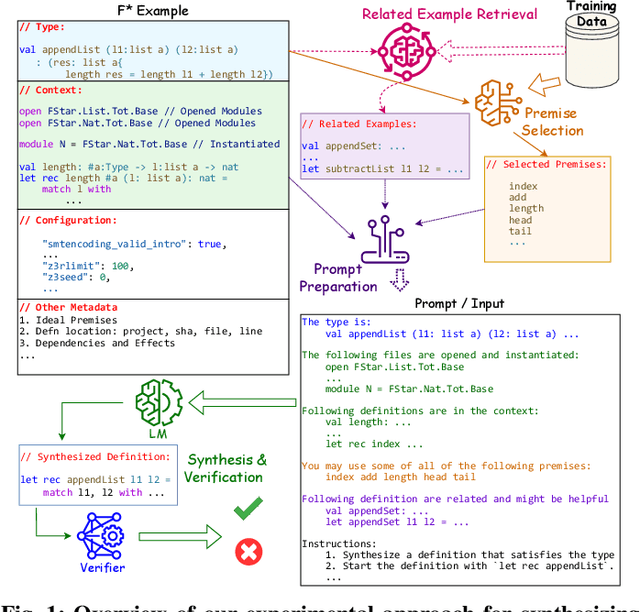
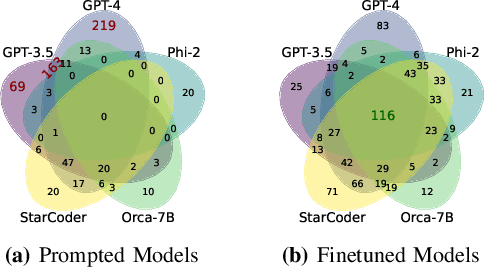
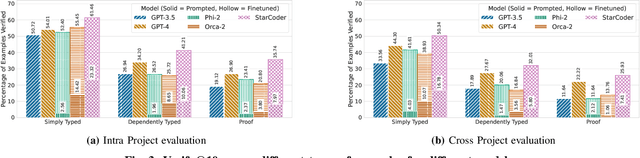
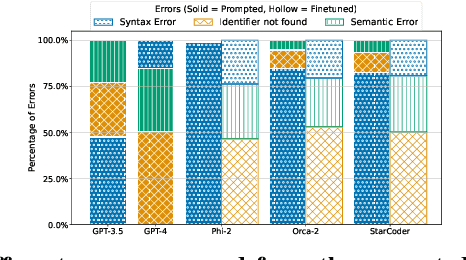
Proof-oriented programs mix computational content with proofs of program correctness. However, the human effort involved in programming and proving is still substantial, despite the use of Satisfiability Modulo Theories (SMT) solvers to automate proofs in languages such as F*. Seeking to spur research on using AI to automate the construction of proof-oriented programs, we curate a dataset of 600K lines of open-source F* programs and proofs, including software used in production systems ranging from Windows and Linux, to Python and Firefox. Our dataset includes around 32K top-level F* definitions, each representing a type-directed program and proof synthesis problem -- producing a definition given a formal specification expressed as an F* type. We provide a program-fragment checker that queries F* to check the correctness of candidate solutions. We believe this is the largest corpus of SMT-assisted program proofs coupled with a reproducible program-fragment checker. Grounded in this dataset, we investigate the use of AI to synthesize programs and their proofs in F*, with promising results. Our main finding in that the performance of fine-tuned smaller language models (such as Phi-2 or StarCoder) compare favorably with large language models (such as GPT-4), at a much lower computational cost. We also identify various type-based retrieval augmentation techniques and find that they boost performance significantly. With detailed error analysis and case studies, we identify potential strengths and weaknesses of models and techniques and suggest directions for future improvements.
Wu's Method can Boost Symbolic AI to Rival Silver Medalists and AlphaGeometry to Outperform Gold Medalists at IMO Geometry
Apr 11, 2024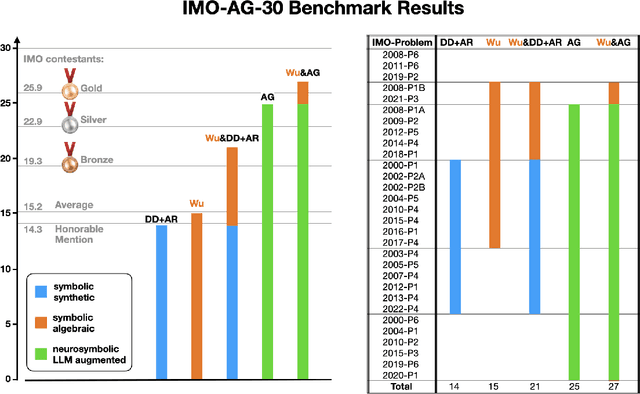
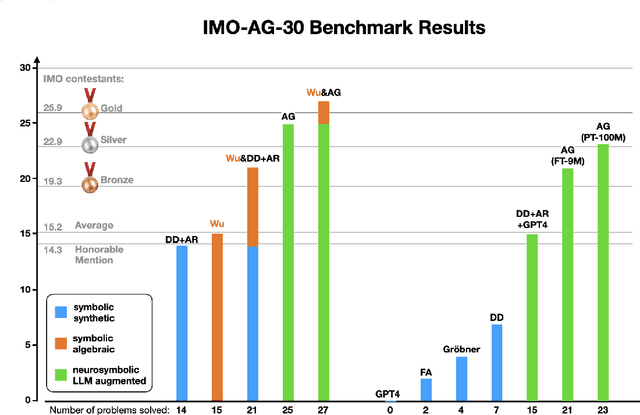
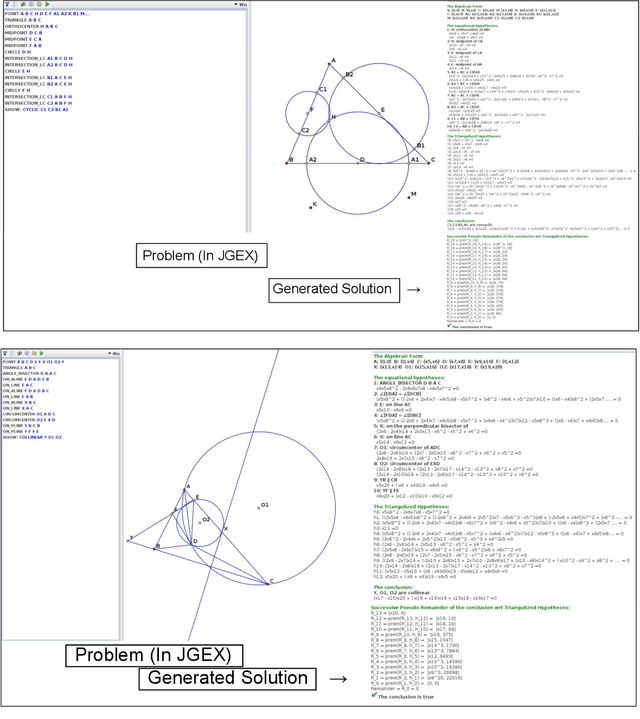
Proving geometric theorems constitutes a hallmark of visual reasoning combining both intuitive and logical skills. Therefore, automated theorem proving of Olympiad-level geometry problems is considered a notable milestone in human-level automated reasoning. The introduction of AlphaGeometry, a neuro-symbolic model trained with 100 million synthetic samples, marked a major breakthrough. It solved 25 of 30 International Mathematical Olympiad (IMO) problems whereas the reported baseline based on Wu's method solved only ten. In this note, we revisit the IMO-AG-30 Challenge introduced with AlphaGeometry, and find that Wu's method is surprisingly strong. Wu's method alone can solve 15 problems, and some of them are not solved by any of the other methods. This leads to two key findings: (i) Combining Wu's method with the classic synthetic methods of deductive databases and angle, ratio, and distance chasing solves 21 out of 30 methods by just using a CPU-only laptop with a time limit of 5 minutes per problem. Essentially, this classic method solves just 4 problems less than AlphaGeometry and establishes the first fully symbolic baseline strong enough to rival the performance of an IMO silver medalist. (ii) Wu's method even solves 2 of the 5 problems that AlphaGeometry failed to solve. Thus, by combining AlphaGeometry with Wu's method we set a new state-of-the-art for automated theorem proving on IMO-AG-30, solving 27 out of 30 problems, the first AI method which outperforms an IMO gold medalist.