 Add to Chrome
 Add to Firefox
 Add to Edge
Scaling Unverifiable Rewards: A Case Study on Visual Insights
Dec 27, 2025
Large Language Model (LLM) agents can increasingly automate complex reasoning through Test-Time Scaling (TTS), iterative refinement guided by reward signals. However, many real-world tasks involve multi-stage pipeline whose final outcomes lack verifiable rewards or sufficient data to train robust reward models, making judge-based refinement prone to accumulate error over stages. We propose Selective TTS, a process-based refinement framework that scales inference across different stages in multi-agent pipeline, instead of repeated refinement over time by prior work. By distributing compute across stages and pruning low-quality branches early using process-specific judges, Selective TTS mitigates the judge drift and stabilizes refinement. Grounded in the data science pipeline, we build an end-to-end multi-agent pipeline for generating visually insightful charts and report of given dataset, and design a reliable LLM-based judge model, aligned with human experts (Kendall's τ=0.55). Our proposed selective TTS then improves insight quality under a fixed compute budget, increasing mean scores from 61.64 to 65.86 while reducing variance. We hope our findings serve as the first step toward to scaling complex, open-ended tasks with unverifiable rewards, such as scientific discovery and story generation.

A2P-Vis: an Analyzer-to-Presenter Agentic Pipeline for Visual Insights Generation and Reporting
Dec 26, 2025Automating end-to-end data science pipeline with AI agents still stalls on two gaps: generating insightful, diverse visual evidence and assembling it into a coherent, professional report. We present A2P-Vis, a two-part, multi-agent pipeline that turns raw datasets into a high-quality data-visualization report. The Data Analyzer orchestrates profiling, proposes diverse visualization directions, generates and executes plotting code, filters low-quality figures with a legibility checker, and elicits candidate insights that are automatically scored for depth, correctness, specificity, depth and actionability. The Presenter then orders topics, composes chart-grounded narratives from the top-ranked insights, writes justified transitions, and revises the document for clarity and consistency, yielding a coherent, publication-ready report. Together, these agents convert raw data into curated materials (charts + vetted insights) and into a readable narrative without manual glue work. We claim that by coupling a quality-assured Analyzer with a narrative Presenter, A2P-Vis operationalizes co-analysis end-to-end, improving the real-world usefulness of automated data analysis for practitioners. For the complete dataset report, please see: https://www.visagent.org/api/output/f2a3486d-2c3b-4825-98d4-5af25a819f56.
* 3 pages, 3 figures; Accepted by 1st Workshop on GenAI, Agents and the Future of VIS as Mini-challenge paper and win the Honorable Mention award. Submit number is 7597 and the paper is archived on the workshop website: https://visxgenai.github.io/subs-2025/7597/7597-doc.pdf
Agent S: An Open Agentic Framework that Uses Computers Like a Human
Oct 10, 2024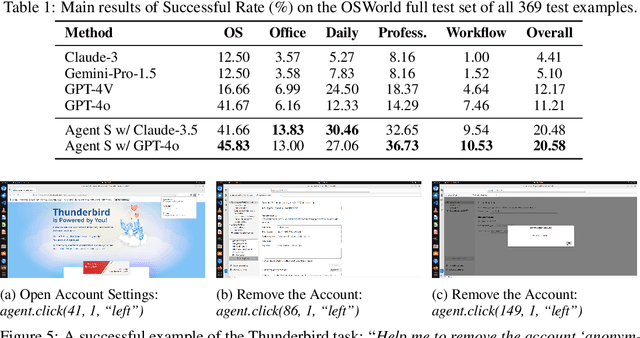
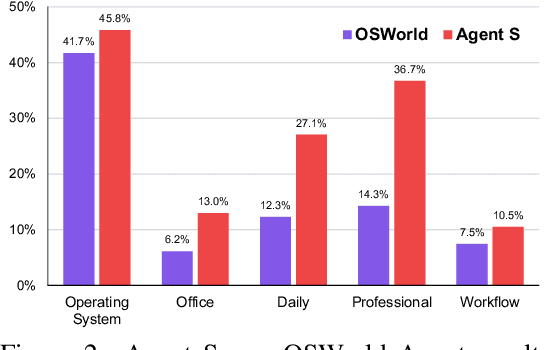

We present Agent S, an open agentic framework that enables autonomous interaction with computers through a Graphical User Interface (GUI), aimed at transforming human-computer interaction by automating complex, multi-step tasks. Agent S aims to address three key challenges in automating computer tasks: acquiring domain-specific knowledge, planning over long task horizons, and handling dynamic, non-uniform interfaces. To this end, Agent S introduces experience-augmented hierarchical planning, which learns from external knowledge search and internal experience retrieval at multiple levels, facilitating efficient task planning and subtask execution. In addition, it employs an Agent-Computer Interface (ACI) to better elicit the reasoning and control capabilities of GUI agents based on Multimodal Large Language Models (MLLMs). Evaluation on the OSWorld benchmark shows that Agent S outperforms the baseline by 9.37% on success rate (an 83.6% relative improvement) and achieves a new state-of-the-art. Comprehensive analysis highlights the effectiveness of individual components and provides insights for future improvements. Furthermore, Agent S demonstrates broad generalizability to different operating systems on a newly-released WindowsAgentArena benchmark. Code available at https://github.com/simular-ai/Agent-S.