 Add to Chrome
 Add to Firefox
 Add to Edge
Scaling Unverifiable Rewards: A Case Study on Visual Insights
Dec 27, 2025
Large Language Model (LLM) agents can increasingly automate complex reasoning through Test-Time Scaling (TTS), iterative refinement guided by reward signals. However, many real-world tasks involve multi-stage pipeline whose final outcomes lack verifiable rewards or sufficient data to train robust reward models, making judge-based refinement prone to accumulate error over stages. We propose Selective TTS, a process-based refinement framework that scales inference across different stages in multi-agent pipeline, instead of repeated refinement over time by prior work. By distributing compute across stages and pruning low-quality branches early using process-specific judges, Selective TTS mitigates the judge drift and stabilizes refinement. Grounded in the data science pipeline, we build an end-to-end multi-agent pipeline for generating visually insightful charts and report of given dataset, and design a reliable LLM-based judge model, aligned with human experts (Kendall's τ=0.55). Our proposed selective TTS then improves insight quality under a fixed compute budget, increasing mean scores from 61.64 to 65.86 while reducing variance. We hope our findings serve as the first step toward to scaling complex, open-ended tasks with unverifiable rewards, such as scientific discovery and story generation.

Incremental XAI: Memorable Understanding of AI with Incremental Explanations
Apr 10, 2024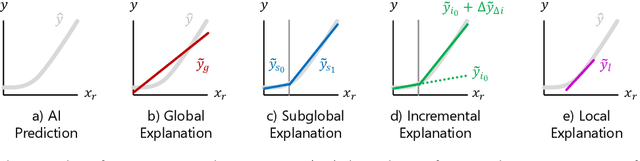

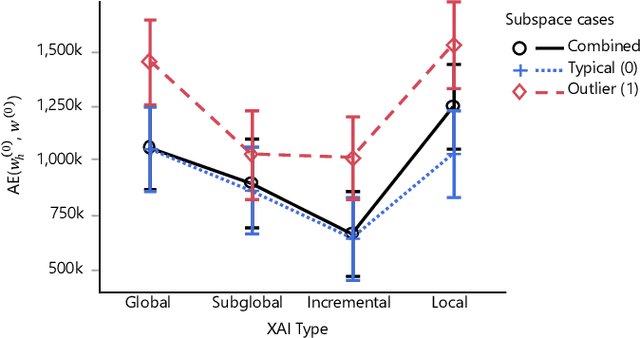
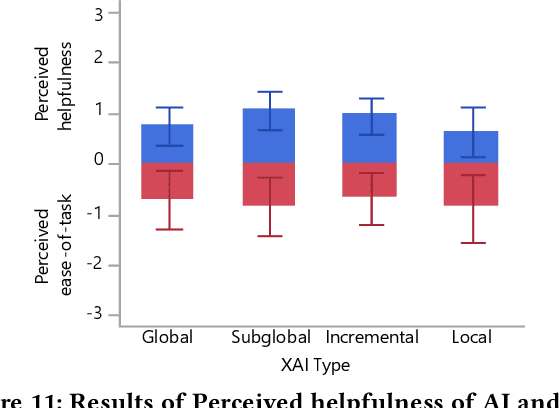
Many explainable AI (XAI) techniques strive for interpretability by providing concise salient information, such as sparse linear factors. However, users either only see inaccurate global explanations, or highly-varying local explanations. We propose to provide more detailed explanations by leveraging the human cognitive capacity to accumulate knowledge by incrementally receiving more details. Focusing on linear factor explanations (factors $\times$ values = outcome), we introduce Incremental XAI to automatically partition explanations for general and atypical instances by providing Base + Incremental factors to help users read and remember more faithful explanations. Memorability is improved by reusing base factors and reducing the number of factors shown in atypical cases. In modeling, formative, and summative user studies, we evaluated the faithfulness, memorability and understandability of Incremental XAI against baseline explanation methods. This work contributes towards more usable explanation that users can better ingrain to facilitate intuitive engagement with AI.