 Add to Chrome
 Add to Firefox
 Add to Edge
SCTA: An Agentic Framework for Stable and Interpretable Target Gene Discovery from Single-Cell RNA Sequencing
Jul 26, 2026
Identifying therapeutic target genes from single-cell RNA sequencing (scRNA-seq) data remains a fundamental challenge in translational biology. Unlike bulk assays, scRNA-seq captures heterogeneous cellular states and rare subpopulations, but this same heterogeneity makes target discovery highly sensitive to analytical choices throughout the pipeline, including preprocessing, cell population selection, differential expression analysis, and downstream biological interpretation. As a result, existing workflows and general-purpose analysis agents often produce unstable or difficult-to-interpret target hypotheses, limiting their reliability for disease-focused discovery. We present SCTA (Single-Cell Target Agent), a decision-centric agentic framework for stable and interpretable target gene discovery from scRNA-seq data. Rather than treating analysis as a single general-purpose reasoning task, SCTA decomposes target discovery into specialized agents aligned with key decision points in the single-cell pipeline and constrains downstream reasoning with structured biological evidence. In a representative ablation study on hereditary chronic pancreatitis, we demonstrate that SCTA's full evidence integration yields the most stable target selection across independent runs among the tested configurations, while recovering biologically coherent, disease-relevant mechanisms validated in prior studies. These results suggest that decision-aware agent orchestration tailored to the structure of single-cell analysis can improve the robustness, interpretability, and practical utility of target discovery in precision medicine.

LC-NeRF: Local Controllable Face Generation in Neural Randiance Field
Feb 19, 2023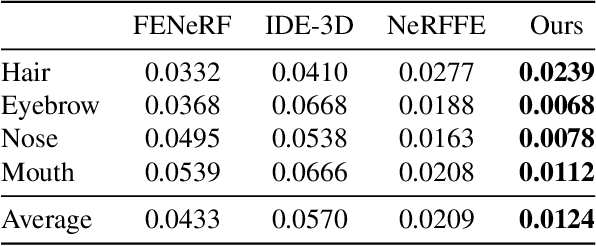
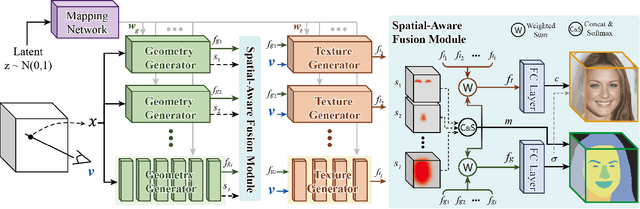
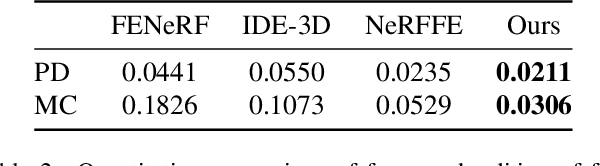
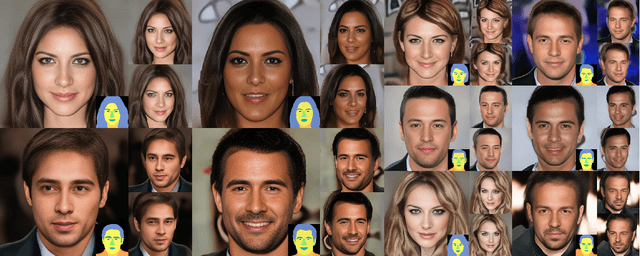
3D face generation has achieved high visual quality and 3D consistency thanks to the development of neural radiance fields (NeRF). Recently, to generate and edit 3D faces with NeRF representation, some methods are proposed and achieve good results in decoupling geometry and texture. The latent codes of these generative models affect the whole face, and hence modifications to these codes cause the entire face to change. However, users usually edit a local region when editing faces and do not want other regions to be affected. Since changes to the latent code affect global generation results, these methods do not allow for fine-grained control of local facial regions. To improve local controllability in NeRF-based face editing, we propose LC-NeRF, which is composed of a Local Region Generators Module and a Spatial-Aware Fusion Module, allowing for local geometry and texture control of local facial regions. Qualitative and quantitative evaluations show that our method provides better local editing than state-of-the-art face editing methods. Our method also performs well in downstream tasks, such as text-driven facial image editing.