 Add to Chrome
 Add to Firefox
 Add to Edge
OSDEnhancer: Taming Real-World Space-Time Video Super-Resolution with One-Step Diffusion
Jan 28, 2026
Diffusion models (DMs) have demonstrated exceptional success in video super-resolution (VSR), showcasing a powerful capacity for generating fine-grained details. However, their potential for space-time video super-resolution (STVSR), which necessitates not only recovering realistic visual content from low-resolution to high-resolution but also improving the frame rate with coherent temporal dynamics, remains largely underexplored. Moreover, existing STVSR methods predominantly address spatiotemporal upsampling under simplified degradation assumptions, which often struggle in real-world scenarios with complex unknown degradations. Such a high demand for reconstruction fidelity and temporal consistency makes the development of a robust STVSR framework particularly non-trivial. To address these challenges, we propose OSDEnhancer, a novel framework that, to the best of our knowledge, represents the first method to achieve real-world STVSR through an efficient one-step diffusion process. OSDEnhancer initializes essential spatiotemporal structures through a linear pre-interpolation strategy and pivots on training temporal refinement and spatial enhancement mixture of experts (TR-SE MoE), which allows distinct expert pathways to progressively learn robust, specialized representations for temporal coherence and spatial detail, further collaboratively reinforcing each other during inference. A bidirectional deformable variational autoencoder (VAE) decoder is further introduced to perform recurrent spatiotemporal aggregation and propagation, enhancing cross-frame reconstruction fidelity. Experiments demonstrate that the proposed method achieves state-of-the-art performance while maintaining superior generalization capability in real-world scenarios.

EvEnhancer: Empowering Effectiveness, Efficiency and Generalizability for Continuous Space-Time Video Super-Resolution with Events
May 07, 2025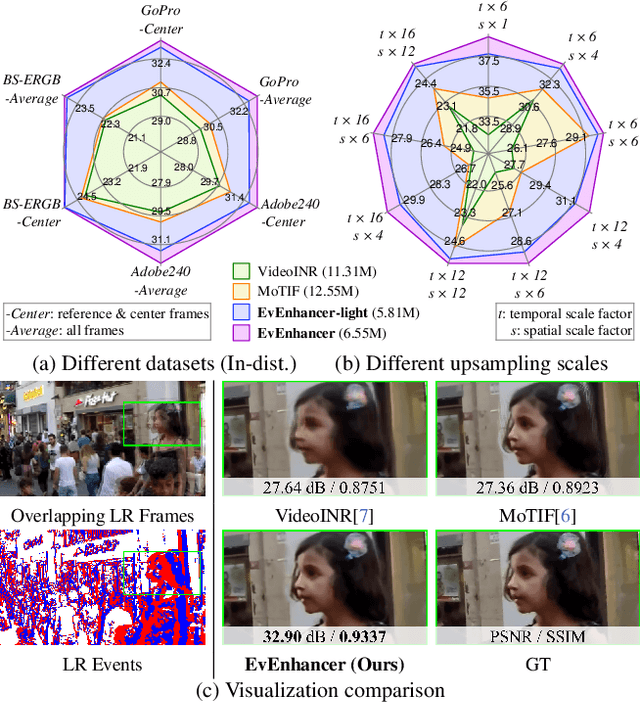
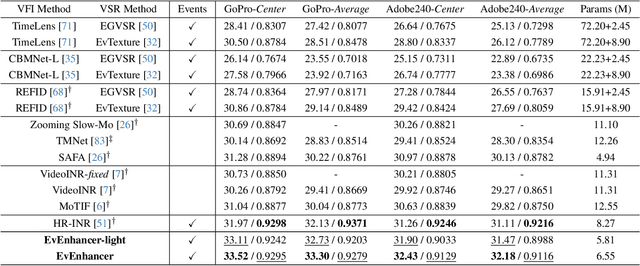
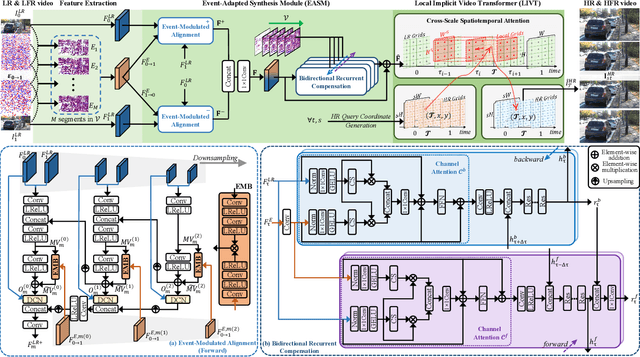
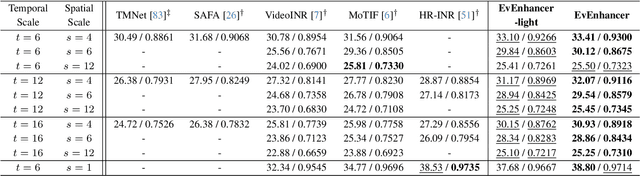
Continuous space-time video super-resolution (C-STVSR) endeavors to upscale videos simultaneously at arbitrary spatial and temporal scales, which has recently garnered increasing interest. However, prevailing methods struggle to yield satisfactory videos at out-of-distribution spatial and temporal scales. On the other hand, event streams characterized by high temporal resolution and high dynamic range, exhibit compelling promise in vision tasks. This paper presents EvEnhancer, an innovative approach that marries the unique advantages of event streams to elevate effectiveness, efficiency, and generalizability for C-STVSR. Our approach hinges on two pivotal components: 1) Event-adapted synthesis capitalizes on the spatiotemporal correlations between frames and events to discern and learn long-term motion trajectories, enabling the adaptive interpolation and fusion of informative spatiotemporal features; 2) Local implicit video transformer integrates local implicit video neural function with cross-scale spatiotemporal attention to learn continuous video representations utilized to generate plausible videos at arbitrary resolutions and frame rates. Experiments show that EvEnhancer achieves superiority on synthetic and real-world datasets and preferable generalizability on out-of-distribution scales against state-of-the-art methods. Code is available at https://github.com/W-Shuoyan/EvEnhancer.
NTIRE 2025 Challenge on Event-Based Image Deblurring: Methods and Results
Apr 16, 2025This paper presents an overview of NTIRE 2025 the First Challenge on Event-Based Image Deblurring, detailing the proposed methodologies and corresponding results. The primary goal of the challenge is to design an event-based method that achieves high-quality image deblurring, with performance quantitatively assessed using Peak Signal-to-Noise Ratio (PSNR). Notably, there are no restrictions on computational complexity or model size. The task focuses on leveraging both events and images as inputs for single-image deblurring. A total of 199 participants registered, among whom 15 teams successfully submitted valid results, offering valuable insights into the current state of event-based image deblurring. We anticipate that this challenge will drive further advancements in event-based vision research.