 Add to Chrome
 Add to Firefox
 Add to Edge
Machine Learning for Depression Screening and Intervention: an Original Circadian Rhythm Score-based Methodology
Jul 06, 2026
Depression screening from large-scale behavioral data is challenged by fragmented circadian indicators, limited interpretability, and the lack of intervention-oriented analysis. Existing approaches typically analyze sleep, activity, and social behaviors in isolation, failing to capture their joint circadian structure. To address this limitation, we first propose the Circadian Rhythm Score (CRS), a composite index that compresses multi-domain daily behaviors into a unified representation of circadian rhythm. CRS is constructed to maximize discriminative power for depression screening while preserving behavioral semantics through non-negativity constraints. Empirical results demonstrate near-lossless compression, where a single CRS retains almost the full predictive capability compared with multiple raw behavioral indicators. Building upon CRS, we develop an interpretable depression screening framework based on gradient-boosted trees and SHAP analysis, revealing nonlinear and saturation-like associations between circadian rhythm and depression risk. Beyond risk prediction, we further integrate interaction modeling and counterfactual regression to estimate heterogeneous and dose-dependent behavioral effects, enabling intervention-oriented reasoning under different circadian contexts. Experiments on the China Health and Retirement Longitudinal Study (CHARLS, n=15,233), demonstrate robust screening performance (ROC-AUC=0.825) and identify actionable behavioral thresholds, including a minimum effective exercise dose of approximately 300 MET-min/week and an optimal restorative nap duration of approximately 65 minutes for sleep-deprived individuals. By bridging supervised representation learning and interpretable modeling, this work provides a scalable framework for depression screening and intervention-aware healthcare data mining.

Profiling Neural Blocks and Design Spaces for Mobile Neural Architecture Search
Sep 25, 2021
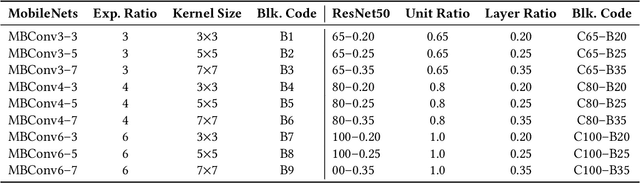
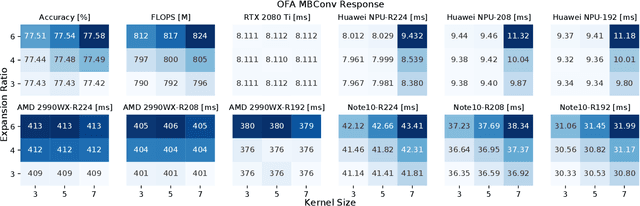
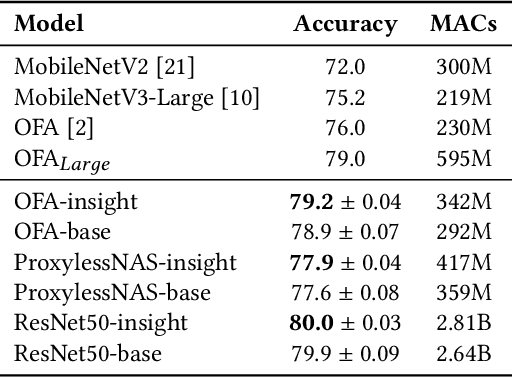
Neural architecture search automates neural network design and has achieved state-of-the-art results in many deep learning applications. While recent literature has focused on designing networks to maximize accuracy, little work has been conducted to understand the compatibility of architecture design spaces to varying hardware. In this paper, we analyze the neural blocks used to build Once-for-All (MobileNetV3), ProxylessNAS and ResNet families, in order to understand their predictive power and inference latency on various devices, including Huawei Kirin 9000 NPU, RTX 2080 Ti, AMD Threadripper 2990WX, and Samsung Note10. We introduce a methodology to quantify the friendliness of neural blocks to hardware and the impact of their placement in a macro network on overall network performance via only end-to-end measurements. Based on extensive profiling results, we derive design insights and apply them to hardware-specific search space reduction. We show that searching in the reduced search space generates better accuracy-latency Pareto frontiers than searching in the original search spaces, customizing architecture search according to the hardware. Moreover, insights derived from measurements lead to notably higher ImageNet top-1 scores on all search spaces investigated.
L$^{2}$NAS: Learning to Optimize Neural Architectures via Continuous-Action Reinforcement Learning
Sep 25, 2021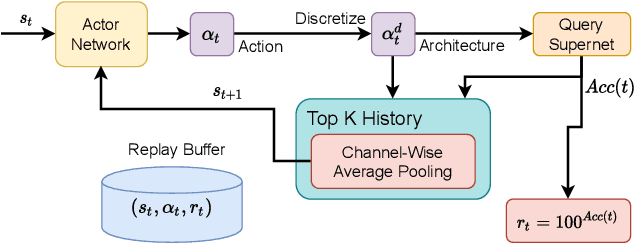
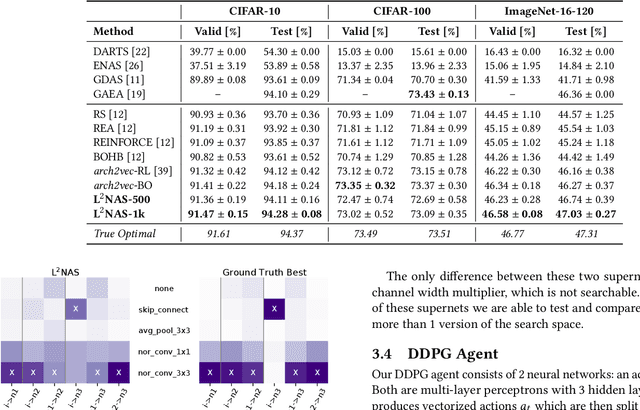
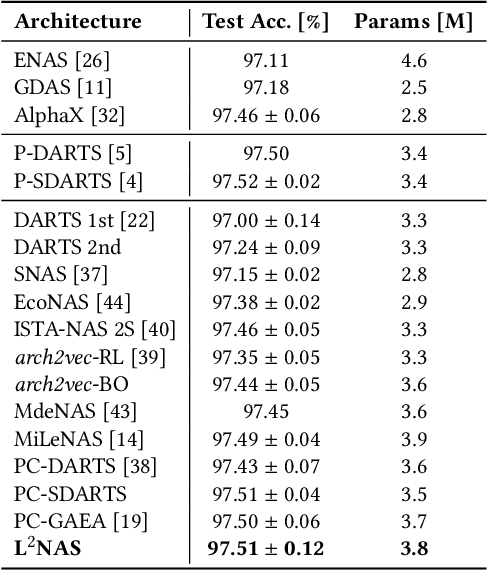
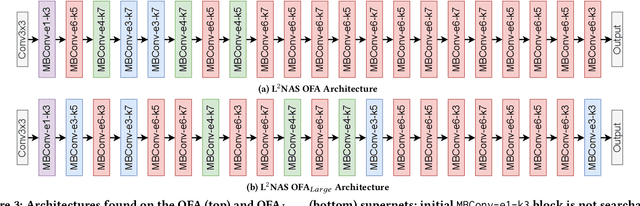
Neural architecture search (NAS) has achieved remarkable results in deep neural network design. Differentiable architecture search converts the search over discrete architectures into a hyperparameter optimization problem which can be solved by gradient descent. However, questions have been raised regarding the effectiveness and generalizability of gradient methods for solving non-convex architecture hyperparameter optimization problems. In this paper, we propose L$^{2}$NAS, which learns to intelligently optimize and update architecture hyperparameters via an actor neural network based on the distribution of high-performing architectures in the search history. We introduce a quantile-driven training procedure which efficiently trains L$^{2}$NAS in an actor-critic framework via continuous-action reinforcement learning. Experiments show that L$^{2}$NAS achieves state-of-the-art results on NAS-Bench-201 benchmark as well as DARTS search space and Once-for-All MobileNetV3 search space. We also show that search policies generated by L$^{2}$NAS are generalizable and transferable across different training datasets with minimal fine-tuning.
Generative Adversarial Neural Architecture Search
May 19, 2021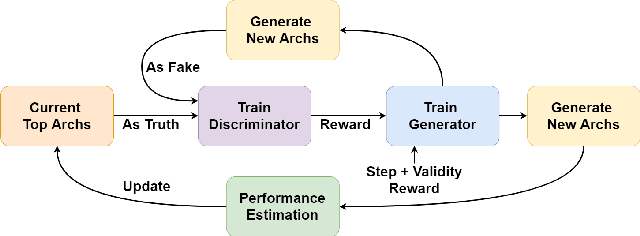
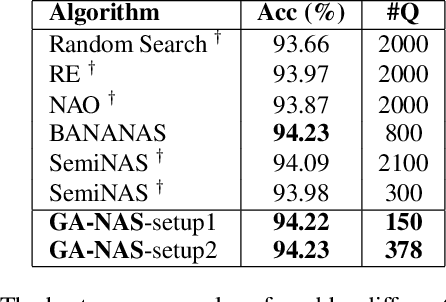
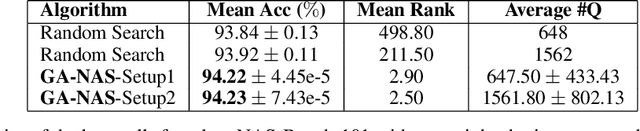
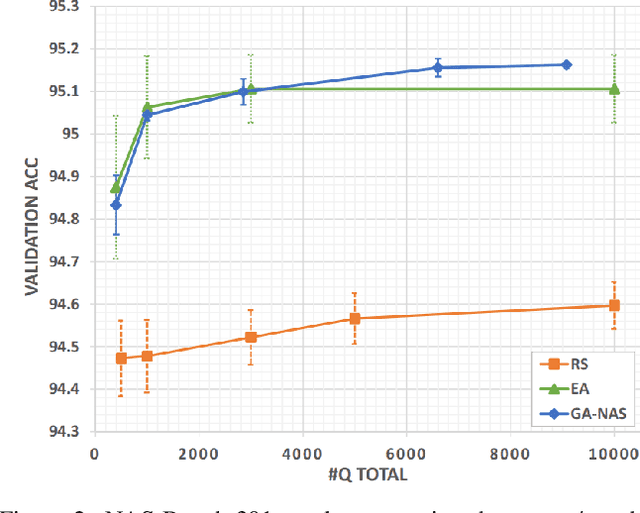
Despite the empirical success of neural architecture search (NAS) in deep learning applications, the optimality, reproducibility and cost of NAS schemes remain hard to assess. In this paper, we propose Generative Adversarial NAS (GA-NAS) with theoretically provable convergence guarantees, promoting stability and reproducibility in neural architecture search. Inspired by importance sampling, GA-NAS iteratively fits a generator to previously discovered top architectures, thus increasingly focusing on important parts of a large search space. Furthermore, we propose an efficient adversarial learning approach, where the generator is trained by reinforcement learning based on rewards provided by a discriminator, thus being able to explore the search space without evaluating a large number of architectures. Extensive experiments show that GA-NAS beats the best published results under several cases on three public NAS benchmarks. In the meantime, GA-NAS can handle ad-hoc search constraints and search spaces. We show that GA-NAS can be used to improve already optimized baselines found by other NAS methods, including EfficientNet and ProxylessNAS, in terms of ImageNet accuracy or the number of parameters, in their original search space.