 Add to Chrome
 Add to Firefox
 Add to Edge
Machine Learning for Depression Screening and Intervention: an Original Circadian Rhythm Score-based Methodology
Jul 06, 2026
Depression screening from large-scale behavioral data is challenged by fragmented circadian indicators, limited interpretability, and the lack of intervention-oriented analysis. Existing approaches typically analyze sleep, activity, and social behaviors in isolation, failing to capture their joint circadian structure. To address this limitation, we first propose the Circadian Rhythm Score (CRS), a composite index that compresses multi-domain daily behaviors into a unified representation of circadian rhythm. CRS is constructed to maximize discriminative power for depression screening while preserving behavioral semantics through non-negativity constraints. Empirical results demonstrate near-lossless compression, where a single CRS retains almost the full predictive capability compared with multiple raw behavioral indicators. Building upon CRS, we develop an interpretable depression screening framework based on gradient-boosted trees and SHAP analysis, revealing nonlinear and saturation-like associations between circadian rhythm and depression risk. Beyond risk prediction, we further integrate interaction modeling and counterfactual regression to estimate heterogeneous and dose-dependent behavioral effects, enabling intervention-oriented reasoning under different circadian contexts. Experiments on the China Health and Retirement Longitudinal Study (CHARLS, n=15,233), demonstrate robust screening performance (ROC-AUC=0.825) and identify actionable behavioral thresholds, including a minimum effective exercise dose of approximately 300 MET-min/week and an optimal restorative nap duration of approximately 65 minutes for sleep-deprived individuals. By bridging supervised representation learning and interpretable modeling, this work provides a scalable framework for depression screening and intervention-aware healthcare data mining.

Unlocking air traffic flow prediction through microscopic aircraft-state modeling
May 11, 2026Short-term air traffic flow prediction in terminal airspace is essential for proactive air traffic management. Existing approaches predominantly model traffic flow as aggregated time series, despite traffic dynamics being governed by aircraft states and interactions in continuous airspace. Such aggregation obscures fine-grained information including aircraft kinematics, boundary interactions, and control intent. Here we present AeroSense, a state-to-flow modeling framework that predicts future traffic flow directly from instantaneous airspace situations represented as dynamic sets of aircraft states derived from ADS-B trajectories. By establishing an end-to-end mapping from microscopic aircraft states to future regional traffic flow, AeroSense preserves aircraft-level dynamics while naturally accommodating varying traffic density without relying on historical look-back windows. Experiments on a large-scale real-world dataset show that AeroSense consistently improves predictive accuracy over aggregation-based forecasting approaches, particularly during high-density traffic periods. These findings suggest that instantaneous airspace situations provide an effective alternative to conventional time-series-based traffic forecasting paradigms.
Multi-fold Correlation Attention Network for Predicting Traffic Speeds with Heterogeneous Frequency
Apr 19, 2021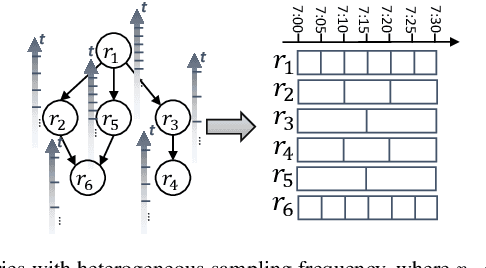
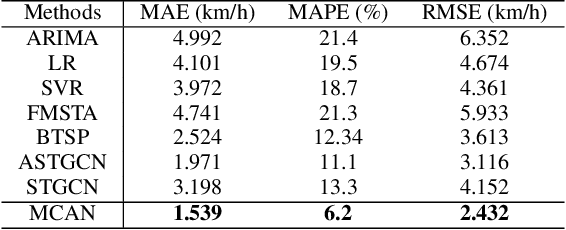
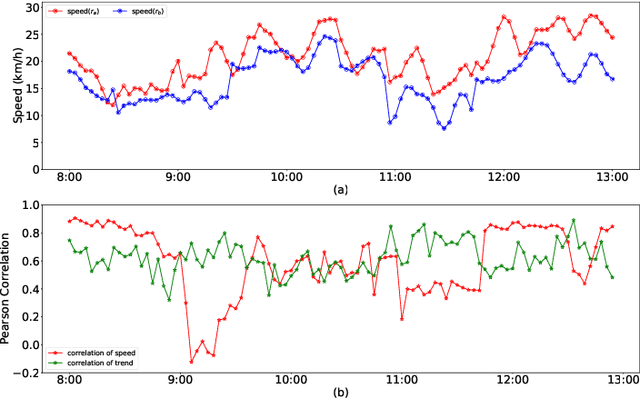
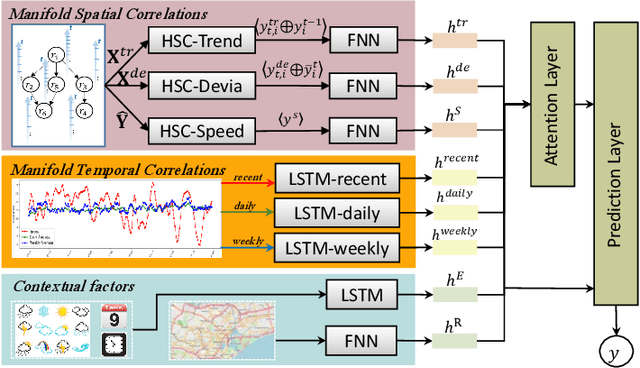
Substantial efforts have been devoted to the investigation of spatiotemporal correlations for improving traffic speed prediction accuracy. However, existing works typically model the correlations based solely on the observed traffic state (e.g. traffic speed) without due consideration that different correlation measurements of the traffic data could exhibit a diverse set of patterns under different traffic situations. In addition, the existing works assume that all road segments can employ the same sampling frequency of traffic states, which is impractical. In this paper, we propose new measurements to model the spatial correlations among traffic data and show that the resulting correlation patterns vary significantly under various traffic situations. We propose a Heterogeneous Spatial Correlation (HSC) model to capture the spatial correlation based on a specific measurement, where the traffic data of varying road segments can be heterogeneous (i.e. obtained with different sampling frequency). We propose a Multi-fold Correlation Attention Network (MCAN), which relies on the HSC model to explore multi-fold spatial correlations and leverage LSTM networks to capture multi-fold temporal correlations to provide discriminating features in order to achieve accurate traffic prediction. The learned multi-fold spatiotemporal correlations together with contextual factors are fused with attention mechanism to make the final predictions. Experiments on real-world datasets demonstrate that the proposed MCAN model outperforms the state-of-the-art baselines.