 Add to Chrome
 Add to Firefox
 Add to Edge
AcceRL: A Distributed Asynchronous Reinforcement Learning and World Model Framework for Vision-Language-Action Models
Mar 19, 2026
Reinforcement learning (RL) for large-scale Vision-Language-Action (VLA) models faces significant challenges in computational efficiency and data acquisition. We propose AcceRL, a fully asynchronous and decoupled RL framework designed to eliminate synchronization barriers by physically isolating training, inference, and rollouts. Crucially, AcceRL is the first to integrate a plug-and-play, trainable world model into a distributed asynchronous RL pipeline to generate virtual experiences. Experiments on the LIBERO benchmark demonstrate that AcceRL achieves state-of-the-art (SOTA) performance. Systematically, it exhibits super-linear scaling in throughput and highly efficient hardware utilization. Algorithmically, the world-model-augmented variant delivers unprecedented sample efficiency and robust training stability in complex control tasks.

GIPO: Gaussian Importance Sampling Policy Optimization
Mar 04, 2026Post-training with reinforcement learning (RL) has recently shown strong promise for advancing multimodal agents beyond supervised imitation. However, RL remains limited by poor data efficiency, particularly in settings where interaction data are scarce and quickly become outdated. To address this challenge, GIPO (Gaussian Importance sampling Policy Optimization) is proposed as a policy optimization objective based on truncated importance sampling, replacing hard clipping with a log-ratio-based Gaussian trust weight to softly damp extreme importance ratios while maintaining non-zero gradients. Theoretical analysis shows that GIPO introduces an implicit, tunable constraint on the update magnitude, while concentration bounds guarantee robustness and stability under finite-sample estimation. Experimental results show that GIPO achieves state-of-the-art performance among clipping-based baselines across a wide range of replay buffer sizes, from near on-policy to highly stale data, while exhibiting superior bias--variance trade-off, high training stability and improved sample efficiency.
Monte Carlo Tree Search based Space Transfer for Black-box Optimization
Dec 10, 2024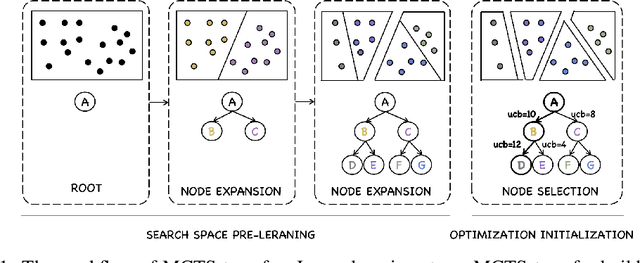
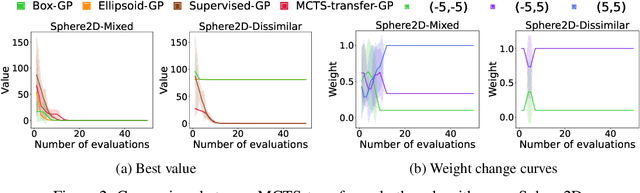
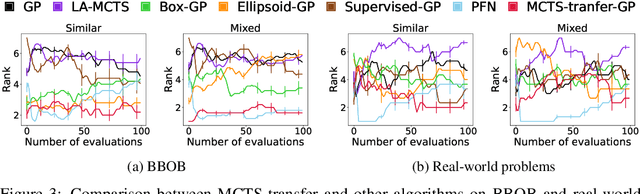

Bayesian optimization (BO) is a popular method for computationally expensive black-box optimization. However, traditional BO methods need to solve new problems from scratch, leading to slow convergence. Recent studies try to extend BO to a transfer learning setup to speed up the optimization, where search space transfer is one of the most promising approaches and has shown impressive performance on many tasks. However, existing search space transfer methods either lack an adaptive mechanism or are not flexible enough, making it difficult to efficiently identify promising search space during the optimization process. In this paper, we propose a search space transfer learning method based on Monte Carlo tree search (MCTS), called MCTS-transfer, to iteratively divide, select, and optimize in a learned subspace. MCTS-transfer can not only provide a well-performing search space for warm-start but also adaptively identify and leverage the information of similar source tasks to reconstruct the search space during the optimization process. Experiments on synthetic functions, real-world problems, Design-Bench and hyper-parameter optimization show that MCTS-transfer can demonstrate superior performance compared to other search space transfer methods under different settings. Our code is available at \url{https://github.com/lamda-bbo/mcts-transfer}.