 Add to Chrome
 Add to Firefox
 Add to Edge
MemCam: Memory-Augmented Camera Control for Consistent Video Generation
Mar 27, 2026
Interactive video generation has significant potential for scene simulation and video creation. However, existing methods often struggle with maintaining scene consistency during long video generation under dynamic camera control due to limited contextual information. To address this challenge, we propose MemCam, a memory-augmented interactive video generation approach that treats previously generated frames as external memory and leverages them as contextual conditioning to achieve controllable camera viewpoints with high scene consistency. To enable longer and more relevant context, we design a context compression module that encodes memory frames into compact representations and employs co-visibility-based selection to dynamically retrieve the most relevant historical frames, thereby reducing computational overhead while enriching contextual information. Experiments on interactive video generation tasks show that MemCam significantly outperforms existing baseline methods as well as open-source state-of-the-art approaches in terms of scene consistency, particularly in long video scenarios with large camera rotations.

Efficient Knowledge Infusion via KG-LLM Alignment
Jun 06, 2024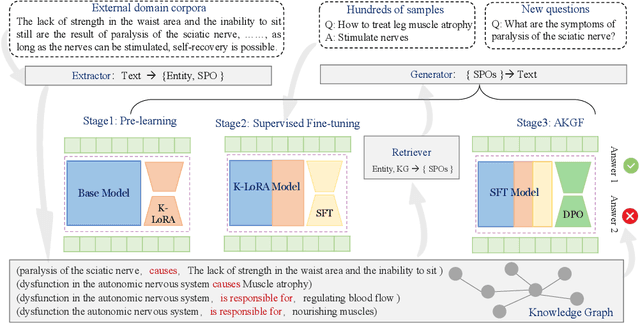
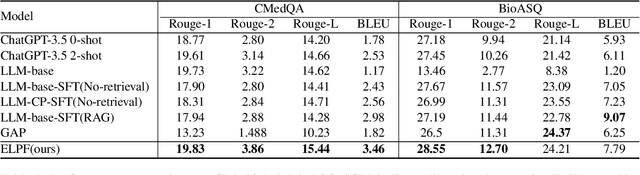
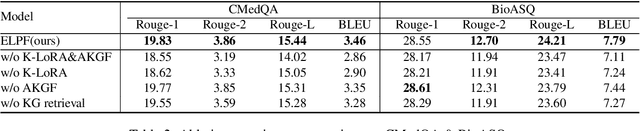
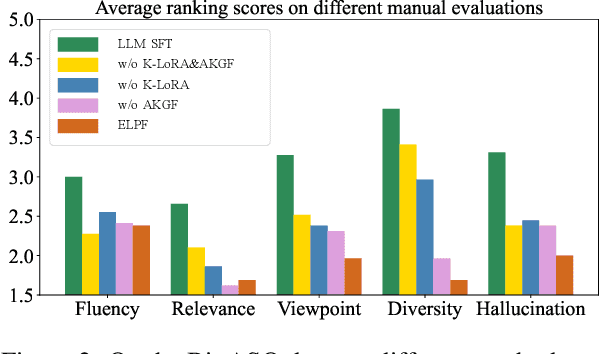
To tackle the problem of domain-specific knowledge scarcity within large language models (LLMs), knowledge graph-retrievalaugmented method has been proven to be an effective and efficient technique for knowledge infusion. However, existing approaches face two primary challenges: knowledge mismatch between public available knowledge graphs and the specific domain of the task at hand, and poor information compliance of LLMs with knowledge graphs. In this paper, we leverage a small set of labeled samples and a large-scale corpus to efficiently construct domain-specific knowledge graphs by an LLM, addressing the issue of knowledge mismatch. Additionally, we propose a three-stage KG-LLM alignment strategyto enhance the LLM's capability to utilize information from knowledge graphs. We conduct experiments with a limited-sample setting on two biomedical question-answering datasets, and the results demonstrate that our approach outperforms existing baselines.