 Add to Chrome
 Add to Firefox
 Add to Edge
GAUGE: Grading Agent-Built Financial Models Without a Golden Answer
Jul 27, 2026
Financial models combine public disclosures with analyst assumptions to produce forecasts and valuations. While some components can be checked mechanically, forecasts, discount rates, and target prices often admit multiple reasonable answers. Existing benchmarks nevertheless tend to grade such outputs against a single expert reference. Using independently built analyst models for the same companies, we find that across 108 directed pairs covering 65 companies, the median single-reference score is 0.33, 92.6% score below 0.70, and no same-vintage pair agrees on implied price within 10%. Point-tolerance grading can therefore penalize disagreement already present among professionals. We introduce GAUGE, a benchmark for evaluating agent-built valuation models against observed analyst practice rather than a single point answer. GAUGE uses 1,001 vendor-classified analyst workbooks and a 196-task evaluation set, with a three-layer observed-practice envelope, 56 auditable facets, eight validity gates, and deterministic structural checks. We validate the benchmark with a 55-participant known-groups study, company-grouped cross-fitting, and judge-stability audits. On the failure-aware score $φ_0$, senior analysts average 88.3, juniors 66.0, and finance students 43.2. Across 24 agents and 1,011 scored generations, the best agent scores 53.4, above the student mean but below every senior and most juniors. It passes 93% of mechanical facets and 78% of judgment facets, with a fleet-median gap of 26 points. Current agents are substantially stronger at model construction than valuation judgment. We release the methodology, a gated de-identified data tier, a controlled training split, a versioned 48-task evaluation core, and a withheld refresh pool.

Efficient Knowledge Infusion via KG-LLM Alignment
Jun 06, 2024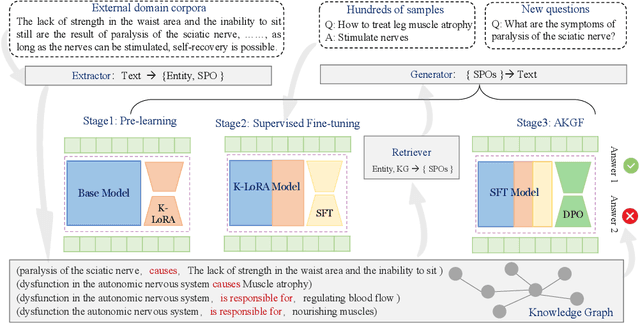
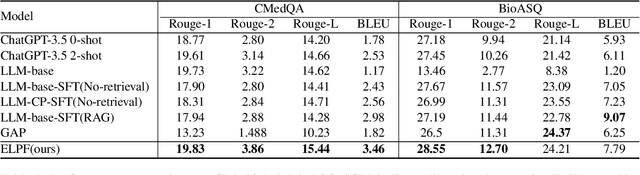
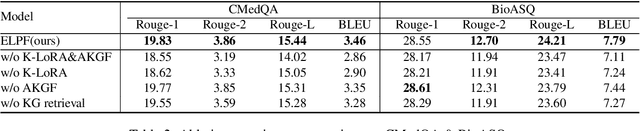
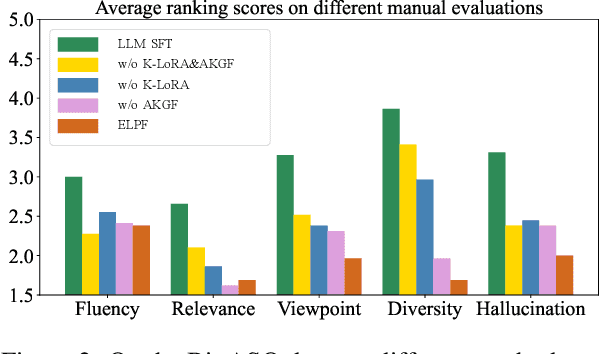
To tackle the problem of domain-specific knowledge scarcity within large language models (LLMs), knowledge graph-retrievalaugmented method has been proven to be an effective and efficient technique for knowledge infusion. However, existing approaches face two primary challenges: knowledge mismatch between public available knowledge graphs and the specific domain of the task at hand, and poor information compliance of LLMs with knowledge graphs. In this paper, we leverage a small set of labeled samples and a large-scale corpus to efficiently construct domain-specific knowledge graphs by an LLM, addressing the issue of knowledge mismatch. Additionally, we propose a three-stage KG-LLM alignment strategyto enhance the LLM's capability to utilize information from knowledge graphs. We conduct experiments with a limited-sample setting on two biomedical question-answering datasets, and the results demonstrate that our approach outperforms existing baselines.
Reverse Chain: A Generic-Rule for LLMs to Master Multi-API Planning
Oct 10, 2023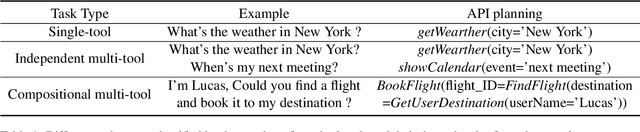
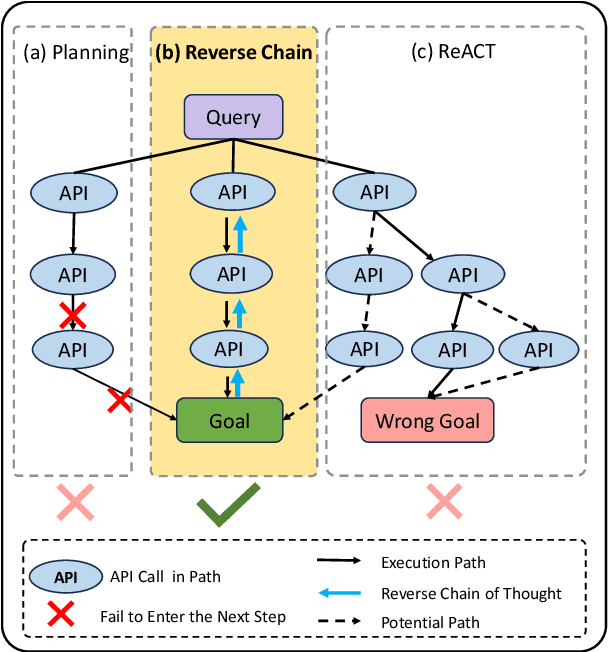
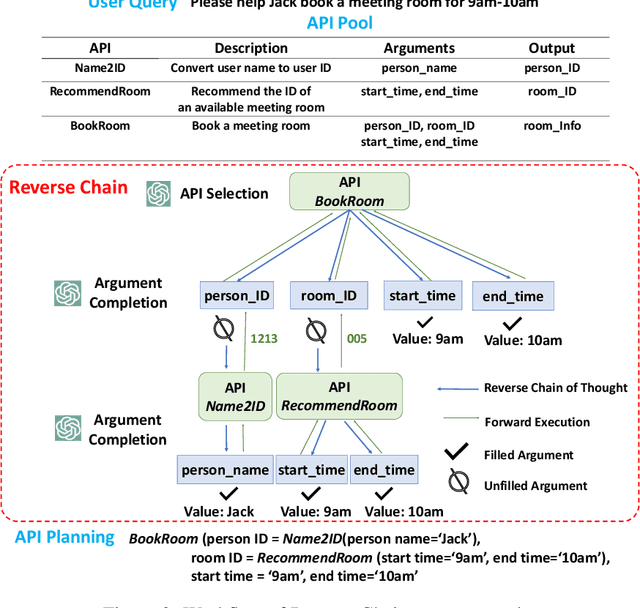
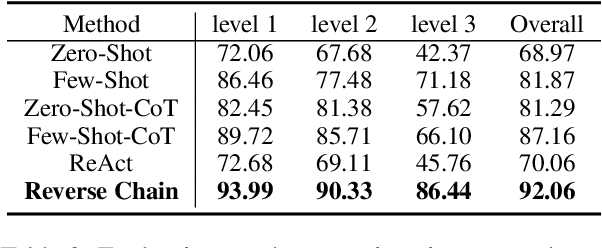
While enabling large language models to implement function calling (known as APIs) can greatly enhance the performance of LLMs, function calling is still a challenging task due to the complicated relations between different APIs, especially in a context-learning setting without fine-tuning. This paper proposes a simple yet controllable target-driven approach called Reverse Chain to empower LLMs with capabilities to use external APIs with only prompts. Given that most open-source LLMs have limited tool-use or tool-plan capabilities, LLMs in Reverse Chain are only employed to implement simple tasks, e.g., API selection and argument completion, and a generic rule is employed to implement a controllable multiple functions calling. In this generic rule, after selecting a final API to handle a given task via LLMs, we first ask LLMs to fill the required arguments from user query and context. Some missing arguments could be further completed by letting LLMs select another API based on API description before asking user. This process continues until a given task is completed. Extensive numerical experiments indicate an impressive capability of Reverse Chain on implementing multiple function calling. Interestingly enough, the experiments also reveal that tool-use capabilities of the existing LLMs, e.g., ChatGPT, can be greatly improved via Reverse Chain.