 Add to Chrome
 Add to Firefox
 Add to Edge
MemCam: Memory-Augmented Camera Control for Consistent Video Generation
Mar 27, 2026
Interactive video generation has significant potential for scene simulation and video creation. However, existing methods often struggle with maintaining scene consistency during long video generation under dynamic camera control due to limited contextual information. To address this challenge, we propose MemCam, a memory-augmented interactive video generation approach that treats previously generated frames as external memory and leverages them as contextual conditioning to achieve controllable camera viewpoints with high scene consistency. To enable longer and more relevant context, we design a context compression module that encodes memory frames into compact representations and employs co-visibility-based selection to dynamically retrieve the most relevant historical frames, thereby reducing computational overhead while enriching contextual information. Experiments on interactive video generation tasks show that MemCam significantly outperforms existing baseline methods as well as open-source state-of-the-art approaches in terms of scene consistency, particularly in long video scenarios with large camera rotations.

IDO-VFI: Identifying Dynamics via Optical Flow Guidance for Video Frame Interpolation with Events
May 18, 2023
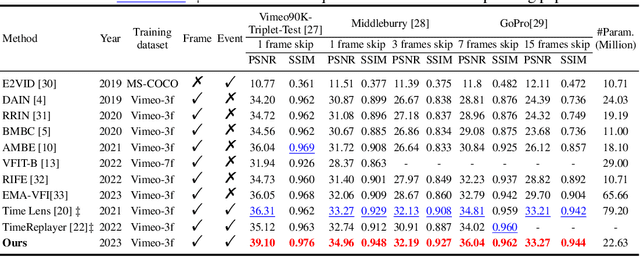

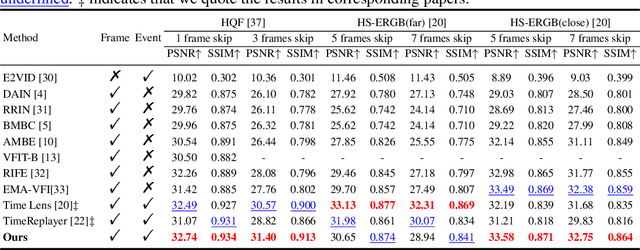
Video frame interpolation aims to generate high-quality intermediate frames from boundary frames and increase frame rate. While existing linear, symmetric and nonlinear models are used to bridge the gap from the lack of inter-frame motion, they cannot reconstruct real motions. Event cameras, however, are ideal for capturing inter-frame dynamics with their extremely high temporal resolution. In this paper, we propose an event-and-frame-based video frame interpolation method named IDO-VFI that assigns varying amounts of computation for different sub-regions via optical flow guidance. The proposed method first estimates the optical flow based on frames and events, and then decides whether to further calculate the residual optical flow in those sub-regions via a Gumbel gating module according to the optical flow amplitude. Intermediate frames are eventually generated through a concise Transformer-based fusion network. Our proposed method maintains high-quality performance while reducing computation time and computational effort by 10% and 17% respectively on Vimeo90K datasets, compared with a unified process on the whole region. Moreover, our method outperforms state-of-the-art frame-only and frames-plus-events methods on multiple video frame interpolation benchmarks. Codes and models are available at https://github.com/shicy17/IDO-VFI.