 Add to Chrome
 Add to Firefox
 Add to Edge
A Systematic Approach for Large Language Models Debugging
Apr 24, 2026
Large language models (LLMs) have become central to modern AI workflows, powering applications from open-ended text generation to complex agent-based reasoning. However, debugging these models remains a persistent challenge due to their opaque and probabilistic nature and the difficulty of diagnosing errors across diverse tasks and settings. This paper introduces a systematic approach for LLM debugging that treats models as observable systems, providing structured, model-agnostic methods from issue detection to model refinement. By unifying evaluation, interpretability, and error-analysis practices, our approach enables practitioners to iteratively diagnose model weaknesses, refine prompts and model parameters, and adapt data for fine-tuning or assessment, while remaining effective in contexts where standardized benchmarks and evaluation criteria are lacking. We argue that such a structured methodology not only accelerates troubleshooting but also fosters reproducibility, transparency, and scalability in the deployment of LLM-based systems.

Enterprise Benchmarks for Large Language Model Evaluation
Oct 11, 2024
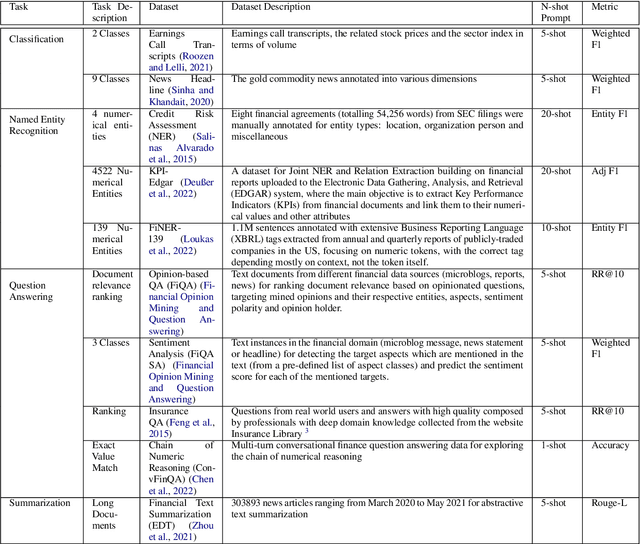
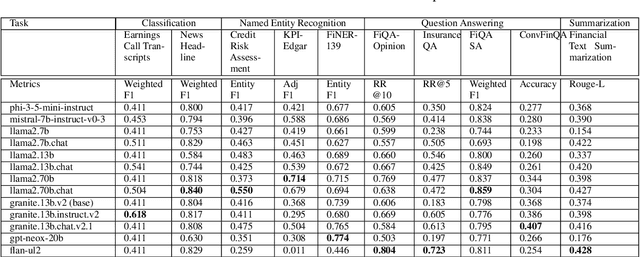
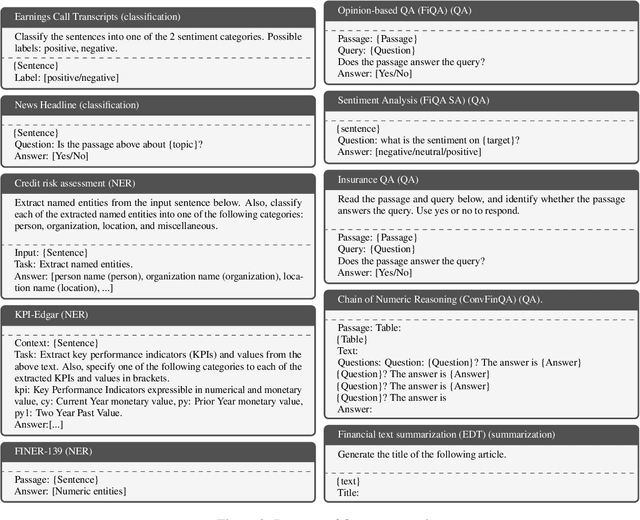
The advancement of large language models (LLMs) has led to a greater challenge of having a rigorous and systematic evaluation of complex tasks performed, especially in enterprise applications. Therefore, LLMs need to be able to benchmark enterprise datasets for various tasks. This work presents a systematic exploration of benchmarking strategies tailored to LLM evaluation, focusing on the utilization of domain-specific datasets and consisting of a variety of NLP tasks. The proposed evaluation framework encompasses 25 publicly available datasets from diverse enterprise domains like financial services, legal, cyber security, and climate and sustainability. The diverse performance of 13 models across different enterprise tasks highlights the importance of selecting the right model based on the specific requirements of each task. Code and prompts are available on GitHub.