 Add to Chrome
 Add to Firefox
 Add to Edge
Automated Hardware Validation Test Plan Generation for Large Scale AI Datacenter Platforms Using a Generative AI Multi-Agents Architecture
Jul 17, 2026
Large-scale AI datacenter platforms comprise thousands of heterogeneous hardware components whose validation requires comprehensive fault injection test plans. Today these plans are authored manually: engineers review hardware self-healing validation documents and bills of materials, enumerate failure modes per field-replaceable unit, and produce flat lists of single-layer test cases. This process is labor-intensive, error-prone, and dependent on institutional knowledge; coverage gaps surface late, traceability to source specifications is implicit, and the effort is largely repeated per platform. This paper presents a generative AI multi-agent architecture that automates the generation of structured hardware validation test plans from two canonical inputs: self-healing validation documents, which enumerate known failure modes and their detection and remediation behaviors per field-replaceable unit, and component Bills of Material. An ingestion agent normalizes heterogeneous inputs into a canonical representation; a classification agent maps components to functional domains via contextual reasoning over part descriptions and sub-category hierarchies; and a generation agent synthesizes test cases by combining normalized failure modes with domain-classified data, filling gaps and producing edge cases. The output conforms to a standardized schema for direct import into internal validation software. Evaluated on two production platforms against manual baselines, the framework achieves coverage expansions of 74.2% and 51.4%, cutting authoring from days to hours. It yields fully traceable mappings from each test case to its source specification, and its multi-agent decomposition is portable across platform generations. Automated and expert evaluations confirm 100% extraction fidelity and high acceptance of new scenarios, validating the framework as a robust human-in-the-loop force multiplier.

A Systematic Approach for Large Language Models Debugging
Apr 24, 2026Large language models (LLMs) have become central to modern AI workflows, powering applications from open-ended text generation to complex agent-based reasoning. However, debugging these models remains a persistent challenge due to their opaque and probabilistic nature and the difficulty of diagnosing errors across diverse tasks and settings. This paper introduces a systematic approach for LLM debugging that treats models as observable systems, providing structured, model-agnostic methods from issue detection to model refinement. By unifying evaluation, interpretability, and error-analysis practices, our approach enables practitioners to iteratively diagnose model weaknesses, refine prompts and model parameters, and adapt data for fine-tuning or assessment, while remaining effective in contexts where standardized benchmarks and evaluation criteria are lacking. We argue that such a structured methodology not only accelerates troubleshooting but also fosters reproducibility, transparency, and scalability in the deployment of LLM-based systems.
QnAMaker: Data to Bot in 2 Minutes
Mar 19, 2020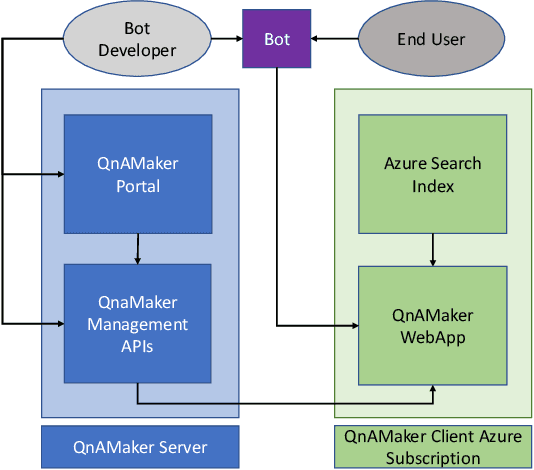
Having a bot for seamless conversations is a much-desired feature that products and services today seek for their websites and mobile apps. These bots help reduce traffic received by human support significantly by handling frequent and directly answerable known questions. Many such services have huge reference documents such as FAQ pages, which makes it hard for users to browse through this data. A conversation layer over such raw data can lower traffic to human support by a great margin. We demonstrate QnAMaker, a service that creates a conversational layer over semi-structured data such as FAQ pages, product manuals, and support documents. QnAMaker is the popular choice for Extraction and Question-Answering as a service and is used by over 15,000 bots in production. It is also used by search interfaces and not just bots.