 Add to Chrome
 Add to Firefox
 Add to Edge
Long SKILL Compliance as Logical Reasoning: Closure-Grounded Detection with Scaling-Guided On-Policy Distillation
Aug 08, 2026
The increasing complexity of enterprise business scenarios has promoted the widespread adoption of long SKILL documents in agent systems, posing new challenges for compliance detection: large models incur substantial inference costs, while small models may fail to maintain detection accuracy. To address this gap, we propose SkillCDG, a graph-based framework for long SKILL compliance detection. SkillCDG represents complex business policies as a two-layer constraint dependency graph, where the upper layer indexes SKILL descriptions for scenario routing and the lower layer captures dependencies among atomic constraints within each SKILL. During inference, two-level retrieval followed by dependency closure supports compliance judgment and source traceability. We comprehensively evaluate the framework on three enterprise datasets and two controlled public benchmark variants. Experimental results demonstrate that SkillCDG outperforms baseline methods by up to 12.8 percentage points in detection F1 score, while reducing token consumption by a maximum 64.3\%. Moreover, we further investigate the inherent relationships among policy-graph complexity, model scale, and detection performance. Comparative experiments conducted on four checkpoints from a single model family validate a concise and effective scaling trend: end-to-end detection correctness exhibits a complexity-differentiated scaling pattern, and the complexity metric derived from the constraint dependency graph can effectively quantify instance difficulty and the performance improvement potential of models. Leveraging this insightful scaling trend, we conduct adaptive training sample selection and adopt on-policy distillation to efficiently enhance the compliance detection capability of small-scale models.

How Much, Then Where: Credit-Conserving Action-to-Token Allocation for Multi-Turn Agent Reinforcement Learning
Aug 07, 2026Credit assignment in multi-turn agent reinforcement learning operates at two levels: assigning trajectory-level credit to actions and distributing each action's credit across its tokens. In this paper, we introduce FACTOR, which separates these decisions. FACTOR uses checkpoint-calibrated TD residuals to assign per-action credits that telescope to the trajectory advantage, and feedback-conditioned teacher-student likelihood gaps to allocate each credit across the realized action tokens. Per-action normalization preserves the action-average coefficient and prevents token-level sign flips. We pair this construction with an action-mean reduction, removing the implicit dependence of an action's scalar surrogate weight on its token length. At the behavior policy and before clipping, each action's inner action-mean surrogate equals its TD credit. FACTOR consistently improves over competitive baselines across ALFWorld, WebShop, and ScienceWorld, with every environment-seed comparison favoring FACTOR and the largest gains emerging on the longest-horizon environment. The same hyperparameters transfer without retuning to a larger backbone and to a different model family. Ablations identify TD action credit as the dominant driver of the improvement, with hindsight token allocation contributing complementary gains.
DPIT: Dual-Pipeline Integrated Transformer for Human Pose Estimation
Sep 02, 2022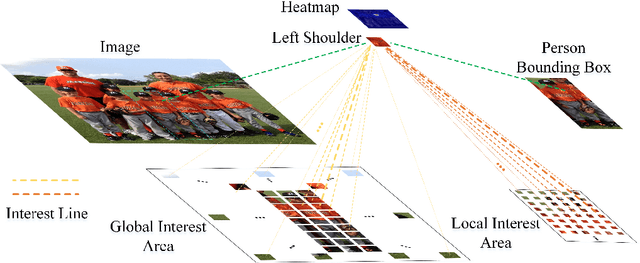
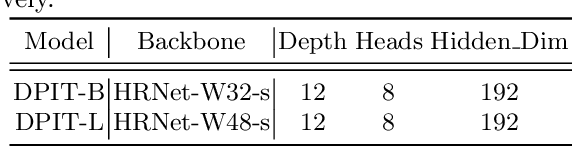
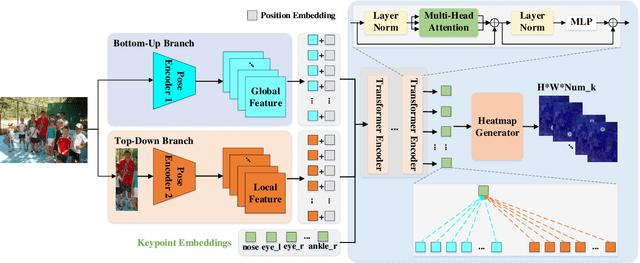
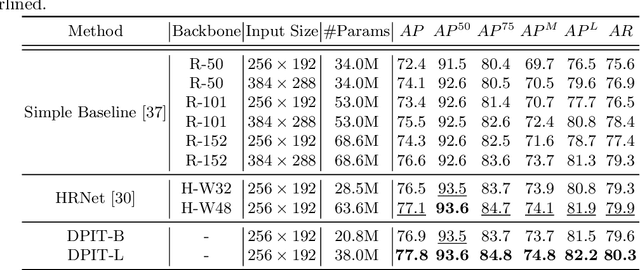
Human pose estimation aims to figure out the keypoints of all people in different scenes. Current approaches still face some challenges despite promising results. Existing top-down methods deal with a single person individually, without the interaction between different people and the scene they are situated in. Consequently, the performance of human detection degrades when serious occlusion happens. On the other hand, existing bottom-up methods consider all people at the same time and capture the global knowledge of the entire image. However, they are less accurate than the top-down methods due to the scale variation. To address these problems, we propose a novel Dual-Pipeline Integrated Transformer (DPIT) by integrating top-down and bottom-up pipelines to explore the visual clues of different receptive fields and achieve their complementarity. Specifically, DPIT consists of two branches, the bottom-up branch deals with the whole image to capture the global visual information, while the top-down branch extracts the feature representation of local vision from the single-human bounding box. Then, the extracted feature representations from bottom-up and top-down branches are fed into the transformer encoder to fuse the global and local knowledge interactively. Moreover, we define the keypoint queries to explore both full-scene and single-human posture visual clues to realize the mutual complementarity of the two pipelines. To the best of our knowledge, this is one of the first works to integrate the bottom-up and top-down pipelines with transformers for human pose estimation. Extensive experiments on COCO and MPII datasets demonstrate that our DPIT achieves comparable performance to the state-of-the-art methods.