 Add to Chrome
 Add to Firefox
 Add to Edge
Athena-WBC: Capability-Aligned Policy Experts for Long-Tail Humanoid Whole-Body Control
Jul 06, 2026
Large-scale humanoid motion-tracking controllers are commonly improved by reallocating training effort: difficult motions are sampled more often, isolated into smaller subsets, or assigned to specialized experts. We show that this view is incomplete. In strong whole-body-control baselines, a residual set of feasible training clips remains unsolved even under targeted training, especially for high-dynamic transitions and balance-critical motions. These failures arise not only from insufficient exposure, but from a mismatch between the motion demands and the effective capability induced by the default training recipe. We propose Athena-WBC, a compact teacher-student pipeline with capability-aligned policy experts for long-tail humanoid whole-body control. Dynamic experts use a tracking-focused, constraint-aware objective that removes conservative effort and temporal-control penalties while preserving physical feasibility constraints; balance experts use a gravity curriculum to improve early-training survivability. The resulting privileged teachers are motion-routed for DAgger distillation and then compressed into a single controller with deployable observations followed by RL fine-tuning. Experiments on a full-size humanoid show improved recovery of training-set long-tail motions and better held-out tracking than a strong SONIC-recipe baseline, using only a small number of experts.

MASH: Cooperative-Heterogeneous Multi-Agent Reinforcement Learning for Single Humanoid Robot Locomotion
Aug 14, 2025This paper proposes a novel method to enhance locomotion for a single humanoid robot through cooperative-heterogeneous multi-agent deep reinforcement learning (MARL). While most existing methods typically employ single-agent reinforcement learning algorithms for a single humanoid robot or MARL algorithms for multi-robot system tasks, we propose a distinct paradigm: applying cooperative-heterogeneous MARL to optimize locomotion for a single humanoid robot. The proposed method, multi-agent reinforcement learning for single humanoid locomotion (MASH), treats each limb (legs and arms) as an independent agent that explores the robot's action space while sharing a global critic for cooperative learning. Experiments demonstrate that MASH accelerates training convergence and improves whole-body cooperation ability, outperforming conventional single-agent reinforcement learning methods. This work advances the integration of MARL into single-humanoid-robot control, offering new insights into efficient locomotion strategies.
MASQ: Multi-Agent Reinforcement Learning for Single Quadruped Robot Locomotion
Aug 25, 2024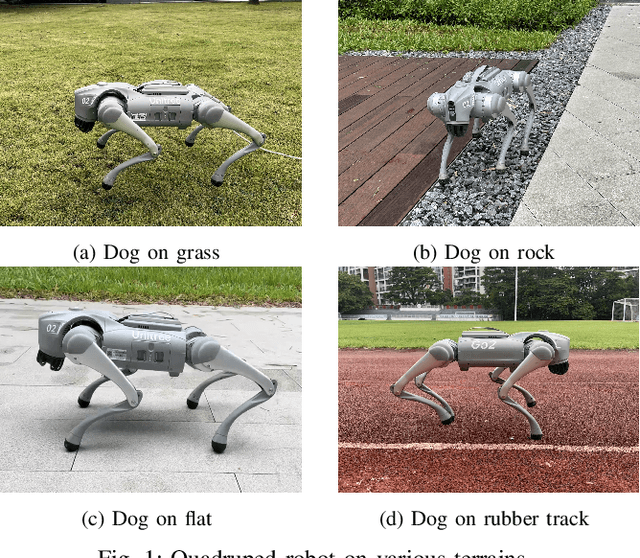
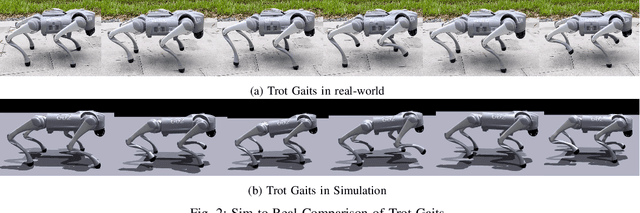
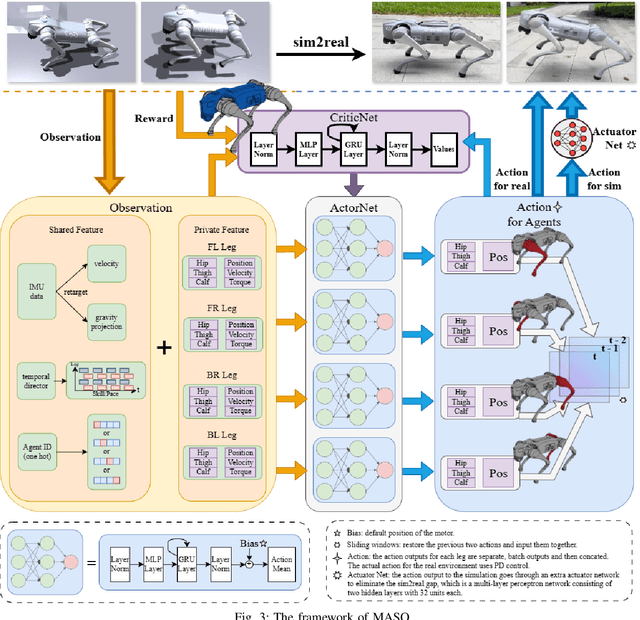
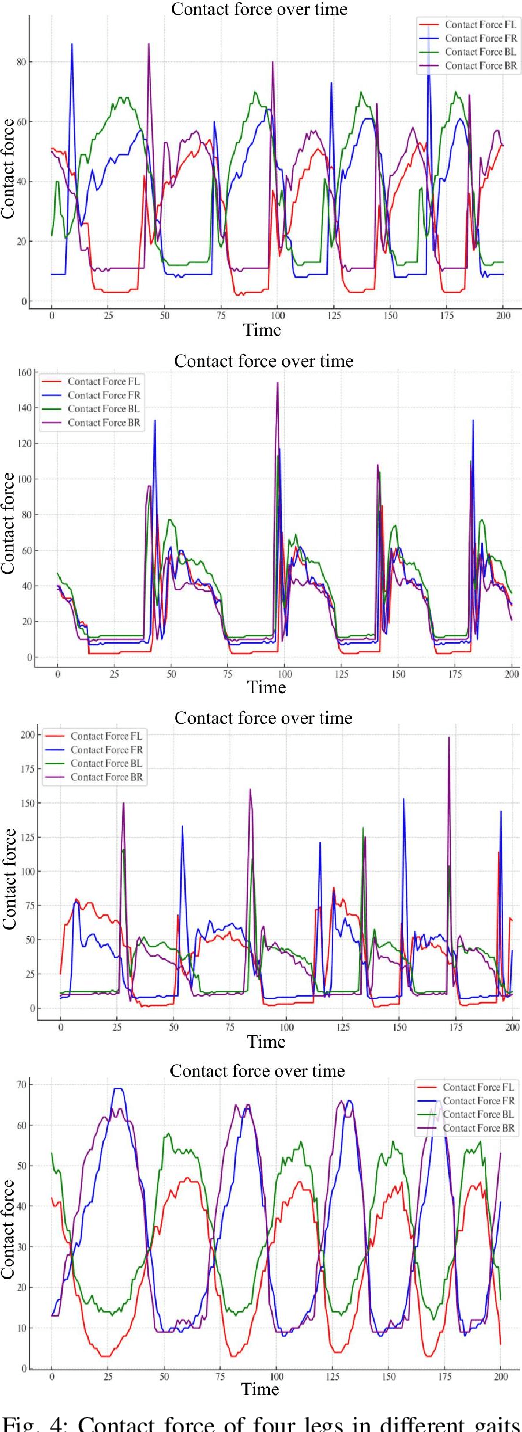
This paper proposes a novel method to improve locomotion learning for a single quadruped robot using multi-agent deep reinforcement learning (MARL). Many existing methods use single-agent reinforcement learning for an individual robot or MARL for the cooperative task in multi-robot systems. Unlike existing methods, this paper proposes using MARL for the locomotion learning of a single quadruped robot. We develop a learning structure called Multi-Agent Reinforcement Learning for Single Quadruped Robot Locomotion (MASQ), considering each leg as an agent to explore the action space of the quadruped robot, sharing a global critic, and learning collaboratively. Experimental results indicate that MASQ not only speeds up learning convergence but also enhances robustness in real-world settings, suggesting that applying MASQ to single robots such as quadrupeds could surpass traditional single-robot reinforcement learning approaches. Our study provides insightful guidance on integrating MARL with single-robot locomotion learning.