 Add to Chrome
 Add to Firefox
 Add to Edge
Athena-WBC: Capability-Aligned Policy Experts for Long-Tail Humanoid Whole-Body Control
Jul 06, 2026
Large-scale humanoid motion-tracking controllers are commonly improved by reallocating training effort: difficult motions are sampled more often, isolated into smaller subsets, or assigned to specialized experts. We show that this view is incomplete. In strong whole-body-control baselines, a residual set of feasible training clips remains unsolved even under targeted training, especially for high-dynamic transitions and balance-critical motions. These failures arise not only from insufficient exposure, but from a mismatch between the motion demands and the effective capability induced by the default training recipe. We propose Athena-WBC, a compact teacher-student pipeline with capability-aligned policy experts for long-tail humanoid whole-body control. Dynamic experts use a tracking-focused, constraint-aware objective that removes conservative effort and temporal-control penalties while preserving physical feasibility constraints; balance experts use a gravity curriculum to improve early-training survivability. The resulting privileged teachers are motion-routed for DAgger distillation and then compressed into a single controller with deployable observations followed by RL fine-tuning. Experiments on a full-size humanoid show improved recovery of training-set long-tail motions and better held-out tracking than a strong SONIC-recipe baseline, using only a small number of experts.

Distributed Control using Reinforcement Learning with Temporal-Logic-Based Reward Shaping
Apr 06, 2022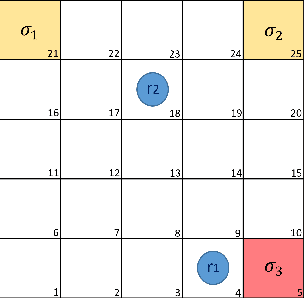

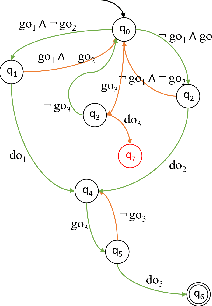
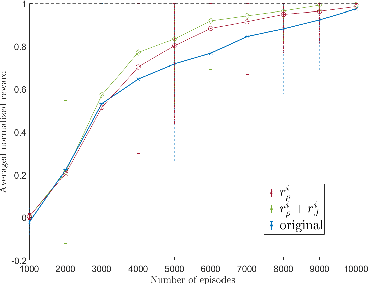
We present a computational framework for synthesis of distributed control strategies for a heterogeneous team of robots in a partially observable environment. The goal is to cooperatively satisfy specifications given as Truncated Linear Temporal Logic (TLTL) formulas. Our approach formulates the synthesis problem as a stochastic game and employs a policy graph method to find a control strategy with memory for each agent. We construct the stochastic game on the product between the team transition system and a finite state automaton (FSA) that tracks the satisfaction of the TLTL formula. We use the quantitative semantics of TLTL as the reward of the game, and further reshape it using the FSA to guide and accelerate the learning process. Simulation results demonstrate the efficacy of the proposed solution under demanding task specifications and the effectiveness of reward shaping in significantly accelerating the speed of learning.