 Add to Chrome
 Add to Firefox
 Add to Edge
Towards Multimodal Time Series Anomaly Detection with Semantic Alignment and Condensed Interaction
Mar 23, 2026
Time series anomaly detection plays a critical role in many dynamic systems. Despite its importance, previous approaches have primarily relied on unimodal numerical data, overlooking the importance of complementary information from other modalities. In this paper, we propose a novel multimodal time series anomaly detection model (MindTS) that focuses on addressing two key challenges: (1) how to achieve semantically consistent alignment across heterogeneous multimodal data, and (2) how to filter out redundant modality information to enhance cross-modal interaction effectively. To address the first challenge, we propose Fine-grained Time-text Semantic Alignment. It integrates exogenous and endogenous text information through cross-view text fusion and a multimodal alignment mechanism, achieving semantically consistent alignment between time and text modalities. For the second challenge, we introduce Content Condenser Reconstruction, which filters redundant information within the aligned text modality and performs cross-modal reconstruction to enable interaction. Extensive experiments on six real-world multimodal datasets demonstrate that the proposed MindTS achieves competitive or superior results compared to existing methods. The code is available at: https://github.com/decisionintelligence/MindTS.

Improving MLLMs in Embodied Exploration and Question Answering with Human-Inspired Memory Modeling
Feb 17, 2026Deploying Multimodal Large Language Models as the brain of embodied agents remains challenging, particularly under long-horizon observations and limited context budgets. Existing memory assisted methods often rely on textual summaries, which discard rich visual and spatial details and remain brittle in non-stationary environments. In this work, we propose a non-parametric memory framework that explicitly disentangles episodic and semantic memory for embodied exploration and question answering. Our retrieval-first, reasoning-assisted paradigm recalls episodic experiences via semantic similarity and verifies them through visual reasoning, enabling robust reuse of past observations without rigid geometric alignment. In parallel, we introduce a program-style rule extraction mechanism that converts experiences into structured, reusable semantic memory, facilitating cross-environment generalization. Extensive experiments demonstrate state-of-the-art performance on embodied question answering and exploration benchmarks, yielding a 7.3% gain in LLM-Match and an 11.4% gain in LLM MatchXSPL on A-EQA, as well as +7.7% success rate and +6.8% SPL on GOAT-Bench. Analyses reveal that our episodic memory primarily improves exploration efficiency, while semantic memory strengthens complex reasoning of embodied agents.
MultiRC: Joint Learning for Time Series Anomaly Prediction and Detection with Multi-scale Reconstructive Contrast
Oct 21, 2024

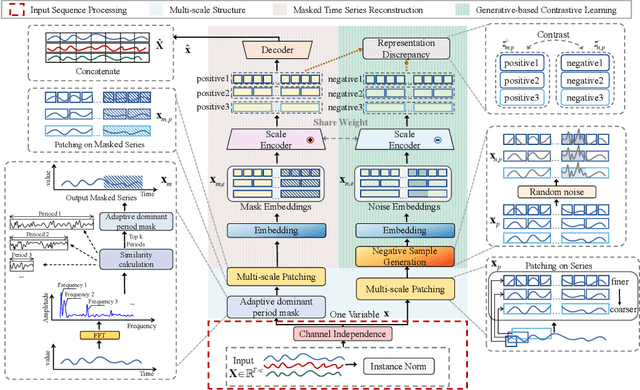
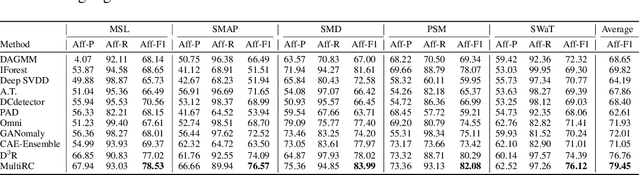
Many methods have been proposed for unsupervised time series anomaly detection. Despite some progress, research on predicting future anomalies is still relatively scarce. Predicting anomalies is particularly challenging due to the diverse reaction time and the lack of labeled data. To address these challenges, we propose MultiRC to integrate reconstructive and contrastive learning for joint learning of anomaly prediction and detection, with multi-scale structure and adaptive dominant period mask to deal with the diverse reaction time. MultiRC also generates negative samples to provide essential training momentum for the anomaly prediction tasks and prevent model degradation. We evaluate seven benchmark datasets from different fields. For both anomaly prediction and detection tasks, MultiRC outperforms existing state-of-the-art methods.