 Add to Chrome
 Add to Firefox
 Add to Edge
Beyond Bellman: High-Order Generator Regression for Continuous-Time Policy Evaluation
Apr 21, 2026
We study finite-horizon continuous-time policy evaluation from discrete closed-loop trajectories under time-inhomogeneous dynamics. The target value surface solves a backward parabolic equation, but the Bellman baseline obtained from one-step recursion is only first-order in the grid width. We estimate the time-dependent generator from multi-step transitions using moment-matching coefficients that cancel lower-order truncation terms, and combine the resulting surrogate with backward regression. The main theory gives an end-to-end decomposition into generator misspecification, projection error, pooling bias, finite-sample error, and start-up error, together with a decision-frequency regime map explaining when higher-order gains should be visible. Across calibration studies, four-scale benchmarks, feature and start-up ablations, and gain-mismatch stress tests, the second-order estimator consistently improves on the Bellman baseline and remains stable in the regime where the theory predicts visible gains. These results position high-order generator regression as an interpretable continuous-time policy-evaluation method with a clear operating region.

Hyperparameter Transfer Laws for Non-Recurrent Multi-Path Neural Networks
Feb 07, 2026Deeper modern architectures are costly to train, making hyperparameter transfer preferable to expensive repeated tuning. Maximal Update Parametrization ($μ$P) helps explain why many hyperparameters transfer across width. Yet depth scaling is less understood for modern architectures, whose computation graphs contain multiple parallel paths and residual aggregation. To unify various non-recurrent multi-path neural networks such as CNNs, ResNets, and Transformers, we introduce a graph-based notion of effective depth. Under stabilizing initializations and a maximal-update criterion, we show that the optimal learning rate decays with effective depth following a universal -3/2 power law. Here, the maximal-update criterion maximizes the typical one-step representation change at initialization without causing instability, and effective depth is the minimal path length from input to output, counting layers and residual additions. Experiments across diverse architectures confirm the predicted slope and enable reliable zero-shot transfer of learning rates across depths and widths, turning depth scaling into a predictable hyperparameter-transfer problem.
Utilizing Causal Network Markers to Identify Tipping Points ahead of Critical Transition
Dec 19, 2024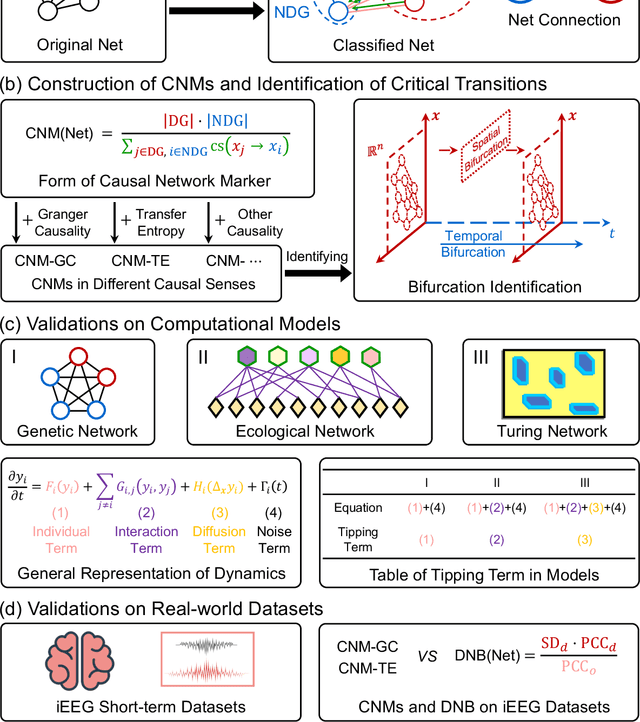



Early-warning signals of delicate design are always used to predict critical transitions in complex systems, which makes it possible to render the systems far away from the catastrophic state by introducing timely interventions. Traditional signals including the dynamical network biomarker (DNB), based on statistical properties such as variance and autocorrelation of nodal dynamics, overlook directional interactions and thus have limitations in capturing underlying mechanisms and simultaneously sustaining robustness against noise perturbations. This paper therefore introduces a framework of causal network markers (CNMs) by incorporating causality indicators, which reflect the directional influence between variables. Actually, to detect and identify the tipping points ahead of critical transition, two markers are designed: CNM-GC for linear causality and CNM-TE for non-linear causality, as well as a functional representation of different causality indicators and a clustering technique to verify the system's dominant group. Through demonstrations using benchmark models and real-world datasets of epileptic seizure, the framework of CNMs shows higher predictive power and accuracy than the traditional DNB indicator. It is believed that, due to the versatility and scalability, the CNMs are suitable for comprehensively evaluating the systems. The most possible direction for application includes the identification of tipping points in clinical disease.