 Add to Chrome
 Add to Firefox
 Add to Edge
Revisiting RaBitQ and TurboQuant: A Symmetric Comparison of Methods, Theory, and Experiments
Apr 21, 2026
This technical note revisits the relationship between RaBitQ and TurboQuant under a unified comparison framework. We compare the two methods in terms of methodology, theoretical guarantees, and empirical performance, using a reproducible, transparent, and symmetric setup. Our results show that, despite the claimed advantage of TurboQuant, TurboQuant does not provide a consistent improvement over RaBitQ in directly comparable settings; in many tested configurations, it performs worse than RaBitQ. We further find that several reported runtime and recall results in the TurboQuant paper could not be reproduced from the released implementation under the stated configuration. Overall, this note clarifies the shared structure and genuine differences between the two lines of work, while documenting reproducibility issues in the experimental results reported by the TurboQuant paper.

GPU-Native Approximate Nearest Neighbor Search with IVF-RaBitQ: Fast Index Build and Search
Feb 27, 2026Approximate nearest neighbor search (ANNS) on GPUs is gaining increasing popularity for modern retrieval and recommendation workloads that operate over massive high-dimensional vectors. Graph-based indexes deliver high recall and throughput but incur heavy build-time and storage costs. In contrast, cluster-based methods build and scale efficiently yet often need many probes for high recall, straining memory bandwidth and compute. Aiming to simultaneously achieve fast index build, high-throughput search, high recall, and low storage requirement for GPUs, we present IVF-RaBitQ (GPU), a GPU-native ANNS solution that integrates the cluster-based method IVF with RaBitQ quantization into an efficient GPU index build/search pipeline. Specifically, for index build, we develop a scalable GPU-native RaBitQ quantization method that enables fast and accurate low-bit encoding at scale. For search, we develop GPU-native distance computation schemes for RaBitQ codes and a fused search kernel to achieve high throughput with high recall. With IVF-RaBitQ implemented and integrated into the NVIDIA cuVS Library, experiments on cuVS Bench across multiple datasets show that IVF-RaBitQ offers a strong performance frontier in recall, throughput, index build time, and storage footprint. For Recall approximately equal to 0.95, IVF-RaBitQ achieves 2.2x higher QPS than the state-of-the-art graph-based method CAGRA, while also constructing indices 7.7x faster on average. Compared to the cluster-based method IVF-PQ, IVF-RaBitQ delivers on average over 2.7x higher throughput while avoiding accessing the raw vectors for reranking.
Utilizing Causal Network Markers to Identify Tipping Points ahead of Critical Transition
Dec 19, 2024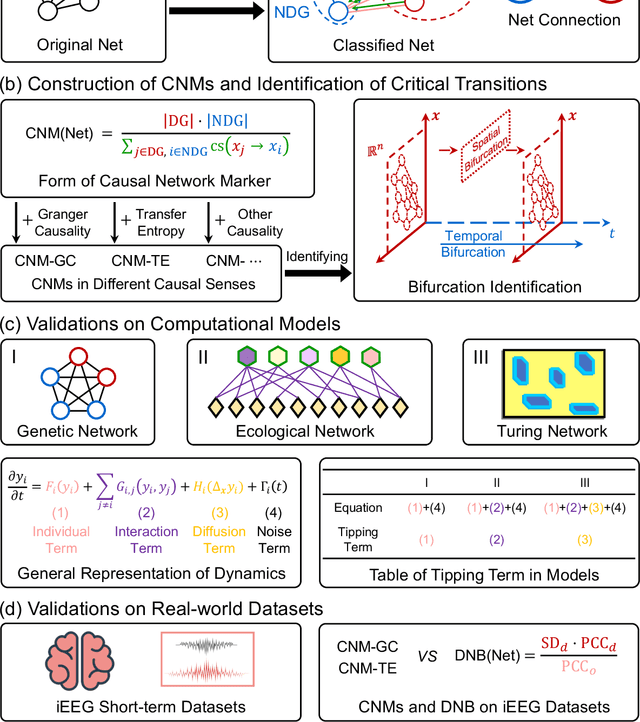



Early-warning signals of delicate design are always used to predict critical transitions in complex systems, which makes it possible to render the systems far away from the catastrophic state by introducing timely interventions. Traditional signals including the dynamical network biomarker (DNB), based on statistical properties such as variance and autocorrelation of nodal dynamics, overlook directional interactions and thus have limitations in capturing underlying mechanisms and simultaneously sustaining robustness against noise perturbations. This paper therefore introduces a framework of causal network markers (CNMs) by incorporating causality indicators, which reflect the directional influence between variables. Actually, to detect and identify the tipping points ahead of critical transition, two markers are designed: CNM-GC for linear causality and CNM-TE for non-linear causality, as well as a functional representation of different causality indicators and a clustering technique to verify the system's dominant group. Through demonstrations using benchmark models and real-world datasets of epileptic seizure, the framework of CNMs shows higher predictive power and accuracy than the traditional DNB indicator. It is believed that, due to the versatility and scalability, the CNMs are suitable for comprehensively evaluating the systems. The most possible direction for application includes the identification of tipping points in clinical disease.
Dynamical causality under invisible confounders
Aug 10, 2024Causality inference is prone to spurious causal interactions, due to the substantial confounders in a complex system. While many existing methods based on the statistical methods or dynamical methods attempt to address misidentification challenges, there remains a notable lack of effective methods to infer causality, in particular in the presence of invisible/unobservable confounders. As a result, accurately inferring causation with invisible confounders remains a largely unexplored and outstanding issue in data science and AI fields. In this work, we propose a method to overcome such challenges to infer dynamical causality under invisible confounders (CIC method) and further reconstruct the invisible confounders from time-series data by developing an orthogonal decomposition theorem in a delay embedding space. The core of our CIC method lies in its ability to decompose the observed variables not in their original space but in their delay embedding space into the common and private subspaces respectively, thereby quantifying causality between those variables both theoretically and computationally. This theoretical foundation ensures the causal detection for any high-dimensional system even with only two observed variables under many invisible confounders, which is actually a long-standing problem in the field. In addition to the invisible confounder problem, such a decomposition actually makes the intertwined variables separable in the embedding space, thus also solving the non-separability problem of causal inference. Extensive validation of the CIC method is carried out using various real datasets, and the experimental results demonstrates its effectiveness to reconstruct real biological networks even with unobserved confounders.
Deciphering interventional dynamical causality from non-intervention systems
Jun 29, 2024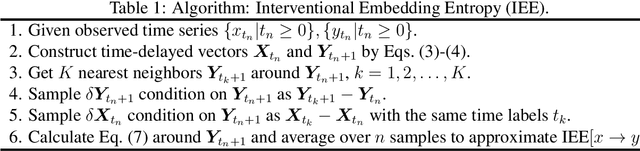
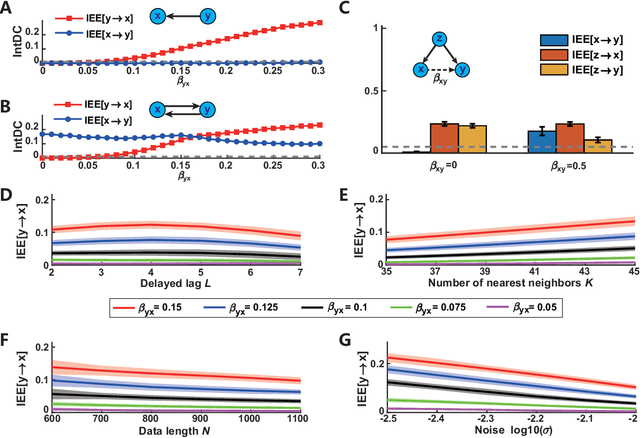
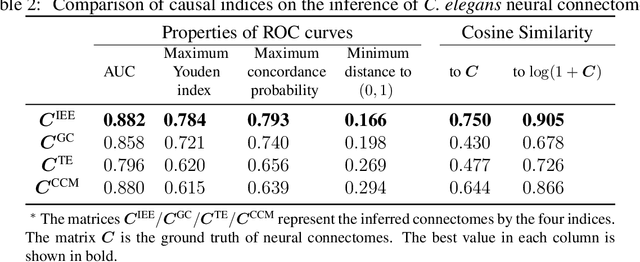
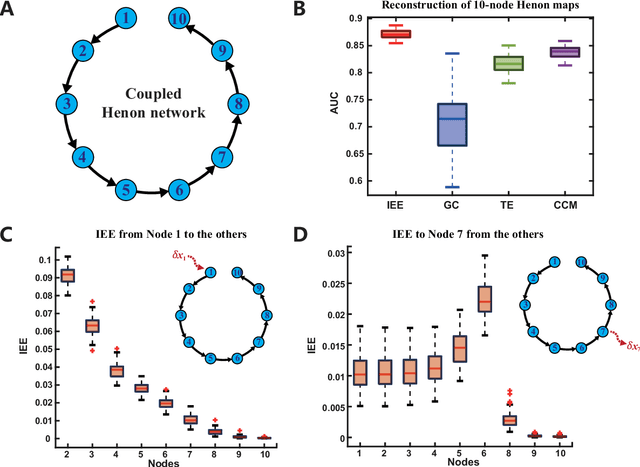
Detecting and quantifying causality is a focal topic in the fields of science, engineering, and interdisciplinary studies. However, causal studies on non-intervention systems attract much attention but remain extremely challenging. To address this challenge, we propose a framework named Interventional Dynamical Causality (IntDC) for such non-intervention systems, along with its computational criterion, Interventional Embedding Entropy (IEE), to quantify causality. The IEE criterion theoretically and numerically enables the deciphering of IntDC solely from observational (non-interventional) time-series data, without requiring any knowledge of dynamical models or real interventions in the considered system. Demonstrations of performance showed the accuracy and robustness of IEE on benchmark simulated systems as well as real-world systems, including the neural connectomes of C. elegans, COVID-19 transmission networks in Japan, and regulatory networks surrounding key circadian genes.