 Add to Chrome
 Add to Firefox
 Add to Edge
Unleashing Implicit Rewards: Prefix-Value Learning for Distribution-Level Optimization
Apr 14, 2026
Process reward models (PRMs) provide fine-grained reward signals along the reasoning process, but training reliable PRMs often requires step annotations or heavy verification pipelines, making them expensive to scale and refresh during online RL. Implicit PRMs mitigate this cost by learning decomposable token- or step-level rewards from trajectory-level outcome labels. However, they suffer from a train-inference mismatch: training only constrains a sequence-level aggregate, whereas inference requires token-level scores to reflect local step quality. As a result, token-level credits are weakly identified and may fail to faithfully reflect which reasoning steps are actually correct. This unreliability undermines a key promise of implicit PRMs: scoring many candidate tokens. In practice, noisy per-token advantages may systematically reinforce incorrect continuations. We address this problem with a novel Implicit Prefix-Value Reward Model (IPVRM), which directly learns a prefix-conditioned value function estimating the probability of eventual correctness, and derives step signals via temporal-difference (TD) differences. IPVRM substantially improves step-verification F1 on ProcessBench. Building on these calibrated prefix values, we further propose Distribution-Level RL (DistRL), which computes TD advantages for both sampled tokens and high-probability candidate tokens, enabling dense counterfactual updates without additional rollouts. While DistRL offers limited gains when powered by miscalibrated implicit rewards, it consistently improves downstream reasoning once paired with IPVRM.

Stabilizing Policy Optimization via Logits Convexity
Mar 01, 2026While reinforcement learning (RL) has been central to the recent success of large language models (LLMs), RL optimization is notoriously unstable, especially when compared to supervised fine-tuning (SFT). In this work, we investigate the stability gap between SFT and RL from a gradient-based perspective, and show that the convexity of the SFT loss with respect to model logits plays a key role in enabling stable training. Our theoretical analysis demonstrates that this property induces favorable gradient directionality during optimization. In contrast, Proximal Policy Optimization (PPO), a widely adopted policy gradient algorithm utilizing a clipped surrogate objective, lacks this stabilizing property. Motivated by this observation, we propose Logits Convex Optimization (LCO), a simple yet effective policy optimization framework that aligns the learned policy with an optimal target derived from the original RL objective, thereby emulating the stabilizing effects of logits-level convexity. Extensive experiments across multiple model families show that our LCO framework consistently improves training stability and outperforms conventional RL methods on a broad range of benchmarks.
Discriminative Policy Optimization for Token-Level Reward Models
May 29, 2025Process reward models (PRMs) provide more nuanced supervision compared to outcome reward models (ORMs) for optimizing policy models, positioning them as a promising approach to enhancing the capabilities of LLMs in complex reasoning tasks. Recent efforts have advanced PRMs from step-level to token-level granularity by integrating reward modeling into the training of generative models, with reward scores derived from token generation probabilities. However, the conflict between generative language modeling and reward modeling may introduce instability and lead to inaccurate credit assignments. To address this challenge, we revisit token-level reward assignment by decoupling reward modeling from language generation and derive a token-level reward model through the optimization of a discriminative policy, termed the Q-function Reward Model (Q-RM). We theoretically demonstrate that Q-RM explicitly learns token-level Q-functions from preference data without relying on fine-grained annotations. In our experiments, Q-RM consistently outperforms all baseline methods across various benchmarks. For example, when integrated into PPO/REINFORCE algorithms, Q-RM enhances the average Pass@1 score by 5.85/4.70 points on mathematical reasoning tasks compared to the ORM baseline, and by 4.56/5.73 points compared to the token-level PRM counterpart. Moreover, reinforcement learning with Q-RM significantly enhances training efficiency, achieving convergence 12 times faster than ORM on GSM8K and 11 times faster than step-level PRM on MATH. Code and data are available at https://github.com/homzer/Q-RM.
Advantage-Guided Distillation for Preference Alignment in Small Language Models
Feb 25, 2025Alignment techniques enable Large Language Models (LLMs) to generate outputs that align with human preferences and play a crucial role in their effectiveness. However, their impact often diminishes when applied to Small Language Models (SLMs), likely due to the limited capacity of these models. Instead of directly applying existing alignment techniques to SLMs, we propose to utilize a well-aligned teacher LLM to guide the alignment process for these models, thereby facilitating the transfer of the teacher's knowledge of human preferences to the student model. To achieve this, we first explore a straightforward approach, Dual-Constrained Knowledge Distillation (DCKD), that employs knowledge distillation with two KL-divergence constraints from the aligned teacher to the unaligned student. To further enhance the student's ability to distinguish between preferred and dispreferred responses, we then propose Advantage-Guided Distillation for Preference Alignment (ADPA), which leverages an advantage function from the aligned teacher to deliver more nuanced, distribution-level reward signals for the student's alignment. Our experimental results show that these two approaches appreciably improve the alignment of SLMs and narrow the performance gap with larger counterparts. Among them, ADPA demonstrates superior performance and achieves even greater effectiveness when integrated with DCKD. Our code is available at https://github.com/SLIT-AI/ADPA.
Self-Evolution Fine-Tuning for Policy Optimization
Jun 16, 2024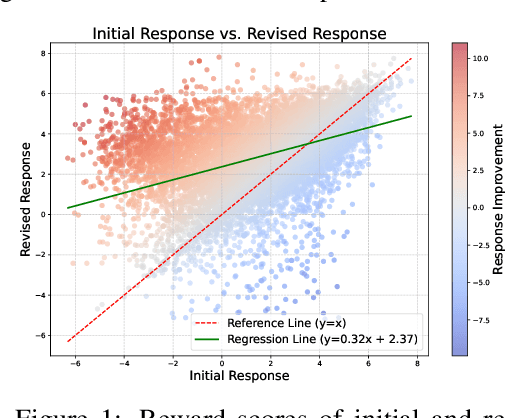

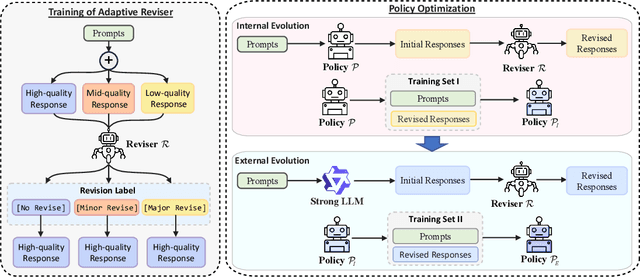
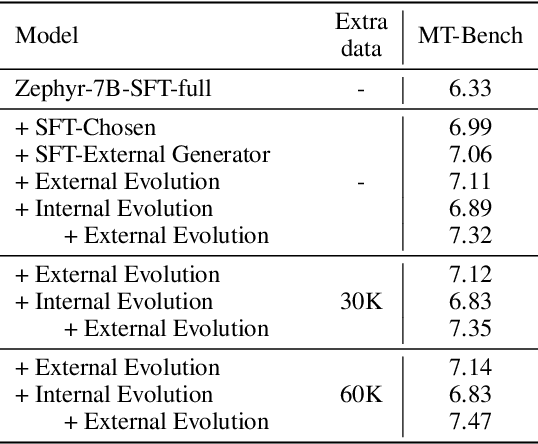
The alignment of large language models (LLMs) is crucial not only for unlocking their potential in specific tasks but also for ensuring that responses meet human expectations and adhere to safety and ethical principles. Current alignment methodologies face considerable challenges. For instance, supervised fine-tuning (SFT) requires extensive, high-quality annotated samples, while reinforcement learning from human feedback (RLHF) is complex and often unstable. In this paper, we introduce self-evolution fine-tuning (SEFT) for policy optimization, with the aim of eliminating the need for annotated samples while retaining the stability and efficiency of SFT. SEFT first trains an adaptive reviser to elevate low-quality responses while maintaining high-quality ones. The reviser then gradually guides the policy's optimization by fine-tuning it with enhanced responses. One of the prominent features of this method is its ability to leverage unlimited amounts of unannotated data for policy optimization through supervised fine-tuning. Our experiments on AlpacaEval 2.0 and MT-Bench demonstrate the effectiveness of SEFT. We also provide a comprehensive analysis of its advantages over existing alignment techniques.