 Add to Chrome
 Add to Firefox
 Add to Edge
OGG-FR: Orthogonal Gradient Gaming and Frequency Rectification for Unmanned Aerial Vehicle Infrared Image Super-Resolution
Aug 10, 2026
Unmanned aerial vehicle (UAV) infrared image super-resolution aims to recover weak thermal structures for deployment on resource-constrained platforms; lightweight models are therefore preferred, but multi-loss training can be unstable. A common strategy combines pixel-domain and frequency-domain objectives; however, low contrast, limited high-frequency content, and sensor-specific noise often make their gradients weakly aligned or conflicting. To address this optimization ambiguity, we propose Orthogonal Gradient Gaming and Frequency Rectification (OGG-FR), a plug-and-play optimization framework that decomposes the frequency gradient into a redundant parallel component and an orthogonal innovation component relative to the pixel gradient. In the conflict regime, OGG-FR computes a safe base gradient using the Multiple Gradient Descent Algorithm (MGDA) and adds a variance-rectified orthogonal innovation; in the compatible regime, it discards redundant parallel information and injects the orthogonal innovation according to a confidence score estimated from the high-frequency residual. Experimental results on the UAV thermal benchmark show broad gains under BI and BD degradations at $\times 4$ and $\times 8$ scales, while gradient analyses support the effectiveness of the proposed conflict-aware update rule.

Right Answer, Wrong Heat: Explanation-Aware Evaluation and Thermal-Grounded Feedback for MLLMs on Infrared Images
Aug 10, 2026General-purpose multimodal large language models (MLLMs) are increasingly applied to infrared images, where they are commonly scored by answer accuracy alone. However, a correct answer does not ensure that the model's explanation is grounded in infrared thermal evidence. We introduce an explanation-aware evaluation framework that separates answer correctness, output-level explanation groundedness, and thermal grounding for infrared visual questions. Using a Dual-LLM Consensus Judge with a preliminary human-anchor calibration check, we find that correct answers can still rely on weak or visible-light evidence; withholding the original infrared image and showing only a visible-like rendering erodes thermal grounding with little accuracy change; and this erosion is observed most strongly for more capable models but disappears when infrared remains available. We further propose Thermal-Grounded Feedback (TGF), a training-free feedback loop that diagnoses explanation-side failures and revises the explanation while preserving the selected answer. On local paired-input validation, TGF improves explanation-side grounding without changing answers. These findings suggest that future trustworthy MLLMs for infrared scene understanding should be evaluated and developed to produce thermally grounded explanations rather than merely accurate answers.
POCA: Pareto-Optimal Curriculum Alignment for Visual Text Generation
Apr 27, 2026Current visual text generation models struggle with the trade-off between text accuracy and overall image coherence. We find that achieving high text accuracy can reduce aesthetic quality and instruction-following capability. Although reinforcement learning approaches can alleviate the problem through aligning with multiple rewards, they are often unstable for text generation, as existing approaches normally optimize multiple rewards in a weighted-sum way. In addition, it is difficult to balance the weight of each reward. Moreover, reinforcement learning requires a set of training instructions. A large number of prompts require more training time and computing resources, while a small set leads to poor performance. Hence, how to select the prompts for efficient training is an unsolved problem. In this study, we propose Pareto-Optimal Curriculum Alignment (POCA), a framework that addresses this issue as a multi-objective problem by: 1) identifying the Pareto-optimal set to avoid simple scalarization and 2) designing an adaptive curriculum alignment strategy to manage a learning sequence of a multi-reward dataset using automatic difficulty assessment, which is crucial for optimal convergence as RL methods explore in a limited data environment. In synergy, POCA finds the Pareto-optimal set in a unified reward space, which eliminates inconsistent signals to find the best trade-off solution from different rewards under an easy-to-hard optimization landscape. The experimental results show that POCA significantly improves all metrics such as CLIP, HPS scores and sentence accuracy.
GTFMN: Guided Texture and Feature Modulation Network for Low-Light Image Enhancement and Super-Resolution
Jan 27, 2026Low-light image super-resolution (LLSR) is a challenging task due to the coupled degradation of low resolution and poor illumination. To address this, we propose the Guided Texture and Feature Modulation Network (GTFMN), a novel framework that decouples the LLSR task into two sub-problems: illumination estimation and texture restoration. First, our network employs a dedicated Illumination Stream whose purpose is to predict a spatially varying illumination map that accurately captures lighting distribution. Further, this map is utilized as an explicit guide within our novel Illumination Guided Modulation Block (IGM Block) to dynamically modulate features in the Texture Stream. This mechanism achieves spatially adaptive restoration, enabling the network to intensify enhancement in poorly lit regions while preserving details in well-exposed areas. Extensive experiments demonstrate that GTFMN achieves the best performance among competing methods on the OmniNormal5 and OmniNormal15 datasets, outperforming them in both quantitative metrics and visual quality.
U-Harmony: Enhancing Joint Training for Segmentation Models with Universal Harmonization
Jan 21, 2026In clinical practice, medical segmentation datasets are often limited and heterogeneous, with variations in modalities, protocols, and anatomical targets across institutions. Existing deep learning models struggle to jointly learn from such diverse data, often sacrificing either generalization or domain-specific knowledge. To overcome these challenges, we propose a joint training method called Universal Harmonization (U-Harmony), which can be integrated into deep learning-based architectures with a domain-gated head, enabling a single segmentation model to learn from heterogeneous datasets simultaneously. By integrating U-Harmony, our approach sequentially normalizes and then denormalizes feature distributions to mitigate domain-specific variations while preserving original dataset-specific knowledge. More appealingly, our framework also supports universal modality adaptation, allowing the seamless learning of new imaging modalities and anatomical classes. Extensive experiments on cross-institutional brain lesion datasets demonstrate the effectiveness of our approach, establishing a new benchmark for robust and adaptable 3D medical image segmentation models in real-world clinical settings.
Breaking Dataset Boundaries: Class-Agnostic Targeted Adversarial Attacks
May 27, 2025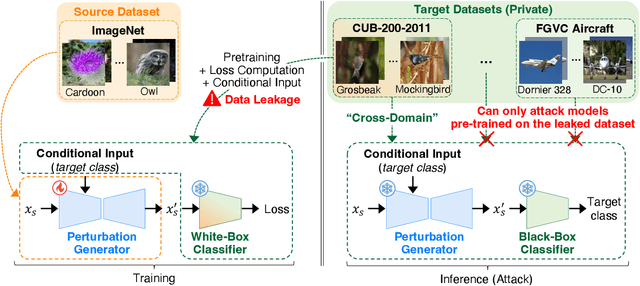
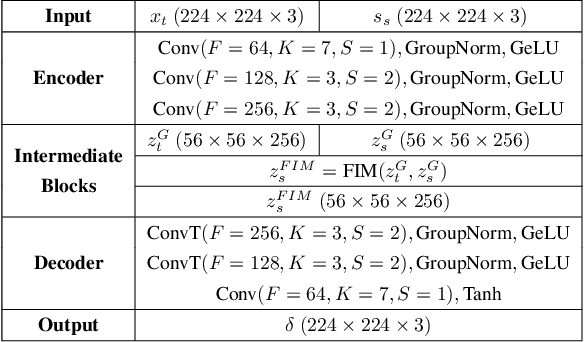
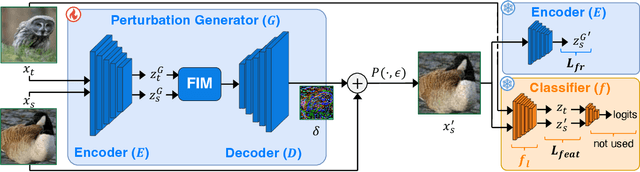
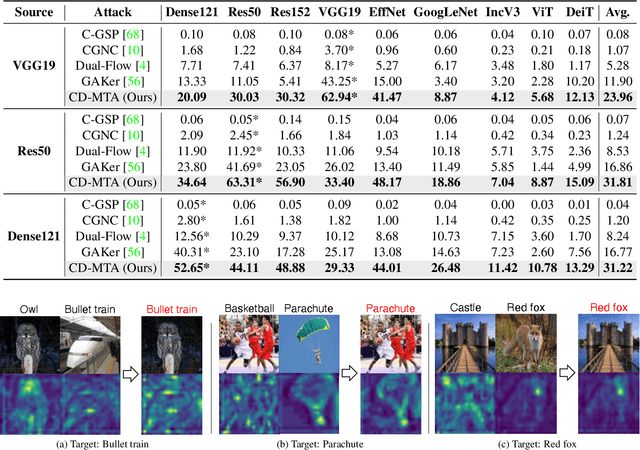
We present Cross-Domain Multi-Targeted Attack (CD-MTA), a method for generating adversarial examples that mislead image classifiers toward any target class, including those not seen during training. Traditional targeted attacks are limited to one class per model, requiring expensive retraining for each target. Multi-targeted attacks address this by introducing a perturbation generator with a conditional input to specify the target class. However, existing methods are constrained to classes observed during training and require access to the black-box model's training data--introducing a form of data leakage that undermines realistic evaluation in practical black-box scenarios. We identify overreliance on class embeddings as a key limitation, leading to overfitting and poor generalization to unseen classes. To address this, CD-MTA replaces class-level supervision with an image-based conditional input and introduces class-agnostic losses that align the perturbed and target images in the feature space. This design removes dependence on class semantics, thereby enabling generalization to unseen classes across datasets. Experiments on ImageNet and seven other datasets show that CD-MTA outperforms prior multi-targeted attacks in both standard and cross-domain settings--without accessing the black-box model's training data.
Joint Low-level and High-level Textual Representation Learning with Multiple Masking Strategies
May 11, 2025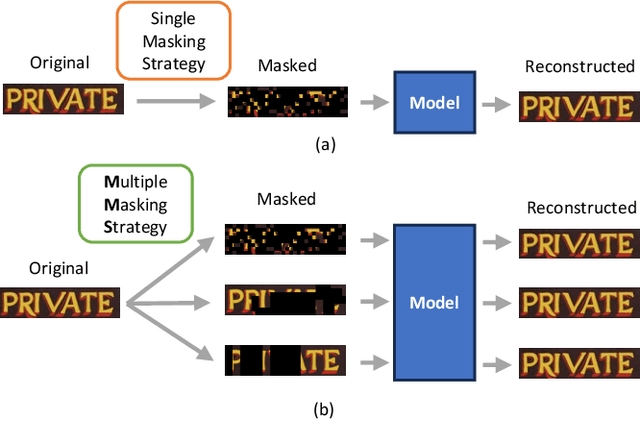
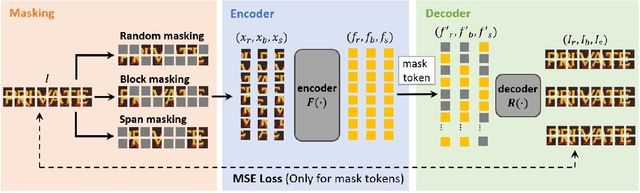
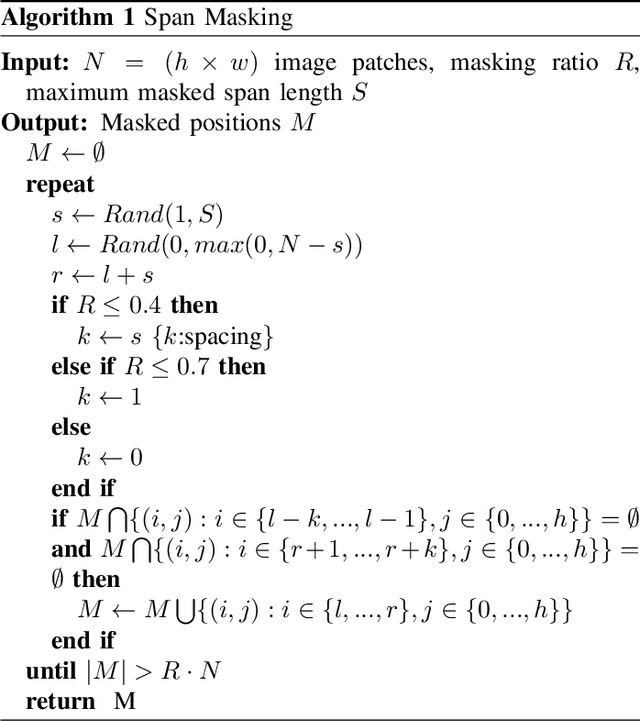
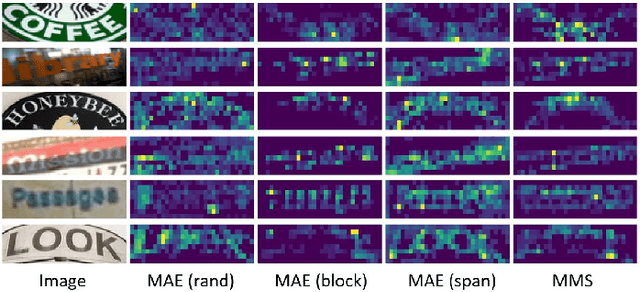
Most existing text recognition methods are trained on large-scale synthetic datasets due to the scarcity of labeled real-world datasets. Synthetic images, however, cannot faithfully reproduce real-world scenarios, such as uneven illumination, irregular layout, occlusion, and degradation, resulting in performance disparities when handling complex real-world images. Recent self-supervised learning techniques, notably contrastive learning and masked image modeling (MIM), narrow this domain gap by exploiting unlabeled real text images. This study first analyzes the original Masked AutoEncoder (MAE) and observes that random patch masking predominantly captures low-level textural features but misses high-level contextual representations. To fully exploit the high-level contextual representations, we introduce random blockwise and span masking in the text recognition task. These strategies can mask the continuous image patches and completely remove some characters, forcing the model to infer relationships among characters within a word. Our Multi-Masking Strategy (MMS) integrates random patch, blockwise, and span masking into the MIM frame, which jointly learns low and high-level textual representations. After fine-tuning with real data, MMS outperforms the state-of-the-art self-supervised methods in various text-related tasks, including text recognition, segmentation, and text-image super-resolution.
Layout-Corrector: Alleviating Layout Sticking Phenomenon in Discrete Diffusion Model
Sep 25, 2024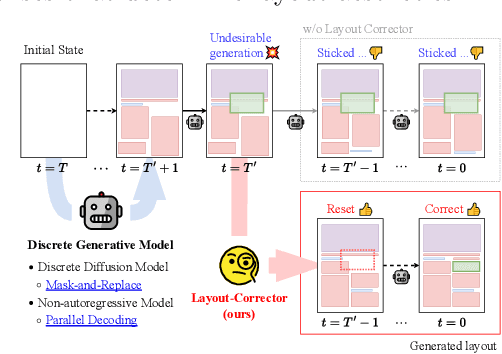
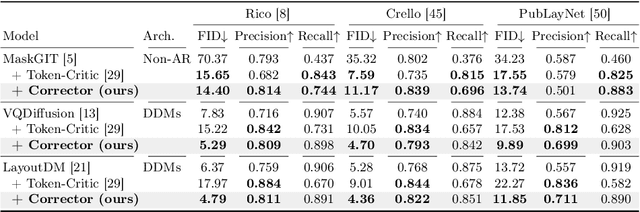
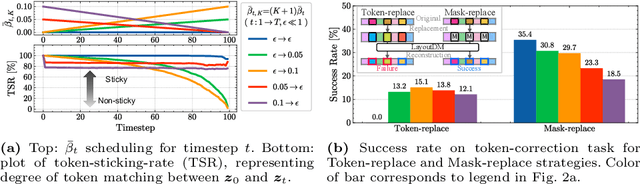
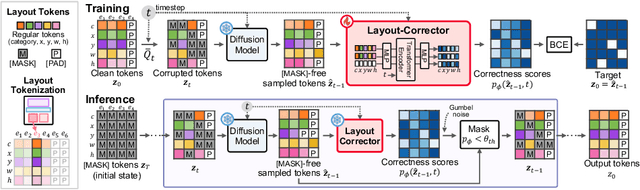
Layout generation is a task to synthesize a harmonious layout with elements characterized by attributes such as category, position, and size. Human designers experiment with the placement and modification of elements to create aesthetic layouts, however, we observed that current discrete diffusion models (DDMs) struggle to correct inharmonious layouts after they have been generated. In this paper, we first provide novel insights into layout sticking phenomenon in DDMs and then propose a simple yet effective layout-assessment module Layout-Corrector, which works in conjunction with existing DDMs to address the layout sticking problem. We present a learning-based module capable of identifying inharmonious elements within layouts, considering overall layout harmony characterized by complex composition. During the generation process, Layout-Corrector evaluates the correctness of each token in the generated layout, reinitializing those with low scores to the ungenerated state. The DDM then uses the high-scored tokens as clues to regenerate the harmonized tokens. Layout-Corrector, tested on common benchmarks, consistently boosts layout-generation performance when in conjunction with various state-of-the-art DDMs. Furthermore, our extensive analysis demonstrates that the Layout-Corrector (1) successfully identifies erroneous tokens, (2) facilitates control over the fidelity-diversity trade-off, and (3) significantly mitigates the performance drop associated with fast sampling.
DiCTI: Diffusion-based Clothing Designer via Text-guided Input
Jul 04, 2024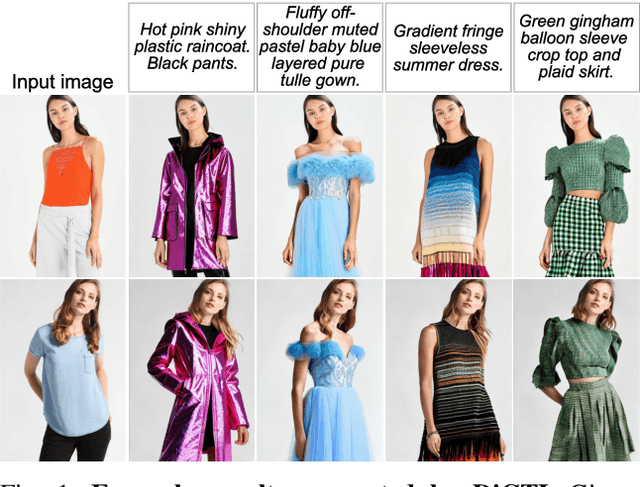
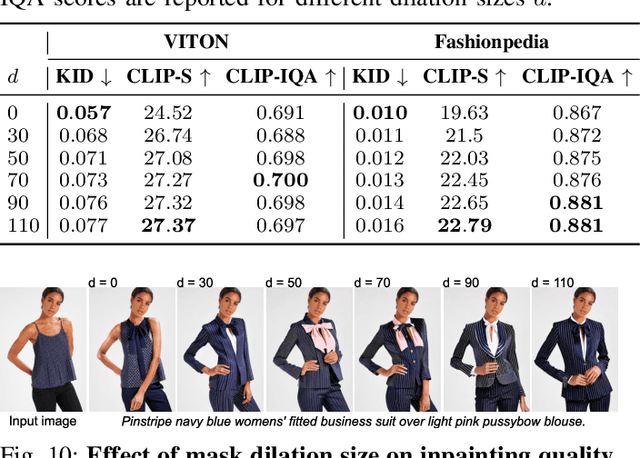
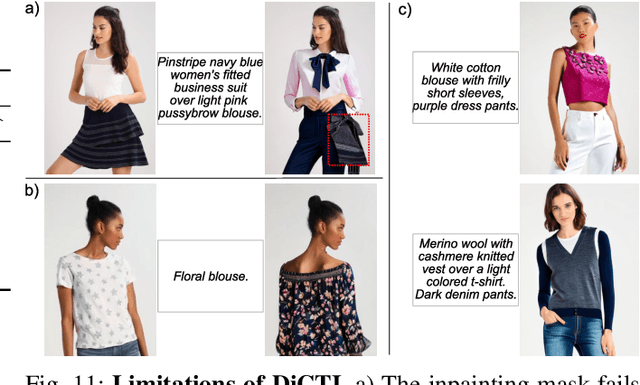
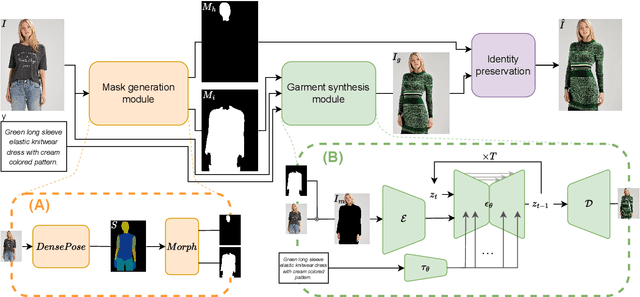
Recent developments in deep generative models have opened up a wide range of opportunities for image synthesis, leading to significant changes in various creative fields, including the fashion industry. While numerous methods have been proposed to benefit buyers, particularly in virtual try-on applications, there has been relatively less focus on facilitating fast prototyping for designers and customers seeking to order new designs. To address this gap, we introduce DiCTI (Diffusion-based Clothing Designer via Text-guided Input), a straightforward yet highly effective approach that allows designers to quickly visualize fashion-related ideas using text inputs only. Given an image of a person and a description of the desired garments as input, DiCTI automatically generates multiple high-resolution, photorealistic images that capture the expressed semantics. By leveraging a powerful diffusion-based inpainting model conditioned on text inputs, DiCTI is able to synthesize convincing, high-quality images with varied clothing designs that viably follow the provided text descriptions, while being able to process very diverse and challenging inputs, captured in completely unconstrained settings. We evaluate DiCTI in comprehensive experiments on two different datasets (VITON-HD and Fashionpedia) and in comparison to the state-of-the-art (SoTa). The results of our experiments show that DiCTI convincingly outperforms the SoTA competitor in generating higher quality images with more elaborate garments and superior text prompt adherence, both according to standard quantitative evaluation measures and human ratings, generated as part of a user study.
Controlling Rate, Distortion, and Realism: Towards a Single Comprehensive Neural Image Compression Model
May 27, 2024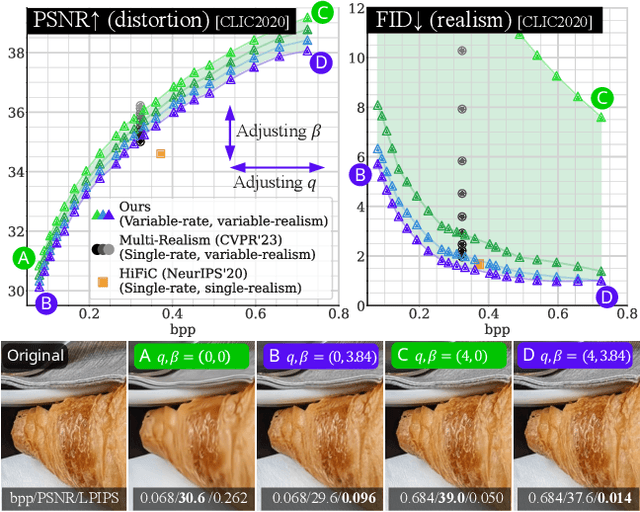
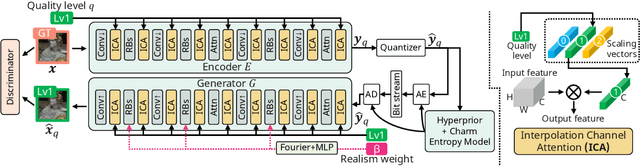
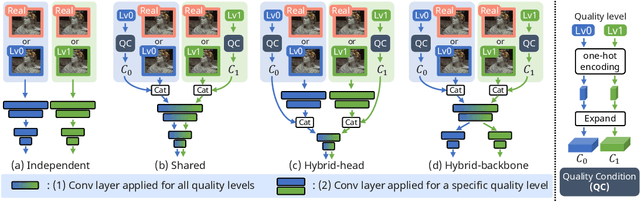
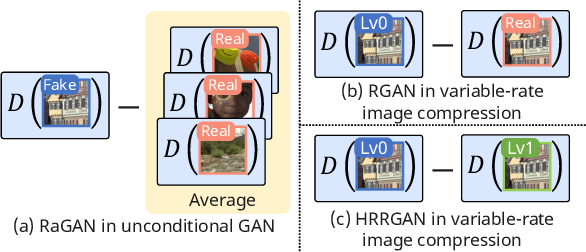
In recent years, neural network-driven image compression (NIC) has gained significant attention. Some works adopt deep generative models such as GANs and diffusion models to enhance perceptual quality (realism). A critical obstacle of these generative NIC methods is that each model is optimized for a single bit rate. Consequently, multiple models are required to compress images to different bit rates, which is impractical for real-world applications. To tackle this issue, we propose a variable-rate generative NIC model. Specifically, we explore several discriminator designs tailored for the variable-rate approach and introduce a novel adversarial loss. Moreover, by incorporating the newly proposed multi-realism technique, our method allows the users to adjust the bit rate, distortion, and realism with a single model, achieving ultra-controllability. Unlike existing variable-rate generative NIC models, our method matches or surpasses the performance of state-of-the-art single-rate generative NIC models while covering a wide range of bit rates using just one model. Code will be available at https://github.com/iwa-shi/CRDR