 Add to Chrome
 Add to Firefox
 Add to Edge
Right Answer, Wrong Heat: Explanation-Aware Evaluation and Thermal-Grounded Feedback for MLLMs on Infrared Images
Aug 10, 2026
General-purpose multimodal large language models (MLLMs) are increasingly applied to infrared images, where they are commonly scored by answer accuracy alone. However, a correct answer does not ensure that the model's explanation is grounded in infrared thermal evidence. We introduce an explanation-aware evaluation framework that separates answer correctness, output-level explanation groundedness, and thermal grounding for infrared visual questions. Using a Dual-LLM Consensus Judge with a preliminary human-anchor calibration check, we find that correct answers can still rely on weak or visible-light evidence; withholding the original infrared image and showing only a visible-like rendering erodes thermal grounding with little accuracy change; and this erosion is observed most strongly for more capable models but disappears when infrared remains available. We further propose Thermal-Grounded Feedback (TGF), a training-free feedback loop that diagnoses explanation-side failures and revises the explanation while preserving the selected answer. On local paired-input validation, TGF improves explanation-side grounding without changing answers. These findings suggest that future trustworthy MLLMs for infrared scene understanding should be evaluated and developed to produce thermally grounded explanations rather than merely accurate answers.

OGG-FR: Orthogonal Gradient Gaming and Frequency Rectification for Unmanned Aerial Vehicle Infrared Image Super-Resolution
Aug 10, 2026Unmanned aerial vehicle (UAV) infrared image super-resolution aims to recover weak thermal structures for deployment on resource-constrained platforms; lightweight models are therefore preferred, but multi-loss training can be unstable. A common strategy combines pixel-domain and frequency-domain objectives; however, low contrast, limited high-frequency content, and sensor-specific noise often make their gradients weakly aligned or conflicting. To address this optimization ambiguity, we propose Orthogonal Gradient Gaming and Frequency Rectification (OGG-FR), a plug-and-play optimization framework that decomposes the frequency gradient into a redundant parallel component and an orthogonal innovation component relative to the pixel gradient. In the conflict regime, OGG-FR computes a safe base gradient using the Multiple Gradient Descent Algorithm (MGDA) and adds a variance-rectified orthogonal innovation; in the compatible regime, it discards redundant parallel information and injects the orthogonal innovation according to a confidence score estimated from the high-frequency residual. Experimental results on the UAV thermal benchmark show broad gains under BI and BD degradations at $\times 4$ and $\times 8$ scales, while gradient analyses support the effectiveness of the proposed conflict-aware update rule.
POCA: Pareto-Optimal Curriculum Alignment for Visual Text Generation
Apr 27, 2026Current visual text generation models struggle with the trade-off between text accuracy and overall image coherence. We find that achieving high text accuracy can reduce aesthetic quality and instruction-following capability. Although reinforcement learning approaches can alleviate the problem through aligning with multiple rewards, they are often unstable for text generation, as existing approaches normally optimize multiple rewards in a weighted-sum way. In addition, it is difficult to balance the weight of each reward. Moreover, reinforcement learning requires a set of training instructions. A large number of prompts require more training time and computing resources, while a small set leads to poor performance. Hence, how to select the prompts for efficient training is an unsolved problem. In this study, we propose Pareto-Optimal Curriculum Alignment (POCA), a framework that addresses this issue as a multi-objective problem by: 1) identifying the Pareto-optimal set to avoid simple scalarization and 2) designing an adaptive curriculum alignment strategy to manage a learning sequence of a multi-reward dataset using automatic difficulty assessment, which is crucial for optimal convergence as RL methods explore in a limited data environment. In synergy, POCA finds the Pareto-optimal set in a unified reward space, which eliminates inconsistent signals to find the best trade-off solution from different rewards under an easy-to-hard optimization landscape. The experimental results show that POCA significantly improves all metrics such as CLIP, HPS scores and sentence accuracy.
Rumour Detection and Analysis on Twitter
Apr 04, 2023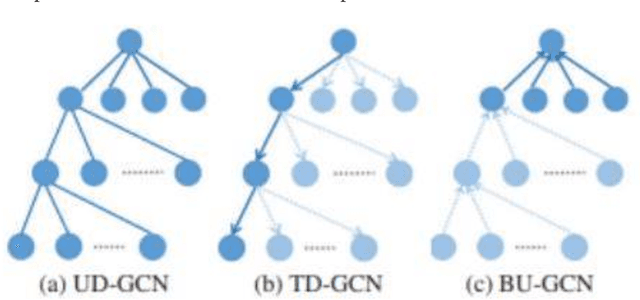
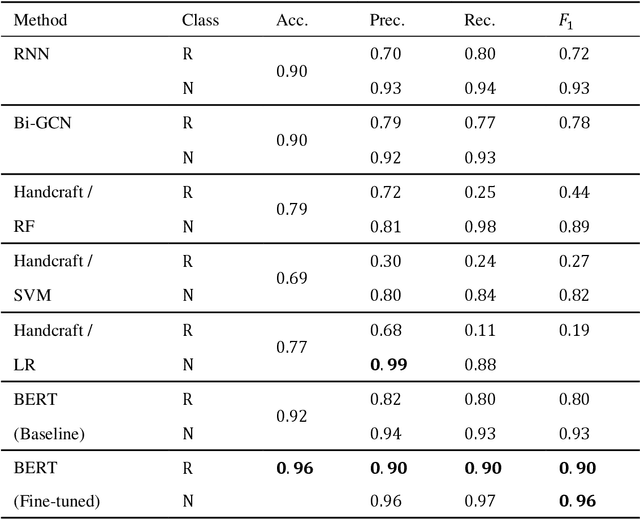
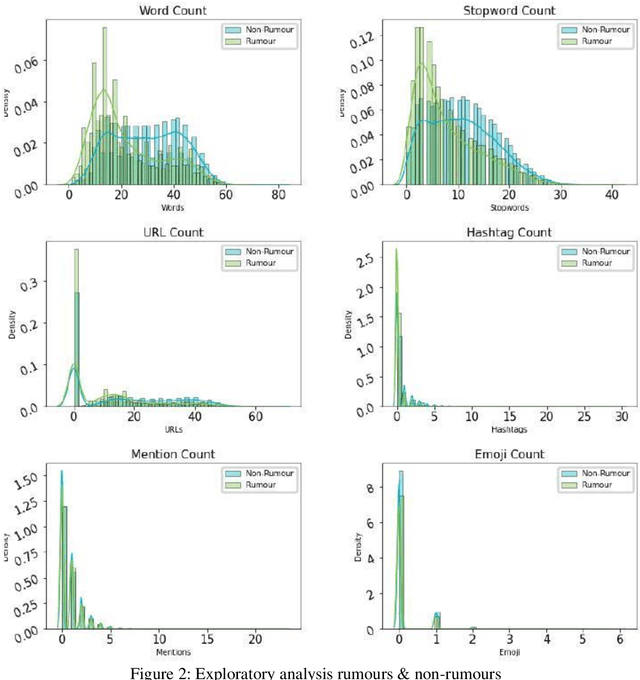
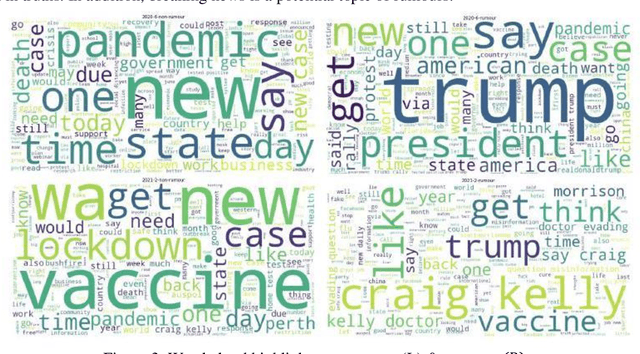
In recent years people have become increasingly reliant on social media to read news and get information, and some social media users post unsubstantiated information to gain attention. Such information is known as rumours. Nowadays, rumour detection is receiving a growing amount of attention because of the pandemic of the New Coronavirus, which has led to a large number of rumours being spread. In this paper, a Natural Language Processing (NLP) system is built to predict rumours. The best model is applied to the COVID-19 tweets to conduct exploratory data analysis. The contribution of this study is twofold: (1) to compare rumours and facts using state-of-the-art natural language processing models in two dimensions: language structure and propagation route. (2) An analysis of how rumours differ from facts in terms of their lexical use and the emotions they imply. This study shows that linguistic structure is a better feature to distinguish rumours from facts compared to the propagation path. In addition, rumour tweets contain more vocabulary related to politics and negative emotions.
Stop Words for Processing Software Engineering Documents: Do they Matter?
Mar 18, 2023Stop words, which are considered non-predictive, are often eliminated in natural language processing tasks. However, the definition of uninformative vocabulary is vague, so most algorithms use general knowledge-based stop lists to remove stop words. There is an ongoing debate among academics about the usefulness of stop word elimination, especially in domain-specific settings. In this work, we investigate the usefulness of stop word removal in a software engineering context. To do this, we replicate and experiment with three software engineering research tools from related work. Additionally, we construct a corpus of software engineering domain-related text from 10,000 Stack Overflow questions and identify 200 domain-specific stop words using traditional information-theoretic methods. Our results show that the use of domain-specific stop words significantly improved the performance of research tools compared to the use of a general stop list and that 17 out of 19 evaluation measures showed better performance.