 Add to Chrome
 Add to Firefox
 Add to Edge
AutoFocus: Uncertainty-Aware Active Visual Search for GUI Grounding
May 04, 2026
Vision-Language Models (VLMs) have enabled autonomous GUI agents that translate natural language instructions into executable screen coordinates. However, grounding performance degrades in high-resolution interfaces, where dense layouts and small interactive elements expose a resolution gap between modern displays and model input constraints. Existing zoom-in strategies rely on fixed anchors, heuristic grids, or reinforcement learning, lacking a principled mechanism to adaptively determine where refinement is needed and how much spatial uncertainty should be explored. We propose AutoFocus, a training-free, uncertainty-aware active visual search framework for GUI grounding. Our key insight is that token-level perplexity in coordinate generation naturally reflects spatial uncertainty. Rather than committing to a single prediction, AutoFocus samples multiple coordinate hypotheses and converts their axial perplexities into an anisotropic gaussian spatial probability field, explicitly modeling directional uncertainty. Based on this field, we generate global and local region proposals and introduce Shape-Aware Zooming to balance tight localization with contextual preservation. A visual prompt-based aggregation step then selects the most consistent prediction via structured comparison. Extensive experiments on ScreenSpot-Pro and ScreenSpot-V2 demonstrate consistent improvements across both general-purpose and GUI-specialized VLMs.

MARS2 2025 Challenge on Multimodal Reasoning: Datasets, Methods, Results, Discussion, and Outlook
Sep 17, 2025
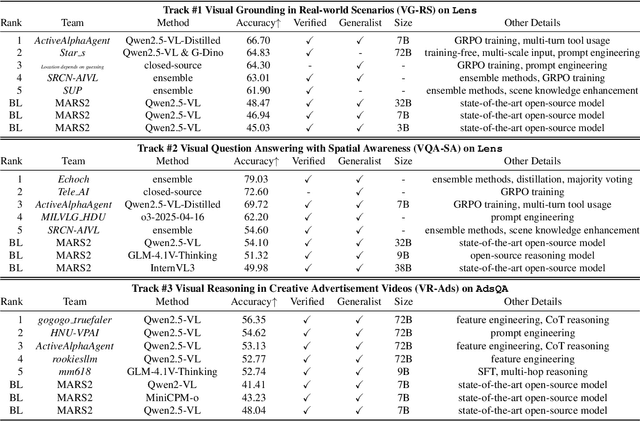

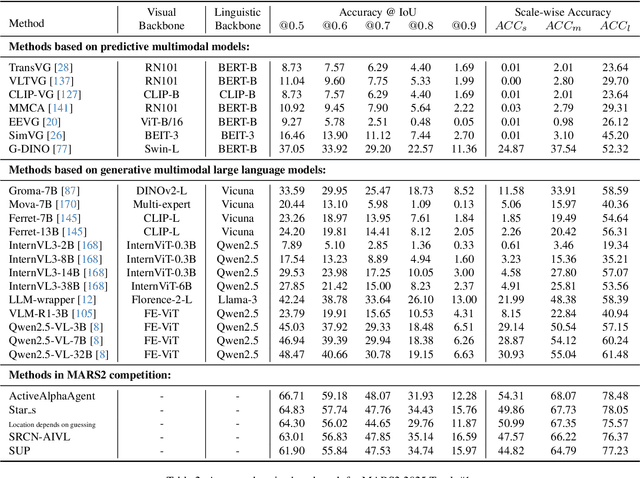
This paper reviews the MARS2 2025 Challenge on Multimodal Reasoning. We aim to bring together different approaches in multimodal machine learning and LLMs via a large benchmark. We hope it better allows researchers to follow the state-of-the-art in this very dynamic area. Meanwhile, a growing number of testbeds have boosted the evolution of general-purpose large language models. Thus, this year's MARS2 focuses on real-world and specialized scenarios to broaden the multimodal reasoning applications of MLLMs. Our organizing team released two tailored datasets Lens and AdsQA as test sets, which support general reasoning in 12 daily scenarios and domain-specific reasoning in advertisement videos, respectively. We evaluated 40+ baselines that include both generalist MLLMs and task-specific models, and opened up three competition tracks, i.e., Visual Grounding in Real-world Scenarios (VG-RS), Visual Question Answering with Spatial Awareness (VQA-SA), and Visual Reasoning in Creative Advertisement Videos (VR-Ads). Finally, 76 teams from the renowned academic and industrial institutions have registered and 40+ valid submissions (out of 1200+) have been included in our ranking lists. Our datasets, code sets (40+ baselines and 15+ participants' methods), and rankings are publicly available on the MARS2 workshop website and our GitHub organization page https://github.com/mars2workshop/, where our updates and announcements of upcoming events will be continuously provided.